
スターリング公式の簡単な導出
公式
次の方程式をスターリング公式stirling's formulaという。
$$ \lim_{n \to \infty} {{n!} \over {e^{n \ln n - n} \sqrt{ 2 \pi n} }} = 1 $$
説明1
この近似は、大きな数に対する階乗の計算という点で有用である。熱力学や統計力学のような分野では多数の分子を仮定するため必須であり、
$$ \begin{align*} n! &\approx \sqrt{2\pi n}\left( \dfrac{n}{e} \right)^{n} \\[0.6em] \log_{2} n! &\approx n \log_{2} n - n \log_{2}e \\[0.6em] \ln n! &\approx n \ln n - n \end{align*} $$
のように、より簡略化された表現も使われる。以下の証明は解析学的にやや厳密性に欠けるが、応用のために事実だけを重視するなら十分である。
関連リンク
導出2
ガンマ関数 $\displaystyle n! = \int_{0}^{\infty} x^{n} e^{-x} dx$から始めよう。$f(x) = n \ln x - x$とおくと、次の式が成り立つ。
$$ e^{f(x)} = x^{n} e^{-x} $$
$\displaystyle {{df(x)} \over {dx}} = {{n } \over {x }} - 1$であり、$\displaystyle {{d^2 f(x)} \over {dx^2 }} = - {{n } \over {x^2 }}$、そして$\displaystyle {{d^3 f(x)} \over {dx^3 }} = {{ 2n } \over {x^3 }}$なので、$f$のテイラー展開は次のようになる。
$$ \begin{align*} f(x) =& f(n) + f '(n) (x-n) + {{1} \over {2!}} f ''(n) (x-n)^2 + {{1} \over {3!}} f^{(3)} (n) (x-n)^3 + \cdots \\ =& n \ln n - n + 0 \cdot (x-n) - {{1} \over {2}} {{n} \over{ n^2}} (x-n)^2 + {{1} \over {6}} {{2n} \over{ n^3}} (x-n)^3 + \cdots \\ =& n \ln n - n - {{ (x-n)^2 } \over{ 2n }} + {{ (x-n)^3 } \over{ 3 n^2 }} + \cdots \end{align*} $$
$n$が十分に大きいとき、$\displaystyle {{ (x-n)^2 } \over{ 2 n }}$以降の項は分母が大きくなる速度があまりに速いため無視できる。したがって、以下の結果を得る。
$$ f(x) \approx n \ln n - n - {{ (x-n)^2 } \over{ 2n }} $$
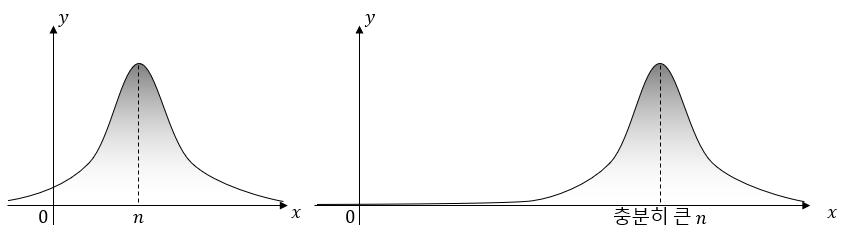
また、$n$が十分に大きければ、ガウス曲線の積分は$0$から$\infty$まで行っても$-\infty$から$\infty$まで行っても大きな違いはない。結果的に、十分に大きな$n$に対して $$ n! = e^{n \ln n - n} \int_{0}^{\infty} e^{-(x-n)^2 / 2n + \cdots } dx \approx e^{n \ln n - n} \int_{-\infty}^{\infty} e^{-(x-n)^2 / 2n } dx $$ ガウス積分により$\displaystyle \int_{-\infty}^{\infty} e^{-(x-n)^2 / 2n } dx = \sqrt{ 2 \pi n}$なので、次の式が成り立つ。
$$ n! \approx e^{n \ln n - n} \sqrt{ 2 \pi n} $$
両辺に対数を取ると、以下の式を得る。
$$ \ln n! \approx n \ln n - n + \dfrac{1}{2}\ln 2\pi n $$
$n$が非常に大きければ、次の近似式が成り立つ。
$$ \ln n! \approx n \ln n - n $$
■