Conjugacy of Maps in Chaos Theory
Overview
In chaos theory, the conjugate of maps is similar to an isometry or an isomorphism, and in fact, in the more general context of dynamical systems, it is a homeomorphism itself.
1 Depending on the textbook it may not be exactly the same, but its purpose is precisely the same. As with everything done in mathematics, one confirms that some property holds where computation is easy, and then transfers that property to where a proof is actually needed.
Definition2
For two maps $f, g : X \to X$ defined on $X$, if there exists a continuous bijection $C$ satisfying $C \circ f = g \circ C$, then $f$ and $g$ are said to be conjugate.
Theorem3
Suppose that $g \left( C(x) \right) = C \left( f(x) \right)$ for all $x$.
- [1]: If $x$ is a periodic-$k$ point of $f$, then $C(x)$ is a periodic-$k$ point of $g$.
- [2]: On a periodic-$k$ orbit of $f$, if $C’ \ne 0$, then $$\left( g^{k} \right) ' \left( C (x) \right) = \left( f^{k} \right) ' (x)$$
Explanation
The two theorems above mean that conjugacy is preserved regardless of taking repeated iterations of a map and of differentiation. This in turn means that if it is easy to compute the Lyapunov exponent in one system, then it is also easy to compute the Lyapunov exponent in a system conjugate to it.
Example4
A good example of this is showing that the logistic map has a chaotic orbit.
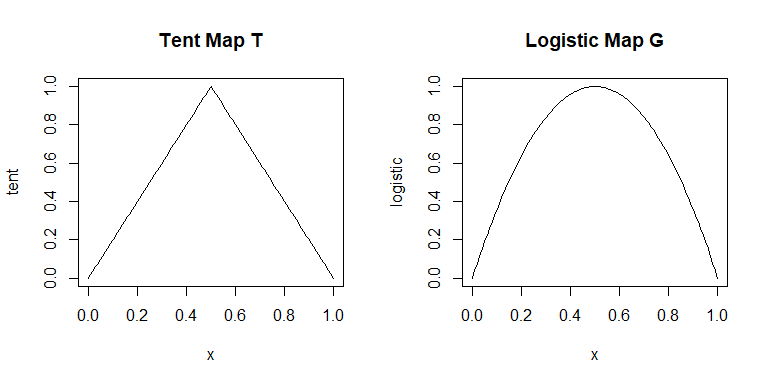
As an example, the tent map $T : [0,1] \to [0,1]$ is defined by $T(x) = 1 - | 1 - 2x|$, and the logistic map $G$ is defined, as the logistic family with $a=4$, by $G (x) := g_{4} (x) = 4x(1-x)$. For these,
$$C(x) : = {{ 1- \cos \pi x} \over { 2 }}$$
is the continuous bijection that exists so as to make $T$ and $G$ conjugate. In fact, computing directly, one can easily verify that
$$G(C(x)) = \sin^2 \pi x = C ( T(x) )$$
holds.
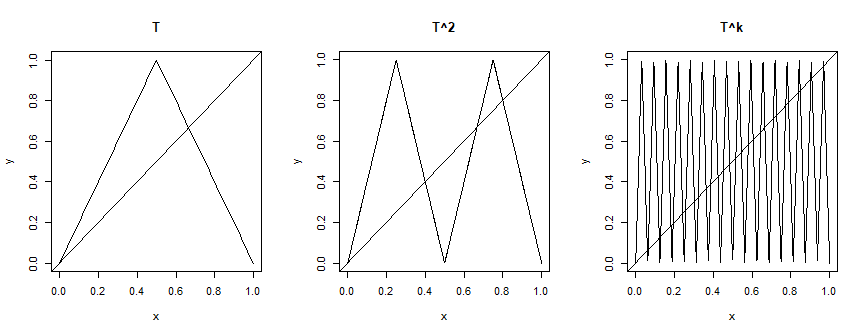
The figures above depict the process of finding the periodic-$k$ points of $T$ by locating the intersections of $y=x$ with the graphs obtained from iterating the tent map repeatedly. From this we can see that $T$ has a periodic-$k$ orbit for every $k \in \mathbb{N}$, and by the existence of $C$ and Theorem [1], we can see that $G$ also has a periodic-$k$ orbit for every $k \in \mathbb{N}$.
Meanwhile, almost everywhere on $[0,1]$ we have $\ln \left| \left( T^{k} (x) \right)' \right| = \ln 2 > 0$, so a periodic point $x$ of $T$ is a source, and the periodic point $C(X)$ of $G$ is likewise a source. Therefore, the periodic orbit $\left\{ C(x) , \cdots \right\}$ of $G$ corresponding to the periodic orbit $\left\{ x , \cdots , \right\}$ of $T$ cannot be asymptotically periodic, and by Theorem [2] we can guarantee that the Lyapunov exponent is positive.
This ultimately means that the logistic map has a chaotic orbit. One might feel that even this indirect proof is difficult, but it is surely much easier than directly proving that the logistic map has a chaotic orbit.
Proof
Proof of Theorem [1]
Assuming that $C \left( f^{k-1} (x) \right) = g^{k-1} \left( C (x) \right)$ holds,
$$ \begin{align*} C \left( f^{k} (x) \right) =& g \left[ C \left( f^{k-1} (x) \right) \right] \\ =& g \left[ g^{k-1} \left( C (x) \right) \right] \\ =& g^{k} \left( C (x) \right) \end{align*} $$
Meanwhile, when $k=1$, since $f^{1} (x) = x$,
$$ g \left( C(x) \right) = C \left( f(x) \right) = C (x) $$
By mathematical induction, for every $k \in \mathbb{N}$,
$$ C \left( f^{k} (x) \right) = g^{k} \left( C (x) \right) $$
If $x$ is a periodic-$k$ point of $f$, then since $f^{k} (x) = x$,
$$ g^{k} \left( C (x) \right) = C(x) $$
Therefore $C(x)$ is a periodic-$k$ point of $g$.
■
Proof of Theorem [2]
Let $x$ be a periodic-$k$ point of $f$.
From the proof of Theorem [1],
$$ g^{k} \left( C (x) \right) = C \left( f^{k} (x) \right) $$
By the chain rule,
$$ \left( g^{k} \right)' \left( C(x) \right) C ' (x) = C ' (x) \left( f^{k} \right)' (x) $$
Since $C ' (x) \ne 0$, cancelling from both sides,
$$ \left( g^{k} \right)' \left( C(x) \right) = \left( f^{k} \right)' (x) $$
■
Code
The following is R code that draws the graphs of the tent map $T$, the logistic map $G$, and $T^{k}$.
tent<-function(x) {1 - abs(1-2*x)}
logistic<-function(x) {4*x*(1-x)}
win.graph(8,4); par(mfrow=c(1,2))
plot(tent,main='Tent Map T')
plot(logistic,main='Logistic Map G\')

win.graph(9,3.5); par(mfrow=c(1,3))
plot(tent,main='T',xlab='x',ylab='y'); abline(0,1)
plot(seq(0,1,len=1000),tent(tent(seq(0,1,len=1000))),main='T^2',type='l',xlab='x',ylab='y');abline(0,1)
plot(seq(0,1,len=1000),tent(tent(tent(tent(tent(seq(0,1,len=1000))))))
     ,main='T^k',type='l',xlab='x',ylab='y');abline(0,1)