Constructible Numbers
Definition
A number that can be obtained from $1$ by a finite number of arithmetic operations and taking square roots is said to be constructible.
Explanation
Constructibility was originally a concept discussed in the demonstrative geometry of ancient Greece, but once modern algebra is brought in, the process of drawing circles with a compass and lines with a straightedge is no longer really necessary. Let us see how these operations take the place of construction.
Addition and Subtraction
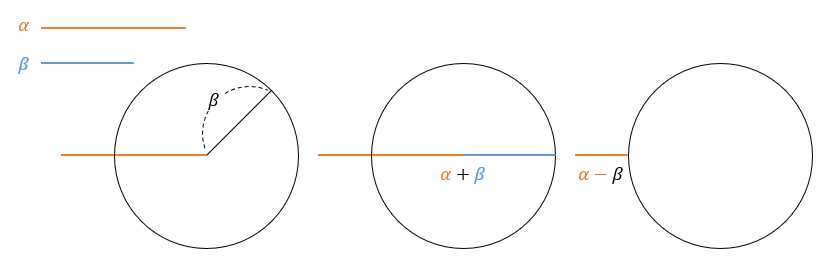 Addition and subtraction are obtained by drawing, at the end of a line segment, a circle whose radius is the number to be added or subtracted.
Multiplication and Division
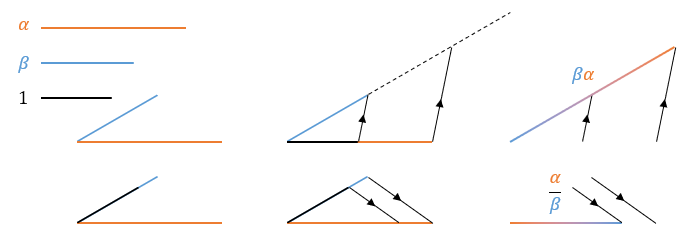 Multiplication and division are obtained using parallel lines and the similarity of triangles.
Square Roots
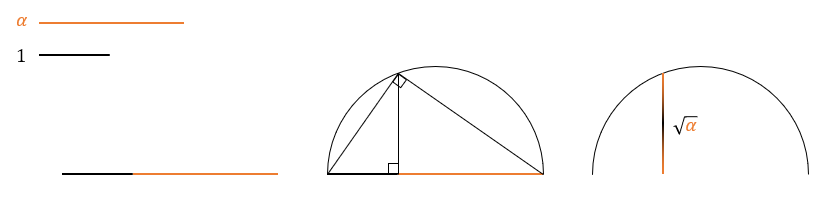
Square roots are obtained using the similarity of right triangles.
Rational Numbers
By adding $1$ a finite number of times we obtain $\mathbb{N}$, by $1-1 = 0$ we obtain $0$, by subtracting $1$ from $0$ a finite number of times we obtain $\mathbb{Z}$, and by dividing integers by one another we obtain $\mathbb{Q}$. Therefore the set of constructible numbers is at least larger than the field of rational numbers, and by allowing square roots we can obtain a slightly larger field. In conclusion, every rational number is constructible.
Algebraic Numbers and Transcendental Numbers
Even irrational numbers can very well be constructible. For example, the irrational number $\sqrt{ 1+ \sqrt{3} }$ is constructible, since it can be obtained by taking the square root of $3$, adding $1$, and then taking the square root again. However, transcendental numbers such as $\pi$ are not constructible.
From the definition, one can easily guess that constructible numbers are algebraic numbers. For example, $\sqrt{2}$ can be obtained by taking the square root of $2$, and at the same time it is an algebraic number as a zero of $(x^{2} - 2 ) \in \mathbb{Q} [ x ]$. Computing backwards, a number such as $a = \sqrt{ 1+ \sqrt{3} }$ satisfies $$ \begin{align*} & a^2 = 1 + \sqrt{3} \\ &=a^2 - 1 = \sqrt{3} \\ =& \left( a^2 - 1 \right)^2 = 3 \\ =& a^4 - 2 a^2 - 2 = 0 \end{align*} $$ and thus is also an algebraic number as a zero of $\left( a^4 - 2 a^2 - 2 \right) \in \mathbb{Q} [ x ]$.
Theorem
- [1]: Constructible numbers are algebraic numbers.
- [2]: If $\gamma \not\in \mathbb{Q}$ is constructible, then there exists a finite sequence $\left\{ a_{i} \right\}_{i=1}^{n}$ satisfying, for $i=2, \cdots , n$, $$ \left[ \mathbb{Q} \left( a_{1} , \cdots , a_{i-1} , a_{i} \right) : \mathbb{Q} \left( a_{1} , \cdots , a_{i-1} \right) \right] = 2 \\ \mathbb{Q} ( \gamma) = \mathbb{Q} \left( a_{1} , \cdots , a_{n} \right) $$ so that for some $r \in \mathbb{N}$ $$ \left[ \mathbb{Q} \left( \gamma \right) : \mathbb{Q} \right] = 2^{r} $$
Proof
[1]
It is trivial by the definition of constructibility.
■
[2]
$$ \left[ \mathbb{Q} \left( a_{1} , \cdots , a_{i-1} , a_{i} \right) : \mathbb{Q} \left( a_{1} , \cdots , a_{i-1} \right) \right] = 2 $$ means that $a_{i} = \sqrt{q}$ for some $q \in \mathbb{Q} \left( a_{1} , \cdots , a_{i-1} \right)$. Adjoining such an $a_{i}$ means that one can add and subtract $a_{i}$ to and from some element $q_{1} a_{1} + \cdots + q_{i-1} a_{i-1}$ existing in the original $\mathbb{Q} \left( a_{1} , \cdots , a_{i-1} \right)$ and then take rational multiples, so $\mathbb{Q} \left( a_{1} , \cdots , a_{i} \right)$ becomes the set of numbers obtained by applying a finite number of arithmetic operations to constructible numbers, which were themselves obtained by a finite number of arithmetic operations and square roots.
That $\gamma$ is constructible means that such a process of operations exists, so a finite number $n \in \mathbb{N}$ satisfying $\mathbb{Q} ( \gamma) = \mathbb{Q} \left( a_{1} , \cdots , a_{n} \right)$ also exists.
Properties of finite extension fields: Let $E$ be a finite extension field of $F$, and $K$ a finite extension field of $E$.
- [2]: $$[E : F] = 1 \iff E = F$$
- [3]: $$[K : F] = [K : E ] [E : F]$$
Then, by the properties of finite extension fields, $$ \begin{align*} 2^n =& \left[ \mathbb{Q} \left( a_{1} , \cdots , a_{n} \right) : \mathbb{Q} \right] \\ =& \left[ \mathbb{Q} \left( a_{1} , \cdots , a_{n} \right) : \mathbb{Q} ( \gamma ) \right] \left[ \mathbb{Q} ( \gamma ) : \mathbb{Q} \right] \end{align*} $$ Meanwhile, since $\mathbb{Q} ( \gamma) = \mathbb{Q} \left( a_{1} , \cdots , a_{n} \right)$, the following holds. $$ 2^n = \left[ \mathbb{Q} ( \gamma ) : \mathbb{Q} \right] $$
■