Saddle-Node Bifurcation
Definition
Easy Definition
A saddle-node bifurcation is a bifurcation in which a fixed point is created or annihilated as a parameter of a dynamical system varies1.
Hard Definition
$$ \dot{x} = f \left( x , r \right) \qquad , x \in \mathbb{R}^{n} , r \in \mathbb{R}^{1} $$ Suppose that $f$ of a given dynamical system is smooth with respect to $x$ and $\alpha$. Let $\bar{x}$ be a hyperbolic fixed point of this system, and let $\lambda_{k}$ be one of the eigenvalues of its Jacobian matrix $D f \left( \bar{x} \right)$. The bifurcation associated with the appearance or disappearance of $\lambda_{k} = 0$ is called a saddle-node bifurcation2.
Normal Form
The saddle-node bifurcation has the following normal form: $$ \dot{x} = r + x^{2} $$
Diagram
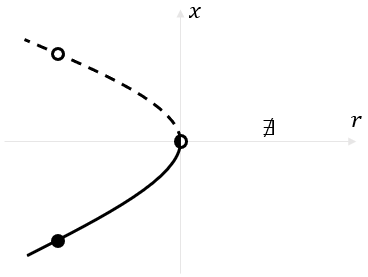
The bifurcation diagram of a saddle-node bifurcation is as follows:
Explanation
The saddle-node bifurcation is the first and most representative example mentioned when explaining bifurcations. It is also called a fold bifurcation, a tangent bifurcation, or a blue sky bifurcation, and in particular its bifurcation point is sometimes called a turning point or a limit point.
Fold?
As can be seen in the bifurcation diagram, this nickname comes from the fact that the curve has a folded shape. In particular, this is more effective terminology in contexts related to hysteresis.
Blue Sky?
Literally, it is an expression that can be used because a fixed point suddenly appears just as lightning strikes out of a blue (clear) sky3. Considering the bifurcation diagram, if we start from $r > 0$ and gradually decrease $r$, then initially there is no fixed point, but at $r = 0$ a saddle-node suddenly appears.