Secant Method
Method
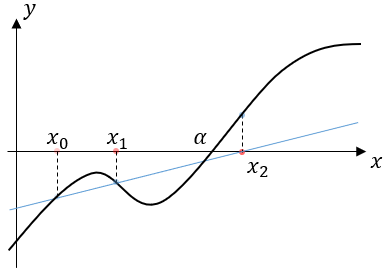
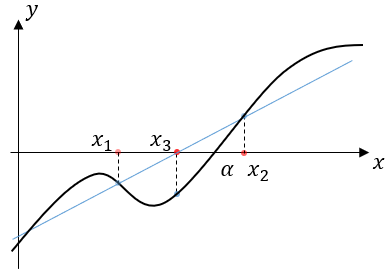
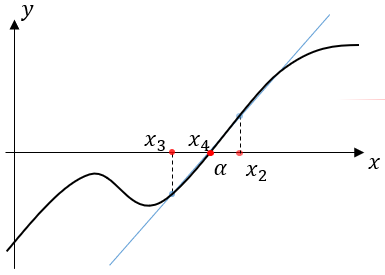
Suppose $f,f ', f ''$ are continuous in a neighborhood of $\alpha$ and $f(\alpha) = 0, f '(\alpha) \ne 0$.
For initial values $x_{0} , x_{1}$ sufficiently close to $\alpha$, the sequence $\left\{ x_{n} \right\}$ defined by $$ x_{n+1} := x_{n} - f ( x_{n} ) {{ x_{n} - x_{n-1} } \over { f ( x_{n} ) - f ( x_{n-1} ) }} $$ converges to $\alpha$ with order $\displaystyle {{1 + \sqrt{5} } \over {2}}$ as $n \to \infty$.
Explanation
The Golden Ratio
The order of convergence should look quite familiar. It is precisely the golden ratio, $\displaystyle {{1 + \sqrt{5} } \over {2}} = 1.618 \cdots$, and since the definition of the sequence uses three consecutive terms, the Fibonacci sequence appears in the proof. Even before mentioning the usefulness of the secant method, this is a rather interesting phenomenon. This order means that the secant method is faster than the bisection method but slower than the Newton-Raphson method.
The reason such a method was devised even though the Newton-Raphson method is faster is that computing the derivative can sometimes be excessively difficult. Also, comparing in terms of computation, since the order of convergence is lower, the number of iterations is larger than for the Newton-Raphson method, but in terms of the cost of each single computation, the secant method can be better. Which method is better depends on the problem. (Frankly, though, hardly anything other than the Newton method is used.)
Initial Value Problem
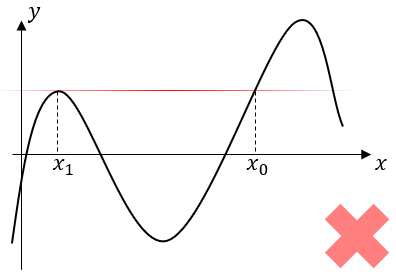
Just like the Newton-Raphson method, if the initial values are given badly, they may not be sufficiently close to $\alpha$ and the method may fail to converge.
Proof1
- $\mathscr{H} \left\{ a,b,c, \cdots \right\}$ denotes the smallest interval containing $a,b,c, \cdots$.
Part 1. Divided Differences
Define $$ \begin{align*} f [ x_{0} , x_{1} ] :=& {{ f ( x_{1} ) - f ( x_{0} ) } \over { x_{1} - x_{0} }} \\ f [ x_{0} , x_{1} , x_{2} ] :=& {{ f [ x_{1} , x_{2} ] - f [ x_{0} , x_{1} ] } \over { x_{2} - x_{0} }} \end{align*} $$ These are called divided differences, and there exist $$ \begin{align*} \xi \in& \mathscr{H} \left\{ x_{0} , x_{1} \right\} \\ \zeta \in& \mathscr{H} \left\{ x_{0} , x_{1} , x_{2} \right\} \end{align*} $$ satisfying $f ' ( \xi ) = f [ x_{0} , x_{1} ]$ and $\displaystyle {{1} \over {2}} f ’’ ( \zeta ) = f [ x_{0} , x_{1} , x_{2} ]$.
Part 2. $\displaystyle \alpha - x_{n+1} = - ( \alpha - x_{n-1} ) ( \alpha - x_{n} ) {{ f ''( \zeta _{n} ) } \over { 2 f ' ( \xi_{n} ) }}$
Multiplying both sides of $x_{n+1} = x_{n} - f ( x_{n} ) {{ x_{n} - x_{n-1} } \over { f ( x_{n} ) - f ( x_{n-1} ) }}$ by $-1$ and adding $\alpha$ gives $$ \alpha - x_{n+1} = \alpha - x_{n} + f ( x_{n} ) {{ x_{n} - x_{n-1} } \over { f ( x_{n} ) - f ( x_{n-1} ) }} $$ and $$ \begin{align*} \alpha - x_{n+1} =& \alpha - x_{n} + {{ x_{n} f ( x_{n} ) - x_{n-1} f ( x_{n} ) } \over { f ( x_{n} ) - f ( x_{n-1} ) }} \\ =& {{ x_{n} f ( x_{n} ) - x_{n-1} f ( x_{n} ) + \alpha f(x_{n}) - x_{n} f(x_{n}) - \alpha f(x_{n-1}) + x_{n} f(x_{n-1}) } \over { f ( x_{n} ) - f ( x_{n-1} ) }} \\ =& {{1 } \over { f ( x_{n} ) - f ( x_{n-1} ) }} \left[ - x_{n-1} f ( x_{n} ) + \alpha f(x_{n}) - \alpha f(x_{n-1}) + x_{n} f(x_{n-1} ) \right] \\ =& {{1 } \over { f ( x_{n} ) - f ( x_{n-1} ) }} \left[ ( \alpha - x_{n-1} ) f ( x_{n} ) - ( \alpha - x_{n} ) f(x_{n-1} ) \right] \\ =& - {{ ( \alpha - x_{n-1} ) ( \alpha - x_{n} ) } \over { f ( x_{n} ) - f ( x_{n-1} ) }} \left[ {{ f ( x_{n} ) } \over { x_{n} - \alpha }} - {{ f(x_{n-1}) }} \right] \\ =& - {{ ( \alpha - x_{n-1} ) ( \alpha - x_{n} ) } \over { f ( x_{n} ) - f ( x_{n-1} ) }} \left[ {{ f ( x_{n} ) - f(\alpha) } \over { x_{n} - \alpha }} - {{ f(x_{n-1} ) - f( \alpha) } \over { x_{n-1} - \alpha }} \right] \\ =& - ( \alpha - x_{n-1} ) ( \alpha - x_{n} ) {{ 1 } \over { f ( x_{n} ) - f ( x_{n-1} ) }} \left[ f[ x_{n} , \alpha ] - f[ x_{n-1} , \alpha ] \right] \\ =& - ( \alpha - x_{n-1} ) ( \alpha - x_{n} ) {{ x_{n} - x_{n-1} } \over { f ( x_{n} ) - f ( x_{n-1} ) }} \left[ {{ f[ x_{n} , \alpha ] - f[ x_{n-1} , \alpha ] } \over { x_{n} - x_{n-1} }} \right] \\ =& - ( \alpha - x_{n-1} ) ( \alpha - x_{n} ) {{ f [ x_{n-1} , x_{n} , \alpha ] } \over { f [ x_{n-1} , x_{n} ] }} \end{align*} $$ Rearranging, we have $$ \alpha - x_{n+1} = - ( \alpha - x_{n-1} ) ( \alpha - x_{n} ) {{ f [ x_{n-1} , x_{n} , \alpha ] } \over { f [ x_{n-1} , x_{n} ] }} $$ and by the properties of divided differences we obtain the following. $$ \alpha - x_{n+1} = - ( \alpha - x_{n-1} ) ( \alpha - x_{n} ) {{ f ''( \zeta _{n} ) } \over { 2 f ' ( \xi_{n} ) }} $$
Part 3. Convergence
Consider a sufficiently small $I : = [ \alpha - \delta , \alpha + \delta ]$ as a neighborhood of $\alpha$ satisfying all the given assumptions.
If we define $$ M := {{ \max_{x \in I } | f '' (x) | } \over { 2 \min_{x \in I} | f '(x) | }} $$ then by the result obtained in Part 1, $$ | \alpha - x_{n+1}| \le | \alpha - x_{n} | | \alpha - x_{n-1} | M $$ Multiplying both sides by $M$ gives $$ | \alpha - x_{n+1}| M \le ( | \alpha - x_{n} | M ) \cdot ( | \alpha - x_{n-1} | M ) $$ Since we assumed a sufficiently small $I$, taking $$ \varepsilon := \max \left\{ ( | \alpha - x_{n} | M ) , ( | \alpha - x_{n-1} | M ) \right\} < 1 $$ yields $$ | \alpha - x_{n+1}| M \le \varepsilon^2 $$ $$ | \alpha - x_{n+3}| M \le ( | \alpha - x_{n+2}| M ) \cdot ( | \alpha - x_{n+1}| M ) \le \varepsilon^2 \cdot \varepsilon = \varepsilon^3 $$ $$ | \alpha - x_{n+4}| M \le ( | \alpha - x_{n+3}| M ) \cdot ( | \alpha - x_{n+2}| M ) \le \varepsilon^3 \cdot \varepsilon^2 = \varepsilon^5 $$ Proceeding in the same way, we obtain the inequality $$ | \alpha - x_{n+m+1}| M \le ( | \alpha - x_{n+m}| M ) \cdot ( | \alpha - x_{n+m-1}| M ) \le \varepsilon^{ q_{m} } \cdot \varepsilon^{ q_{m-1} } = \varepsilon^{ q_{m+1} } $$
General term of the Fibonacci sequence: Suppose a sequence $\left\{ F_{n} \right\}$ is defined by $F_{n+1} := F_{n} + F_{n-1}$. If $F_{0} = F_{1} = 1$, then for $\displaystyle r_{0} : = {{1 + \sqrt{5} } \over {2}}$ and $\displaystyle r_{1} : = {{1 - \sqrt{5} } \over {2}}$, $\displaystyle F_{n} = {{ {r_{0}}^{n+1} - {r_{1}}^{n+1} } \over { r_{0} - r_{1} }} $
$\left\{ q_{m} \right\}$ is none other than the Fibonacci sequence, and for sufficiently large $m$, $$ q_{m} \sim {{1} \over {\sqrt{5}}} ( 1.618 )^{m+1} $$ Therefore $$ | \alpha - x_{n+m}| \le {{1} \over {M}} \varepsilon^{ q_{m} } $$ and we can confirm that as $n \to \infty$, not only does $x_{n} \to \alpha$, but the convergence is of order $$ {{1 + \sqrt{5} } \over {2}} \sim 1.618 $$
■
Implementation
Below is code written in R.
The itmax option is the maximum number of iterations; by default, if a solution of the desired precision is not obtained even after $1000$ iterations, the computation is abandoned.
Secant<-function(f,x0,x1,itmax=10^3,tol=10^(-8))
{
  if(f(x0)==f(x1)){stop('Wrong Initial Values')}

  x2 = x1 - f(x1) \ast ( ( x1  - x0 ) / ( f(x1) - f(x0) ) )
  for(i in 1:itmax)
  {
    x0 = x1
    x1 = x2
    x2 = x1 - f(x1) \ast ( ( x1  - x0 ) / ( f(x1) - f(x0) ) )
    if(abs(x2-x1)<tol) {return(x2)}
  }

  stop('Maybe Wrong Initial Point')
}

f<-function(x) {x^3 + 8}
Secant(f,-7,7)

g<-function(x) {x^6 - x - 1}
Secant(g,0,3)

h<-function(x) {exp(x)-1}
Secant(h,-2,-1)
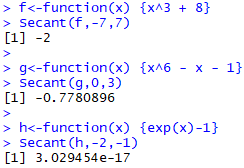
The result of running the above code is as follows.
Atkinson. (1989). An Introduction to Numerical Analysis(2nd Edition): p68~69. ↩︎