
The Entropy of the Universe Does Not Decrease
Theorem
The entropy of the universe does not decrease.
Explanation
The first thing one notices upon seeing the proposition above is that ‘it sounds kind of cool’. But the truly cool person is the one who understands this mathematically, so let’s strive to become such a person.
Proof
We need the assumption that this universe is unique, and therefore that nothing like an ‘outside’ of this universe exists.
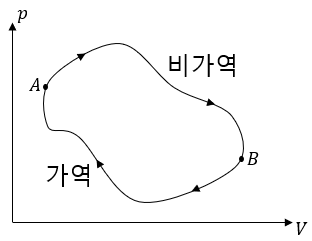
As shown above, consider a cyclic process where $A \to B$ is irreversible and $B \to A$ is reversible. Since this process contains an irreversible process anyway, it is irreversible as a whole.
In a cyclic process, the following holds.
$$ \oint {{\delta Q} \over {T}} \le 0 $$
By the Clausius theorem, the following holds.
$$ \oint {{\delta Q} \over {T}} = \int_{A}^{B} { { \delta Q } \over { T }} + \int_{B}^{A} { {{ \delta Q_{\text{rev} } } \over { T }} } \le 0 $$
Rearranging the upper and lower limits gives the following.
$$ \int_{A}^{B} { { \delta Q } \over { T }} \le \int_{A}^{B} { {{ \delta Q_{\text{rev} } } \over { T }} } $$
The $S$ satisfying the following equation is defined as entropy.
$$ dS = {{ \delta Q_{\text{rev} } } \over { T }} $$
By the definition of entropy, we obtain the following.
$$ \int_{A}^{B} { { \delta Q } \over { T }} \le d S $$
If the universe is the one and only and there is nothing beyond it, it cannot exchange heat energy with an outside. Therefore, when we regard the universe as the whole system, every process is adiabatic, and mathematically we must have $\delta Q = 0$. Putting this together, $dS \ge 0$, so the entropy of the universe cannot decrease.
■