Proof of the First Isomorphism Theorem
Theorem1
Let $G,G'$ be groups.
- First Isomorphism Theorem: If a homomorphism $\phi : G \to G'$ exists, then $$ G / \ker ( \phi ) \simeq \phi (G) $$
- Second Isomorphism Theorem: If $H \le G$ and $N \triangleleft G$, then $$ (HN) / N \simeq H / (H \cap N) $$
- Third Isomorphism Theorem: If $H , K \triangleleft G$ and $K \leq H$, then $$ G/H \simeq (G/K) / (H/K) $$
The isomorphism theorem refers to the three independent theorems above, proved by the algebraist Emmy Noether.
- $\ker$ is the kernel.
- $N \triangleleft G$ means that $N$ is a normal subgroup of $G$.
Explanation
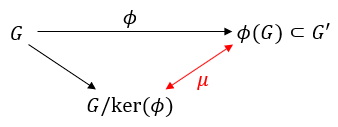
The First Isomorphism Theorem means that there exists an isomorphism $\color{red} {\mu}$ corresponding to the red part in the diagram above. This suggests that, in a group, one can discard the parts unnecessary for $\phi$ and keep only a structure that takes the kernel as a kind of ‘unit’.
Proof
Let $K : = \ker ( \phi )$, and define $\mu : G / K \to \phi (G)$ by $\mu (xK) = \phi ( x)$. It suffices to show that this $\mu$ is an isomorphism.
Part 1. $\mu$ is a function.
For $x,y \in G$ and the identity element $e'$ of $G'$,
$$ \begin{align*} & xK = yK \\ \iff & x^{-1} y \in K \\ \iff & \phi ( x^{-1} y ) = e' \\ \iff & \phi ( x^{-1} ) \phi ( y ) = e' \\ \iff & \phi ( x ) ^{-1} \phi ( y ) = e' \\ \iff & \phi ( x ) = \phi ( y ) \end{align*} $$ In other words, $xK = yK \implies \phi ( x ) = \phi ( y )$, so $\mu$ is a function.
Part 2. $\mu$ is injective.
Tracing the process of Part 1 backwards gives $\phi ( x ) = \phi ( y ) \implies xK = yK$, so $\mu$ is injective.
Part 3. $\mu$ is surjective.
Since $\mu ( G / K ) = \left\{ \mu (xK) \ | \ x \in G \right\} = \left\{ \phi (x) \ | \ x \in G \right\} = \phi (G)$, $\mu$ is surjective.
Part 4. $\mu$ is a homomorphism.
For $x,y \in G$, $$ \mu (xKyK) = \mu (xyK) = \phi (xy) = \phi (x) \phi (y) = \mu (xK) \mu (yK) $$ so $\mu$ is a homomorphism.
■
Generalization
Meanwhile, a theorem extending the First Isomorphism Theorem to rings is known. The proof is almost identical; the difference is that, unlike groups, two operations—addition and multiplication—are considered.
Fundamental Theorem of Homomorphisms: For rings $R$, $r '$, if a homomorphism $\phi : R \to r '$ exists, then $R / \ker ( \phi ) \simeq \phi (R)$
Fraleigh. (2003). A first course in abstract algebra(7th Edition): p307~309. ↩︎