
Heat Capacity
Definition1
The amount of heat $dQ$ required to raise the temperature of an object by $dT$ is called the object’s heat capacity, and, taking the letter C from “capacity”, it is denoted as follows.
$$ C = \dfrac{dQ}{dT} [\text{J/K}] $$
In particular, the heat capacity per unit mass is called the specific heat, and is sometimes denoted by $C_{p} [\text{J}/(\text{Kg} \cdot \text{K})]$.
Explanation
In fact, it is more intuitive to think about its reciprocal, $\dfrac{1}{C} = \dfrac{dT}{dQ}$. That the heat capacity $C$ is small means that $\dfrac{1}{C}$ is large, i.e., the temperature temperature changes significantly for a given change in thermal energy.
If that still isn’t clear, consider the following analogy.
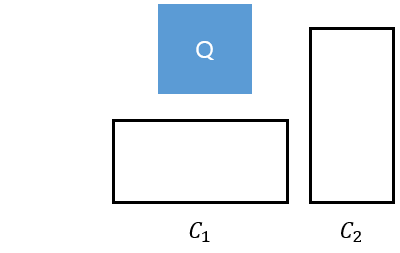
Imagine filling two basins — one with base area $C_{1}$ and the other with base area $C_{2}$ — with $Q$ amount of water. Even with the same amount of water, the basin with the larger base area will have a lower height, while the one with the smaller base area will have a higher height.
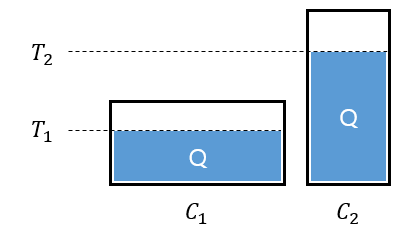
If you actually pour the water, the depths will differ as $T_{1}$ and $T_{2}$ as shown above. Substituting these symbols directly into the definition of heat capacity shows they match exactly. Just as a basin with a large base area can store more water at the same height, a system with a large heat capacity stores more thermal energy at the same temperature.
Meanwhile, the heat capacity at constant volume is written $C_{V}$, and the heat capacity at constant pressure is written $C_{p}$. Intuitively, $C_{p}$ is larger than $C_{V}$, because if the volume is not held constant the motion of gas molecules must also be taken into account, so the change in energy is greater (of course, this is only a qualitative explanation, so do not accept it unquestioningly even if it seems plausible, and it’s perfectly fine if it does not make sense).
In fact, experimentally obtained values are close to $\displaystyle C_{p} = {{5} \over {2}} R > {{3} \over {2} } R = C_{V}$, and the same result can be obtained theoretically.
Stephen J. Blundell and Katherine M. Blundell, Thermal Physics (Concepts in Thermal Physics, trans. Lee Jae-woo) (2nd Edition, 2014), p19 ↩︎