
Maxwell Distribution
Theorem1
The random variable $V$ representing the speed of gas molecules follows the Maxwell distribution, whose probability density function is given as follows.
$$ f(v) = \dfrac{4}{\sqrt{ \pi}} \left( \dfrac{m}{2 k_{B} T} \right)^{3/2} v^{2} e^{-mv^2 / 2k_{B}T } $$
Explanation
The Maxwell distribution is derived from the Boltzmann distribution and is also called the Maxwell-Boltzmann speed distribution. It is a distribution never seen in statistics—so much so that the name statistical mechanics seems misplaced—and if one were to force a connection, it is related to the skewness or kurtosis of the normal distribution.
Through the derivation of the Maxwell distribution, we grasp the motion of gas molecules probabilistically and understand it statistically. We cannot observe the motion of each individual molecule microscopically, but macroscopically things fit together. For the derivation, we assume that the size of a molecule is sufficiently small compared to the distance between molecules, and that the forces acting between molecules can be neglected.
Derivation
Part 1. Distribution of Velocity
Suppose a gas molecule has mass $m$, velocity $\mathbf{v} := ( v_{x} , v_{y} , v_{z} )$, and speed $v := | \mathbf{v} |$. Then the kinetic energy is as follows.
$$ {{1} \over {2}} m v^2 = {{1} \over {2}} m v_{x}^2 + {{1} \over {2}} m v_{y}^2 + {{1} \over {2}} m v_{z}^2 $$
The probability that a system at temperature $T$ has energy $\epsilon$ is as follows.
$$ P(\epsilon) \propto e^{ - \epsilon /k_{B} T } $$
Then the probability that the kinetic energy in the direction of the $v_{x}$-axis is $\displaystyle E = {{1} \over {2}} m v_{x}^2$ is as follows.
$$ g( E ) \propto e^{-mv_{x}^{2} / 2k_{B}T } \implies g( E ) = C e^{-mv_{x}^{2} / 2k_{B}T } $$
Here $C$ is a constant. Now let us normalize $g$ so that it becomes a probability density function. That is, we make the integral of $g$ over the entire domain equal to $1$.
$$ \int_{-\infty}^{\infty} e^{-x^2} dx= \sqrt{\pi} $$
Substituting $v_{x} = \sqrt{\dfrac{2 k_{B} T}{m}} x$ and using the Gaussian integral gives the following.
$$ \begin{align*} \int_{-\infty}^{\infty}g =& C \int_{-\infty}^{\infty} e^{ -m v_{x}^2 / 2 k_{B}T} dv_{x} \\ =& C \int_{-\infty}^{\infty} \sqrt{{2 k_{B} T} \over {m}} e^{ - x^2 } dx \\ =& C \sqrt{\dfrac{2 k_{B} T}{m}} \int_{-\infty}^{\infty} e^{ - x^2 } dx \\ =& C \sqrt{\dfrac{2 k_{B} T}{m}}\cdot \sqrt{\pi} \\ =& C \sqrt{\dfrac{2 \pi k_{B} T }{m}} \\ =& 1 \end{align*} $$
Therefore, $C$ is as follows.
$$ C = \sqrt{\dfrac{m}{2 \pi k_{B} T }} $$
Hence $g(v_{x})$ is as follows.
$$ g(v_{x} ) = \sqrt{ {m} \over {2 \pi k_{B} T } } e^{ - {{m v_{x}^2 } \over {2 k_{B} T}} } $$
Then the fraction of gas molecules with velocity between $(v_{x}, v_{y}, v_{z})$ and $(v_{x} + dv_{x}, v_{y} + dv_{y}, v_{z} + dv_{z})$ is as follows.
$$ g(v_{x}) d v_{x} g(v_{y}) d v_{y} g(v_{z}) d v_{z} \propto e^{- {{m (v_{x}^{2} + v_{y}^{2} + v_{z}^{2})} \over {2 k_{B} T}} } d v_{x} d v_{y} d v_{z} = e^{- {{m v^2} \over {2 k_{B} T}} } d v_{x} d v_{y} d v_{z} $$
Part 2. Distribution of Speed
If we denote by $f(v)$ the probability density function of the distribution that the speed follows, then it must hold that $\displaystyle \int_{0 } ^{\infty} f(v) dv = 1$. Since a gas molecule can move with speed $v$ in any direction, consider a sphere centered at $\mathbb{0}$ with radius $v$.
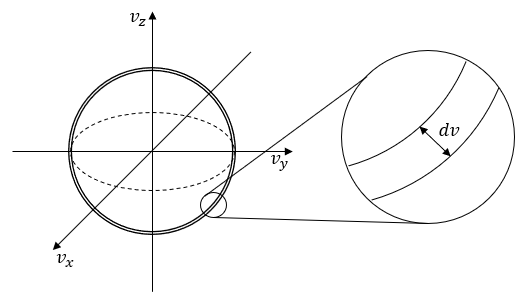
Since the surface area of the sphere is $4 \pi v^2$, letting the thickness of the outer shell of the sphere be $dv$, we can write $d v_{x} d v_{y} d v_{z} = 4 \pi v^2 dv$. Therefore the following equation holds.
$$ e^{- \frac{m v^2}{2 k_{B} T} } d v_{x} d v_{y} d v_{z} = 4 \pi v^2 e^{- \frac{m v^2}{2 k_{B} T} } dv $$
$$ f(v) dv \propto v^2 e^{- \frac{m v^2}{2 k_{B} T} } dv $$
If the explanation with the figure does not quite make sense, it is fine to view it purely formally and accept that a Jacobian has been multiplied. Finally, normalizing by using the Gaussian integral and integration by parts yields the following.
$$ f(v) = {{4} \over { \sqrt{ \pi } }} \left( {{m} \over {2 k_{B} T}} \right)^{{3} \over {2}} v^2 e^{- \frac{m v^2}{2 k_{B} T} } $$
■
Stephen J. Blundell and Katherine M. Blundell, 열 물리학(Concepts in Thermal Physics, 이재우 역) (2nd Edition, 2014), p63-65 ↩︎