
Boltzmann Distribution
Theorem1
The probability that a system with temperature $T$ has energy $\varepsilon$ is as follows.
$$ P(\varepsilon) \propto e^{ - \frac{\varepsilon}{k_{B} T} } $$
Such a distribution is called the Boltzmann distribution.
Derivation
An ensemble is, simply put, 'a situation formed by systems'.
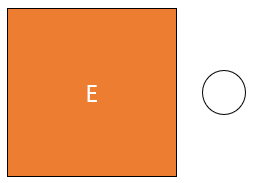
Among them, a canonical ensemble is a situation, as shown above, in which there is a large reservoir and a very small system.
The reservoir is assumed to have temperature $T$ and a very large thermal energy $E$, and is also called a heat bath. Being assumed to be very large, it can give a lot of energy to the system, and even after doing so it maintains the same temperature. It is just like how, when we go to the sea and scoop up a paper cup of seawater, the total amount of seawater is practically unchanged afterward.
The system, being a very small unit, can be taken to an extreme case such as 'a single molecule'. We assume that for every energy the system can have, there is only one microstate. Therefore $\Omega=1$. If there is no condition on how this system must be specifically given, the same discussion would proceed for another system of the reservoir as well. Therefore, 'an investigation of the canonical ensemble' leads directly to 'an investigation of all molecules of a given system'.
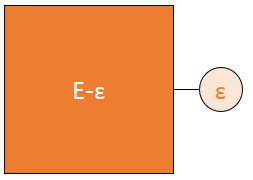
Suppose, as shown above, that the system has gained a very small energy $\varepsilon$ by coming into contact with the reservoir. Since the system was assumed to be very small, it must be viewed from a microscopic perspective, and the energy $\varepsilon$ will follow some distribution. Moreover, the probability that the energy of the given system is $\varepsilon$ is proportional to the number of microstates for the energy $E$ of the reservoir. That is, $P(\varepsilon) \propto \Omega (E)$, and since $\Omega (E) = \Omega (E - \varepsilon) \Omega ( \varepsilon)$, we obtain the following equation.
$$ P(\varepsilon) \propto \Omega (E - \varepsilon) \Omega ( \varepsilon) $$
Here, since the system was assumed to be very small, $\Omega (\varepsilon ) = 1$, so the above equation becomes the following.
$$ P(\varepsilon) \propto \Omega (E - \varepsilon ) $$
If a function $f(x)$ is continuous on $[a,b]$ and $n$ times differentiable on $(a,b)$, then for $x_{0} \in (a,b)$ there exists $\xi \in (a,b)$ satisfying
$$ f(x) = \sum_{k=0}^{n-1} {{( x - x_{0} )^{k}\over{ k! }}{f^{(k)}( x_{0} )}} + {(x - x_{0} )^{n}\over{ n! }}{f^{(n)}(\xi)} $$
Meanwhile, since the system was assumed to be very small, $\varepsilon \ll E$, and the Taylor expansion of $\ln \Omega (E - \varepsilon )$ in a neighborhood of $E$ is as follows.
$$ \begin{align*} \ln \Omega (E - \varepsilon ) =& {{1} \over {0!}} \ln \Omega ( E ) + {{ \left[ ( E - \varepsilon) - E \right] } \over {1!}} \left( \ln \Omega (E) \right)^{\prime} + \cdots \\ =& \ln \Omega (E) - {{ d \ln \Omega (E) } \over { d E }} \varepsilon + \cdots \end{align*} $$
$$ \dfrac{1}{k_{B} T} : = \dfrac{d \ln (\Omega)}{dE } $$
Then, by the definition of temperature, it can be rearranged as follows.
$$ \ln \Omega (E - \varepsilon ) = \ln \Omega (E) - {{ 1 } \over {k_{B} T}} \varepsilon + \cdots $$
Since $\varepsilon$ is sufficiently small, the terms of order $2$ or higher, $\varepsilon^{n}$, can be regarded as nearly $0$. Then we obtain the equation below.
$$ \begin{align*} \ln \Omega (E - \varepsilon ) =& \ln \Omega (E) - \dfrac{\varepsilon}{ k_{B} T} \\ =& \ln \Omega (E) + \ln e^{-\frac{\varepsilon}{k_{B}T}} \\ =& \ln \left( \Omega (E) e^{-\frac{\varepsilon}{k_{B}T}} \right) \end{align*} $$
Removing the logarithm yields the following.
$$ \Omega (E - \varepsilon ) = \Omega ( E) e^{ - {{\varepsilon } \over {k_{B} T}} } $$
Therefore $P(\varepsilon) \propto e^{ - {{\varepsilon } \over {k_{B} T}} }$, and such a distribution is called the Boltzmann distribution. By another name, it is also called the canonical distribution, in the sense that it originates from the canonical ensemble.
Stephen J. Blundell and Katherine M. Blundell, 열 물리학(Concepts in Thermal Physics, 이재우 역) (2nd Edition, 2014), p50-53 ↩︎