
Zeroth Law of Thermodynamics
Law1
For systems $A,B,C$, if $A$ and $B$ are in thermodynamic equilibrium and $B$ and $C$ are in thermodynamic equilibrium, then $A$ and $C$ are also in thermodynamic equilibrium.
Explanation
Expressed mathematically, the zeroth law of thermodynamics amounts to the ‘transitivity of thermodynamic equilibrium’. [Like the first axiom of Euclidean geometry $A = B \land B=C \implies A = C$, it is an important law that forms the foundation of its field, and it is naturally used in many parts of physics.
Thermal contact refers to the process in which different systems exchange heat. If the left is the system with higher temperature and the right is the system with lower temperature, heat flows from the hotter place to the colder place as shown below.
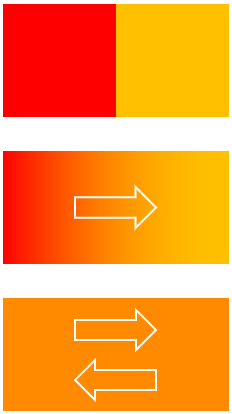
Thermodynamic equilibrium is described as follows:
As time passes, the heat flowing from left to right and the heat flowing from right to left will become equal. Such a state is called thermodynamic equilibrium. What must be noted is that there is no flow of heat (macroscopically), not that heat does not flow (even microscopically). Although no change in heat is observed (macroscopically), one cannot guarantee that the (microscopic) flow of energy itself has truly stopped. Even if such changes in heat exist, they are of such a tiny amount that they can be regarded as no flow when observed.
See Also
Stephen J. Blundell and Katherine M. Blundell, 열 물리학(Concepts in Thermal Physics, 이재우 역) (2nd Edition, 2014), p41-43 ↩︎