One-Point Compactification
Definition 1
For a topological space $(X , \mathscr{T})$, let $\infty \notin X$. For $X_{\infty} := X \cup \left\{ \infty \right\}$, the space $(X_{\infty } , \mathscr{T}_{\infty} )$ with a topology $\mathscr{T}_{\infty}$ defined to satisfy the following two conditions is called the one-Point Compactification of $(X, \mathscr{T})$.
- (i): $\infty \notin U \implies U \in \mathscr{T}_{\infty}$ and $U \in \mathscr{T}$ are equivalent.
- (ii): $\infty \in U \implies U \in \mathscr{T}_{\infty}$ and the statement that $X_{\infty} \setminus U$ is closed and compact are equivalent.
Theorem
$(X_{\infty } , \mathscr{T}_{\infty} )$ has the following properties.
- [1]: $(X , \mathscr{T})$ is a subspace of $(X_{\infty } , \mathscr{T}_{\infty} )$.
- [2]: $(X_{\infty } , \mathscr{T}_{\infty} )$ is compact.
- [3]: $\overline{X} = X_{\infty}$ and $X$ being non-compact are equivalent.
Explanation
Of course, the point’s symbol is just infinity and does not indicate any size or state.
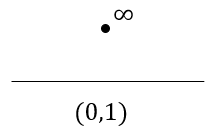
For example, consider taking an open interval $(0,1)$ and a point $\infty$ outside of it, as follows.
Now think of ‘bending’ $(0,1)$ into a curve.
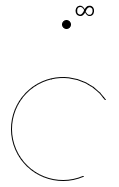
The given interval does not include its two endpoints $0$ and $1$. If we join the junction with $\infty$, it takes the following shape.
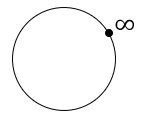
As we know, such a closed curve is compact.
The reason we define the one point outside $X$ specifically as $\infty$ is justified when we consider the discussion leading to the Riemann sphere.
Munkres. (2000). Topology(2nd Edition): p185. ↩︎