Proof of the Peano Space-Filling Theorem
Theorem 1
For $I = [0,1]$, there exists a surjective continuous function $f : I \to I \times I$.
Explanation
It is a short but extremely shocking theorem. If this theorem is true, it means that a plane can be constructed out of lines alone, and it is hard to accept even after seeing the proof. The name ‘space-filling theorem’ is an arbitrary adoption of the translation used in Japan.
Proof
Part 1.
As in the following figures, define the sequence of paths $\left\{ f_{n} \right\}$.
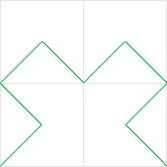
$$ f_{1} : I \to I \times I $$
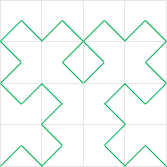
$$ f_{2} : I \to I \times I $$
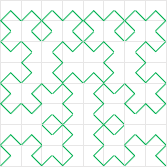
$$ f_{3} : I \to I \times I $$
Then, since $f_{n}$ satisfies, for all $x \in I$, $$ d ( f_{n}(x) , f_{n+1} (x) ) < {{1} \over {2^{n} }} $$ it is Cauchy.
Equivalent conditions for a compact metric space: For a metric space, being compact is equivalent to being complete and totally bounded.
Meanwhile, since $I \times I$ is a metric space and compact, it is a complete space, and $f_{n} (x)$ converges to some point of $I \times I$.
Now let us define $\displaystyle f(x) : = \lim_{n \to \infty} f_{n} (x)$. If we show that $f$ is a surjective continuous function, the proof is complete.
Part 2. $f$ is a function.
It suffices to show that $f(x)$ exists uniquely for all $x \in I$.
- Since $I \times I$ is a complete space, the Cauchy sequence $f_{n} (x)$ converges, and $f(x) \in I \times I$ always exists.
- Since $I \times I$ is a metric space, it is a Hausdorff space, and $f(x)$ is unique.
Part 3. $f$ is continuous.
If we show that $f_{n}$ converges uniformly to $f$, then since $f_{n}$ is continuous, $f$ is also continuous. For a given $\varepsilon > 0$, take $n_{0} \in \mathbb{N}$ such that $\displaystyle {{2} \over {2^{n_{0}} }} < \varepsilon$. Since $\displaystyle d ( f_{n}(x) , f_{n+1} (x) ) < {{1} \over {2^{n} }}$ for all $x \in I$, $$ d ( f_{n}(x) , f (x) ) < {{1} \over {2^{n} }} $$ By the triangle inequality, $$ d ( f_{n}(x) , f (x) ) < d ( f_{n}(x) , f_{n_{0}} (x) ) + d ( f_{n_{0}}(x) , f (x) ) < {{1} \over {2^{n_{0}} }} + {{1} \over {2^{n_{0}} }} = {{2} \over {2^{n_{0}} }} < \varepsilon $$ That is, $f_{n}$ converges uniformly to $f$, and $f$ is continuous.
Part 4. $f$ is surjective.
If we show that $y \in f(I)$ for all $y \in I \times I$, then $f$ is surjective. By the definition of $\left\{ f_{n} \right\}$, for a given $y \in I \times I$ there exist $x \in I$ and $m \in \mathbb{N}$ satisfying $$ d(y, f_{m} (x) ) < {{ 1 } \over { 2^{m} }} $$ Then, for $n \ge m$, $$ d(y, f_{n} (x) ) \le d(y, f_{m} (x) ) + d(f_{m} (x) , f_{n} (x) ) < {{2} \over {2^{m}}} $$ Now, for a given $\epsilon > 0$, take $n_{0} > m$ satisfying $\displaystyle {{3} \over {2^{n_{0}}}} < \epsilon$. By the triangle inequality, $$ d ( y , f (x) ) < d ( y , f_{n_{0}} (x) ) + d ( f_{n_{0}}(x) , f (x) ) < {{2} \over {2^{n_{0}} }} + {{1} \over {2^{n_{0}} }} = { {3} \over { 2^{n_{0} } } } < \varepsilon $$ That is, $B_{d} (y , \varepsilon ) \cap f(I) \ne \emptyset$, and since $\displaystyle d ( y , f (x) ) < \varepsilon$ for all $\varepsilon > 0$, we have $y \in \overline{ f(I) }$.
Compactness and continuous functions: For $f : X \to Y$, suppose $X$ is compact and $f$ is continuous. If $Y$ is Hausdorff, then $f$ is a closed function. For a closed set $C \subset X$, $f(C) \subset Y$ is a closed set.
Since we showed earlier in Part 2. that $f$ is continuous, $f(I)$ is a closed set in $I \times I$, and $y \in \overline{ f(I) } = f(I)$. Therefore, $f : I \to I \times I$ is a surjective continuous function.
■
Munkres. (2000). Topology(2nd Edition): p272. ↩︎