
Rankine-Hugoniot Condition and Entropy Condition
Definition
$$ \begin{cases} u_{t} + u u_{x} = 0 & , t>0 \\ u(t,x) = f(x) & , t=0 \end{cases} $$
Let the solution of the inviscid Burgers’ equation above be $u$, and let its breaking time be $t_{\ast}$.
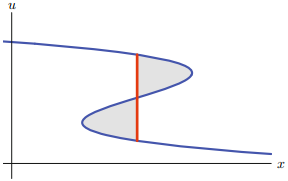
When the solution of the inviscid Burgers’ equation breaks, we connect it with a line segment so that the areas on the left and the right become equal, as shown above. Adjusting the solution so that it can be interpreted physically in this way is called the equal area rule.
Explanation
If we let the position of the discontinuity that arises this way be $\sigma (t)$, then
$$ \begin{cases} \displaystyle u^{+} (t) := \lim_{x \to \sigma (t)^{+}} u(t,x) \\ \displaystyle u^{-} (t) := \lim_{x \to \sigma (t)^{-}} u(t,x)\end{cases} $$
and the following conditions are satisfied.
- rankine-Hugoniot condition: $\displaystyle \sigma ' (t) = {{d} \over {dt}} \sigma (t) = {{u^{+}(t) + u^{-}(t) } \over {2}}$
- entropy condition: $u^{+} (t) \le \sigma '(t) \le u^{-} (t)$
To put it plainly, 1. means that the movement over time of the breaking position is expressed as the average of the left-hand and right-hand limits.
2. is in some sense obvious, because if $u^{+} (t) \le u^{-} (t)$ had not held in the first place, the breaking itself would not have occurred. 1. is a necessary and sufficient condition for $u$ to be a solution; if a solution fails to satisfy this condition, one can confirm that it was computed incorrectly from the start.