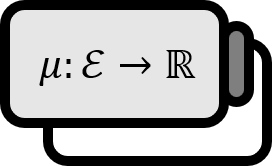
Lebesgue Integrable
Definition 1
Let $E \in \mathcal{M}$ and, for a measurable function $f$, set $$f^{+} := \max \left\{ f , 0 \right\} \\ f^{-} := \max \left\{ -f , 0 \right\}$$ Then it can be expressed as $$ f = f^{+} - f^{-} \\ | f | = f^{+} + f^{-} $$ If $\displaystyle \int_{E} | f | dm < \infty$, that is, $$ \int_{E} f^{+} dm < \infty \\ \int_{E} f^{-} dm < \infty $$ then $f$ is said to be Lebesgue Integrable. The set of functions that are integrable on $E$ is denoted as follows. $$ \mathcal{L}^{1}(E) : = \left\{ f \ \left| \ \int_{E} | f | dm < \infty \right. \right\} $$
Basic Properties
- [1]: An integrable function is a measurable function.
- [2]: If $f \in \mathcal{L}^{1} (E)$, then $\displaystyle \left| \int_{E} f dm \right| \le \int_{E} | f | dm$
- [3]: If $f \in \mathcal{L}^{1} (E) $ and $c \in \mathbb{R}$, then $\displaystyle \int_{E} (c f) dm = c \int_{E} f dm$
- [4]: If $f,g \in \mathcal{L}^{1} (E) $, then $\displaystyle \int_{E} ( f + g ) dm = \int_{E} f dm + \int_{E} g dm$
- [5]: If $f,g \in \mathcal{L}^{1} (E)$ and $f \le g$, then $\displaystyle \int_{E} f dm \le \int_{E} g dm$
- [6]: If $\displaystyle \int_{E} f dm = \int_{E} g dm$ for all $E \in \mathcal{M}$, then $f= g$ almost everywhere.
Explanation
Property [1] appears right below the definition, so it looks easy, but after a while it can get confusing, so memorize it until it becomes second nature.
Meanwhile, from [3]~[5] we can see that $\mathcal{L}^{1}(E)$ is a vector space.
Capinski. (1999). Measure, Integral and Probability: p86. ↩︎