
Solving the Inviscid Burgers' Equation
Definition
The following quasilinear partial differential equation is called the burgers’ equation.
$$ \begin{cases} u_{t} + u u_{x} = 0 & , t>0 \\ u(t,x) = f(x) & , t=0 \end{cases} $$
Here $t$ is time, $x$ is position, and $u(t,x)$ represents the waveform at $x$ at time $t$. $f$ is the initial condition, representing in particular the waveform at $t=0$.
Explanation
The Burgers’ equation represents the case where the diffusion coefficient $\nu$ is $0$ in $\displaystyle u_{t} + u u_{x} = \nu u_{xx}$.
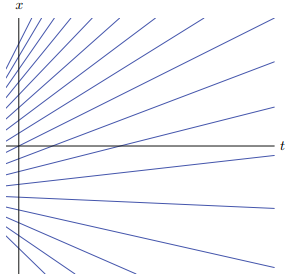
If $f ' (x)>0$, it means that the larger $x$ is, the faster the speed, so the characteristic curves form a rarefaction as shown above. The slope at $(t,x)$ means the speed of the wave, and forming a rarefaction means that the speed only keeps increasing or decreasing. In this case, the characteristic curves never meet each other.
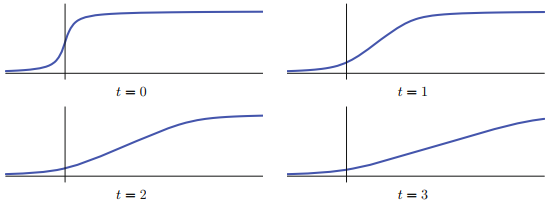
If we draw the waveform, as shown above, the fast points go faster and the slow points go slower, so the difference gradually widens over time.
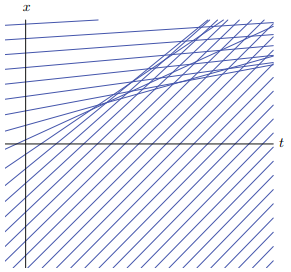
On the other hand, when the speed decreases as $x$ gets larger as shown above, the characteristic curves intersect as shown above.
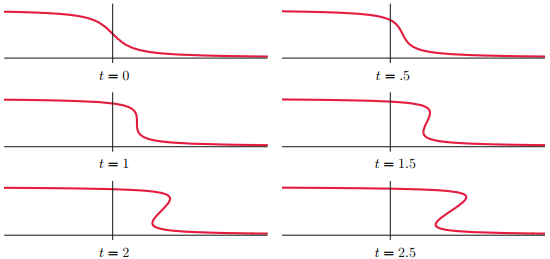
In this case, if we look at the waveform, the points that were behind overtake the points that were ahead. In the figure above, starting from $t=1$, $u$ begins to have multiple values for a given $x$. As an example of a natural phenomenon, it may help to imagine a situation where a wave forms. The water that was moving ahead near the bottom slows down as it rubs against sand or gravel, but the upper part receives force, advances, and topples over. This is called blow-up, mathematically becoming a non-function, and physically being multiple states superposed at the same time.
The case where the characteristic curves form a rarefaction is too easy to analyze, so the case that mainly draws attention is only this one. Finding the solution itself is not difficult, but neatly converting it into explicit function form is difficult, and there are countless cases where this cannot be done. In solving the Burgers’ equation, besides the solution, finding the blow-up time and the blow-up location is also an important problem. If a solution to the inviscid Burgers’ equation exists, the solution is as follows.
Solution
Step 1. Let $\xi = x - tu$.
Step 2. Let $u = f(x - tu)$.
Then, since $\xi = x - t f( x - tu) = x - t f (\xi )$, the characteristic lines become $x = f(\xi) t + \xi$. If $f ' (x) > 0$ for all $x \in \mathbb{R}$, the characteristic lines form a rarefaction and do not meet. If there exists an $x$ with $f ' (x) < 0$, the characteristic lines meet at some point and blow up at that point.
Step 3. Convert the initial condition into the form $f(x-tu) = f(\xi)$.
If $u = f(\xi) = f(x - tu)$ can be converted into explicit function form, convert it.
■
If the solution of the inviscid Burgers’ equation blows up within finite time, that time and location are as follows
Step 1. If $u$ was found in explicit function form, find $t = t_{\ast}$ at which $u$ diverges.
That $t_{\ast}$ becomes the blow-up time.
Step 2. If it could not be found in explicit function form, compute $f ' (x)$.
$$ t_{\ast} : = \inf \left\{ \left. - {{1} \over {f ' (x) }} \ \right| \ f '(x) < 0 \right\} $$
is the blow-up time.
Step 3. Find the point $x_{0}$ where the characteristic line $x = f(\xi) t + \xi$ meets the $x$-axis.
The $x_{*} = x_{0} + f(x_{0}) t_{\ast}$ obtained by substituting $\xi=x_{0}$ and $t = t_{\ast}$ into $x = f(\xi) t + \xi$ is the blow-up location.
■
Example
1
- Find the blow-up time of $\displaystyle \begin{cases} u_{t} + u u_{x} = 0 & , t>0 \\ u(t,x) = \alpha (x - tu) + \beta & , t=0 \end{cases}$.
This is a type where $u$ is neatly expressed in explicit function form.
Solving $u = \alpha ( x - tu ) + \beta$ for $u$ gives $\displaystyle u(t,x) = {{\alpha x + \beta} \over {1 + \alpha t}}$, and the blow-up time is $\displaystyle t_{\ast} = - {{1} \over {\alpha}} $
■
2
- Find the blow-up time of $\displaystyle \begin{cases} u_{t} + u u_{x} = 0 & , t>0 \\ u(t,x) = {{1} \over {2}} \pi - \tan^{-1} x & , t=0 \end{cases}$.
This is a type where it is cumbersome to express $u$ in explicit function form.
$$ f ' (x) = \left( {{1} \over {2}} \pi - \tan^{-1} x \right) = - {{1} \over {1 + x^2}} $$
and $f ' (x) < 0$ for $x \in \mathbb{R}$. Therefore
$$ t_{\ast} = \inf \left\{ \left. - {{1} \over {f ' (x) }} \ \right| \ f '(x) < 0 \right\} = \inf \left\{ \left. (1+ x^2) \ \right| \ f '(x) < 0 \right\} = 1 $$
■