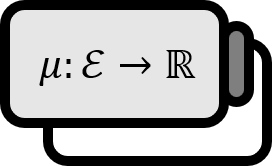
Lebesgue Measurable Functions
Definition 1
If a function $f: E \in \overline{ \mathbb{R} }$ satisfies, for every interval $I \subset \overline{ \mathbb{R} }$, $$ f^{-1} (I) = \left\{ x \in \mathbb{R} \ | \ f(x) \in I \right\} \in \mathcal{M} $$ then $f$ is called (Lebesgue) Measurable.
- $\overline{ \mathbb{R} } = \mathbb{R} \cup \left\{ - \infty , + \infty \right\}$ is the extended real space obtained by adding negative and positive infinity to the $1$-dimensional Euclidean space.
Equivalent Conditions
The following propositions are equivalent to one another.
- (1): $f$ is a Lebesgue measurable function.
- (2): For every $r \in \mathbb{R}$, $f^{-1} ( - \infty , r ] \in \mathcal{M}$
- (3): For every $r \in \mathbb{R}$, $f^{-1} (r, \infty ) \in \mathcal{M}$
- (4): For every $r \in \mathbb{R}$, $f^{-1} ( - \infty , r ) \in \mathcal{M}$
- (5): For every $r \in \mathbb{R}$, $f^{-1} [r, \infty ) \in \mathcal{M}$
Theorem
- [1]: $f$ is measurable if and only if $f^{-1} ( O ) \in \mathcal{M}$ for every open set $O$.
- [2]: When $D \subset E$ and $D \in \mathcal{M}$, $f |_{E}$ is measurable if and only if $f |_{D}$ and $f |_{E \setminus D}$ are measurable.
- [3]: A continuous function is measurable.
- [4]: An indicator function is measurable.
- [5]: A monotonic function is measurable.
- $f |_{X}$ denotes the restriction map that restricts the domain to $X$ and satisfies $f = f |_{X}$.
- An indicator function is a function that, for a given set, returns $1$ if an element belongs to it and $0$ otherwise, as follows: $$\displaystyle \mathbb{1}_{E} (x) = \chi _{E} (x) = \begin{cases} 1 & , x \in E \\ 0 & , x \notin E \end{cases}$$ In writing it cleanly, the condition $E \in \mathcal{M}$ has been omitted, so caution is required.
Explanation
For more convenient manipulation, it will be easier to use the definition of the preimage $f^{-1} (-\infty , r) = \left\{ x \in E \ | \ f(x) < r \right\}$ directly.
If, in the condition for a Lebesgue measurable function, $f^{-1} (I) = \left\{ x \in \mathbb{R} \ | \ f(x) \in I \right\} \in \mathcal{B}$ is satisfied for every interval $I \subset \mathbb{R}$, then it is called borel Measurable, and is referred to as a borel function.
The extended reals $\overline{\mathbb{R}} : = [ - \infty, \infty]$ include infinity as a single point along with all the real numbers. In analysis so far, infinity has been something merely difficult and frightening, but now it is nothing more than an object to be conquered. Do not fear it too much, and let us recover the flexible thinking of those high school days.
When we consider a general measurable space, [1] actually becomes the definition of a measurable function.
Proof
[1]
For a closed interval, we only need to add two points to the endpoints of an open interval, so it suffices to consider only open intervals.
$(\Rightarrow)$
Defining the open intervals $A_{k} := (a_{k}, \infty)$ and $B_{k} := (b_{k}, \infty)$, since $f$ is a measurable function, $$f^{-1} (A_{k}), f^{-1} (B_{k}) \in \mathcal{M}$$ Any open set $O \subset \overline{ \mathbb{R} }$ can be expressed as $\displaystyle O = \bigcup_{k=1}^{\infty} A_{k} \cap B_{k}$, so $$\displaystyle f^{-1} ( O ) = f^{-1} \left[ \bigcup_{k=1}^{\infty} A_{k} \cap B_{k} \right] = \bigcup_{k=1}^{\infty} \left[ f^{-1} (B_{k}) \cap f^{-1} (B_{k}) \right]$$ By the property of the σ-field, $f^{-1} ( O ) \in \mathcal{M}$.
$(\Leftarrow)$ Since $f^{-1} ( O ) \in \mathcal{M}$ for every open set $O \subset \overline{ \mathbb{R} }$, it also holds that $f^{-1} (a,b) \in \mathcal{M}$ for every open interval $(a,b) \subset \overline{ \mathbb{R} }$.
By the definition of a measurable function, $f$ is a measurable function.
■
[2]
$(\Rightarrow)$
Since $f |_{E}$ is a measurable function, $E \in \mathcal{M}$, and since $D \in \mathcal{M}$, we have $( \mathbb{R} \setminus D ) \in \mathcal{M}$. Therefore the following holds. $$E \cap (\mathbb{R} \setminus D ) = ( E \setminus D ) \in \mathcal{M}$$
Since $f |_{E}$ is a measurable function with $D \subset E$ and $D \in \mathcal{M}$, $f |_{D}$ is a measurable function. On the other hand, since $(E \setminus D) \subset E$ and $(E \setminus D) \in \mathcal{M}$, $f |_{E \setminus D}$ is likewise a measurable function.
$(\Leftarrow)$
Since $f |_{D}$ and $f |_{E \setminus D}$ are measurable functions, $D, ( E \setminus D ) \in \mathcal{M}$, and $$D \cup ( E \setminus D ) = E \in \mathcal{M}$$ Therefore $f |_{E}$ satisfies the condition for a measurable function.
What must be noted in this proof is that this is about as far as we could go while refraining as much as possible from saying $f |_{X}$ is measurable. In practice, it must be written repeatedly almost in every section to make the proof correct.
■
[3]
If $f$ is a continuous function, then for every open set $V \subset Y$, $f^{-1} (V)$ is open in $X$.
By the property of continuous functions and Theorem [1], a continuous function is a measurable function.
For reference, a necessary condition for the composite function $f \circ g$ to be a measurable function is that $g : E_{1} \to E_{2}$ and $f : E_{2} \to \mathbb{R}$ are continuous functions.
■
[4]
Obviously, before the proof we must assume $E \in \mathcal{M}$. Then $$\mathbb{1}_{E}^{-1} ( r , \infty) = \begin{cases} \mathbb{R} & , r < 0 \\ E & , 0 \le r < 1 \\ \emptyset & , 1 \le r \end{cases}$$ and for every $r$, $\mathbb{1}_{E}^{-1} (r, \infty) \in \mathcal{M}$.
■
[5]
A monotonic function is either an increasing function or a decreasing function. It suffices to show that an increasing function $f : I \to \mathbb{R}$ defined on an arbitrary interval $I$ is a measurable function.
If we let the set of points at which $f$ is discontinuous on $I$ be $D \subset I$, then $f |_{I \setminus D}$ is a continuous function. Since the points at which $f$ is discontinuous on the domain of a monotonic function are at most countable, $D$ is a countable set.
Since $D \in \mathcal{N} \subset \mathcal{M}$, $f |_{D}$ is a measurable function, and by [3] the continuous function $f |_{I \setminus D}$ is also a measurable function, so by [2], $f_{I} = f$ is a measurable function.
■
Generalization
Capinski. (1999). Measure, Integral and Probability: p57. ↩︎