Topologist's Sine Curve and Comb Space
Definition 1
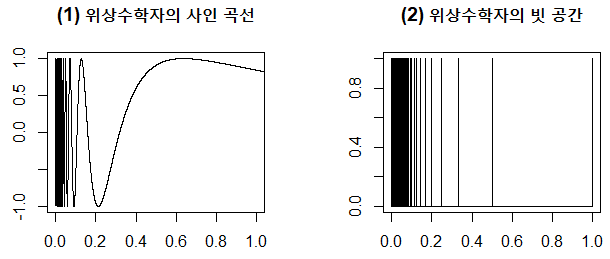
- The set $S$ defined as follows is called the topologist’s Sine curve. $$ S : = \left\{ (0,y) \ | \ y \in [-1,1] \right\} \cup \left\{ \left. \left( x, \sin {{1} \over {x}} \right) \ \right| \ x \in (0,1] \right\} $$
- The set $C$ defined as follows is called the comb space. $$ C := \left\{ (0,y) \ | \ y \in [0,1] \right\} \cup \left\{ (x,0) \ | \ x \in [0,1] \right\} \cup \left\{ \left( {{1} \over {n}} , y \right) \ | \ y \in [0,1] , n \in \mathbb{N} \right\} $$
Explanation
Rather than the expressions written as formulas, let us try to remember the figures themselves. As their names suggest, these are spaces that have interesting properties in topology, and they are usefully employed as counterexamples for various propositions.
Sine Curve
- [1]: $S$ is connected but is neither path-connected nor locally connected.
If we think of drawing the sine curve from $1$ down to $0$, it will surely touch the $y$-axis. However, the closer it gets, the more violently its trajectory oscillates within $[-1,1]$, and there is no way to take a path that precisely joins these two.
Comb Space
- [2]: $C$ is path-connected but is not locally connected.
Although the comb space is entirely connected through the segments on the $x$-axis, it cannot be locally connected on any open set along the $y$-axis.
Code
Additionally, I leave the R code used to draw the figures used in this post.
win.graph(7,3.5)
par(mfrow=c(1,2))

X = seq(0.0001,2,0.0001)
plot(X,sin(1/X),ylim=c(-1,1),type='l',xlim=c(0,1),main='(1) 위상수학자의 사인 곡선',xlab=NA,ylab=NA)
segments(0,0,0,1)

plot(NA,ylim=c(0,1),type='l',xlim=c(0,1),main='(2) 위상수학자의 빗 공간',xlab=NA,ylab=NA)
segments(0,0,1,0)
segments(0,0,0,1)
segments(1/1:1000,0,1/1:1000,1)
Munkres. (2000). Topology(2nd Edition): p157. ↩︎