Path Connectedness in Topology
Definition 1
Let $X$ be a topological space and let $C \subset \mathbb{R}^{n}$.
- A continuous function $p : [0,1] \to X$ is called a path from the initial point $p(0)$ to the terminal point $p(1)$. $\overline{p}(t) = p(1-t)$ is called the reverse path of $p$.
- If for every $a,b \in X$ there exists a path $p$ satisfying $p(0) = a$ and $p(1) = b$, then $X$ is called a path Connected space.
- If $(1-t) a + t b \in C$ for all $a,b \in C$ and $t \in [0,1]$, then $C$ is said to be convex.
- If $p(0) = p(1)$, then it is called a closed path.
Explanation
Simply put, if a path connecting two points of a space always exists, the space is called path connected.
- $X$ is a disconnected space $\iff$ there exists a continuous function $f : X \to \left\{ a, b \right\}$.
- $X$ is a path connected space $\iff$ there exists a continuous function $p : [0,1] \to X$.
For disconnected spaces and path connected spaces, it is easier to think in terms of which continuous function satisfying a certain condition exists. Of course, the propositions above omit many things, so it is problematic to accept them at face value.
Convex
The concept of convexity need not be defined only for subsets of Euclidean space; it can be defined for any subspace of a vector space. Geometrically, being convex means that the straight line connecting two points of $C$ always lies within $C$.
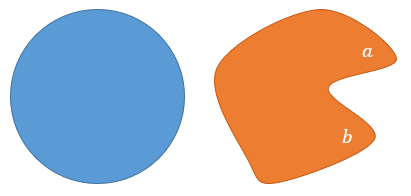
For example, looking at the two figures above, the blue circle is convex because any two points can be connected by a straight line. The orange figure is not convex because there is no straight line connecting $a$ and $b$ within its interior.
Connectedness
On the other hand, if you look closely at the definition of a path connected space, it seems practically no different from a connected space. Indeed, the following theorem can be proven without much difficulty, and distinguishing the two seems meaningless. However, connectedness and path connectedness are definitely different concepts, because there exists a counterexample showing that the converse of the theorem above does not hold. Cases where the converse holds include convex subspaces of $\mathbb{R}$ or open connected subspaces.
Theorem: A path connected space is a connected space.
Proof
For a path connected space $X$, if $X = \emptyset$ then $X$ is a connected space. If $X \ne \emptyset$, we can pick some point $a \in X$. Then for any $x \in X$, there exists a continuous function $p_{x} : [0,1] \to X$ satisfying $p_{x} (0) = a$, $p_{x} (1) = x$.
The continuous image of a connected space is a connected space For a connected space $X$, if $f : X \to Y$ is a continuous function, then $f(X)$ is a connected space.
Since $[0,1]$ is a connected space, $p_{x} ( [0,1] )$ is a connected space, and since $\displaystyle a \in \bigcap_{x \in X} p_{x} ( [0, 1] )$, we have $\displaystyle \bigcap_{x \in X} p_{x} ( [0, 1] ) \ne \emptyset$
(3) For a set $\left\{ A_{\alpha} \ | \ \alpha \in \forall \right\}$ of connected subspaces of $X$, if $\displaystyle \bigcap_{\alpha \in \forall} A_{\alpha} \ne \emptyset$, then $\displaystyle \bigcup_{\alpha \in \forall} A_{\alpha}$ is a connected space.
Therefore $\displaystyle X = \bigcup_{x \in X} p_{x} ( [0, 1] )$ is a connected space.
■
See Also
Munkres. (2000). Topology(2nd Edition): p155. ↩︎