Null Set
Definition 1
For the set $\mathcal{I}$ of intervals of real numbers, define a function $l : \mathcal{I} \to [ 0 , \infty )$ as $l( I ) := \sup{I} - \inf{I}$ and call it the length. If for every $\varepsilon > 0$ there exists a sequence of intervals $\left\{ I_{n} \ | \ n \in \mathbb{N} \right\}$ satisfying $$ A \subset \bigcup_{n = 1}^{\infty} I_{n} \\ \sum_{n=1}^{\infty} l (I_{n}) < \varepsilon $$ then $A \subset \mathbb{R}$ is called a null set.
Explanation
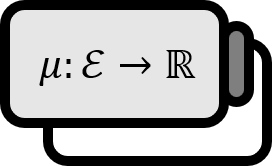
The set of all intervals is denoted by $\mathcal{I}$, and the set of all null sets by $\mathcal{N}$.
Note that although null and empty have similar meanings, they clearly carry different nuances. If one were to explain the difference, null is something that is ’effectively’ as good as absent, whereas empty gives the feeling of ‘actually’ being absent. Come to think of it, outside of mathematics, a true ‘absence’ is in fact hard to find or prove. In some sense, one might say this is the reason why computer science uses null instead of empty. For example, even if a variable is declared but not assigned any value, it is not an abstract ’nothingness’ but rather a ‘meaningless’ state. Since it has no meaning, there is no reason to preserve it by spending memory, and it does not matter when it disappears. According to the distinction above, calling this a null set seems quite reasonable. Defining a null set in that way means that a certain set is not empty, but with respect to the concept of ’length’, it is effectively meaningless.
Theorem
- [1]: The empty set is a null set.
- [2]: A singleton set is a null set.
- [3]: A countable set is a null set.
Proof
[1]
For $n \in \mathbb{N}$, letting $I_{n} : = \emptyset$ gives $$ \emptyset \subset \bigcup_{n = 1}^{\infty} I_{n} \\ \sum_{n=1}^{\infty} l (I_{n}) = 0 < \varepsilon $$
■
[2]
Consider a singleton set $\left\{ x \right\}$. For $n \in \mathbb{N}$, letting $\displaystyle I_{n} : = \left( x - {{ \varepsilon } \over {2 \cdot 2^{n+1}}} , x + {{ \varepsilon } \over {2 \cdot 2^{n+1}}}\right)$, the following naturally holds.
$$ \left\{ x \right\} \subset \bigcup_{n = 1}^{\infty} I_{n} \\ \sum_{n=1}^{\infty} l (I_{n}) = {{\varepsilon} \over {2}} < \varepsilon $$
■
[3]
Strategy: This applies the idea of putting the natural numbers into one-to-one correspondence with the rational numbers. On the other hand, the inverse of [3], ‘an uncountable set is not a null set’, is false, since Cantor’s set serves as a counterexample.
By Theorem [1], a singleton set is a null set, so it suffices to show that for a sequence of null sets $\left\{ N_{n} \right\}$, the set $\displaystyle N : = \bigcup_{n=1}^{\infty} N_{n}$ is a null set. Since $N_{1}$ is a null set, $$ \sum_{k=1}^{\infty} l (I_{(k,1)}) < {{\varepsilon} \over {2}} \\ N_{1} \subset \bigcup_{k=1}^{\infty} I_{(k,1)} $$ there exists $\left\{ I_{(k,1)} \ | \ k \in \mathbb{N} \right\}$ satisfying this. Likewise, since $N_{n}$ is a null set, $$ \sum_{k=1}^{\infty} l (I_{(k,n)}) < {{\varepsilon} \over {2^{n}}} \\ N_{n} \subset \bigcup_{k=1}^{\infty} I_{(k,n)} $$ there exists $\left\{ I_{(k,n)} \ | \ k \in \mathbb{N} \right\}$ satisfying this. $$ \begin{bmatrix} 1 & 2 & 6 & 7 & \cdots \\ 3 & 5 & 8 & \ddots & \\ 4 & 9 & \ddots & & \\ 10 & \ddots & & \\ \vdots & & \end{bmatrix} \mapsto \begin{bmatrix} (1,1) & (1,2) & (1,3) & (1,4) & \cdots \\ (2,1) & (2,2) & (2,3) & \ddots & \\ (4,1) & (4,2) & \ddots & & \\ (5,1) & \ddots & & \\ \vdots & & \end{bmatrix} $$
Defining the sequence of intervals $J_{j} : = I_{(k,n)}$ with indices given as in the matrix above, $$ N = \bigcup_{n=1}^{\infty} N_{n} \subset \bigcup_{n=1}^{\infty} \bigcup_{k=1}^{\infty} I_{(k,n)} = \bigcup_{j=1}^{\infty} J_{j} $$ and $$ \sum_{j=1}^{\infty} l (J_{j}) = \sum_{n=1, k=1}^{\infty} l (I_{(k,n)}) = \sum_{n=1}^{\infty} \left( \sum_{k=1}^{\infty} l (I_{(k,n)}) \right) < \sum_{n=1}^{\infty} {{\varepsilon} \over { 2^{n} }} = \varepsilon $$ so $N$ is a null set.
■
Capinski. (1999). Measure, Integral and Probability: p16. ↩︎