Properties of Subspaces of Connected Spaces
Theorem
For a topological space $X$, let $Y \subset X$.
- [1]: If $Y$ is a connected space, then $\overline{Y}$ is also a connected space.
- [2]: $Y$ being a disconnected space is equivalent to the existence of open sets $U$ and $V$ of $X$ that satisfy $$ U \cap Y \ne \emptyset \\ V \cap Y \ne \emptyset \\ U \cap V \cap Y = \emptyset \\ Y \subset U \cup V $$
- [3]: For a set of connected subspaces $\left\{ A_{\alpha} \ | \ \alpha \in \forall \right\}$ of $X$, if $$ \bigcap_{\alpha \in \forall} A_{\alpha} \ne \emptyset $$ then $\displaystyle \bigcup_{\alpha \in \forall} A_{\alpha}$ is a connected space.
- [4]: For a sequence of connected subspaces $\left\{ A_{n} \ | \ n \in \mathbb{N} \right\}$ of $X$, if $$ A_{n} \cap \left( \bigcup_{i=1}^{n-1} A_{i} \right) \ne \emptyset $$ then $\displaystyle \bigcup_{n = 1}^{\infty} A_{n}$ is a connected space.
Explanation
[2]
Since the statement is long and hard to picture, it is best to draw a diagram.
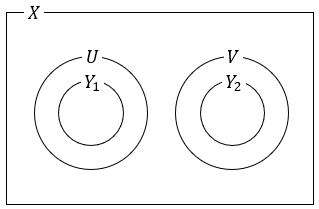
Here $Y = Y_{1} \cup Y_{2}$. No matter how much topology one has studied, when it is only said to be a subset, it is not easy to imagine a shape that is separated like this. Rather than memorizing it word for word, let us recall the definition of disconnectedness itself and accept it as a fact.
[3]
The condition $\displaystyle \bigcap_{\alpha \in \forall} A_{\alpha} \ne \emptyset$ means that, even if we do not know exactly which element it is, at least one point connects all of them. It may help to picture several pieces of cloth pinned to a wall and embedded there by a single nail piercing through all of them.
[4]
The condition $\displaystyle A_{n} \cap \left( \bigcup_{i=1}^{n-1} A_{i} \right) \ne \emptyset$ means that the subspaces are connected even if only through several intermediaries. It may help to picture something that, like a chain, is not linked at every single ring but is connected as a whole. One can take it as the condition on the sets themselves being relaxed, in exchange for the given sets in Theorem [3] being restricted to a countable set.
For reference, Theorems [3] and [4] hold without any problem even if ‘connected’ is replaced by ‘path-connected’.
Proof
[1]
Assume that $\overline{Y}$ is a disconnected space.
Then there exists a surjective and continuous function $f : \overline{Y} \to \left\{ a, b \right\}$. Consider $f|_{Y} : Y \to \left\{ a, b \right\}$, which restricts the domain of this function to only $Y$.
Since the discrete space $\left\{ a, b \right\}$ is not a connected space, by contraposition, either $Y$ is a disconnected space, or $f|_{Y}$ is not surjective, or it is not continuous. However, by premise $Y$ is a connected space and $f|_{Y}$ is still continuous, so $f|_{Y}$ must not be surjective.
[If $f$ is continuous, then for all $A \subset X$, $f( \overline{A} ) \subset \overline{ f(A) } $](../432)
That is, $f(Y) = \left\{ a \right\}$ or $f(Y) = \left\{ b \right\}$, and since $f$ is continuous, $f( \overline{Y}) \subset \overline{ f(Y) } \ne \left\{ a , b \right\}$. This contradicts the fact that $f$ is surjective, so $\overline{Y}$ must be a connected space.
■
Meanwhile, from this we can obtain the following useful corollary.
If a subspace $Y$ of a topological space $X$ is a connected space, then any $Z$ satisfying $Y \subset Z \subset \overline{Y}$ is a connected space.
[2]
$(\Rightarrow)$
Since $Y$ is a disconnected space, there exist nonempty open spaces $A , B$ in $Y$ satisfying $A \cap B = \emptyset$ and $A \cup B = Y$. Since $A$ and $B$ are open spaces, $$ U \cap Y =A \\ V \cap Y = B $$ there exist open spaces $U, V$ in $X$ satisfying the above. Therefore $$ U \cap Y \ne \emptyset \\ V \cap Y \ne \emptyset \\ U \cap V \cap Y = (U \cap Y) \cap (V \cap Y) = A \cap B = \emptyset $$ Meanwhile $Y = A \cup B \subset U \cup V$.
$(\Leftarrow)$
Suppose there exist open sets $U$ and $V$ of $X$ satisfying $$ U \cap Y \ne \emptyset \\ V \cap Y \ne \emptyset \\ U \cap V \cap Y = \emptyset \\ Y \subset U \cup V $$ If we let $$ A := U \cap Y \\ B := V \cap Y $$ then $A, B$ are nonempty open sets in $Y$. Meanwhile $$ A \cap B = (U \cap Y) \cap ( V \cap Y) = U \cap V \cap Y = \emptyset \\ A \cup B = (U \cap Y) \cup (V \cap Y) = ( U \cup V ) \cap Y = Y $$ Therefore $Y$ is a disconnected space.
■
[3]
Assuming $\displaystyle \bigcap_{\alpha \in \forall} A_{\alpha} \ne \emptyset$, suppose that $Y = \displaystyle \bigcup_{\alpha \in \forall} A_{\alpha}$ is a disconnected space. By Theorem [2], there exist open sets $U$ and $V$ of $X$ satisfying $$ U \cap Y \ne \emptyset \\ V \cap Y \ne \emptyset \\ U \cap V \cap Y = \emptyset \\ Y \subset U \cup V $$ Then $$ (U \cap A_{\alpha} ) \cup (V \cap A_{\alpha} ) = (U \cup V) \cap A_{\alpha} = A_{\alpha} \\ (U \cap A_{\alpha} ) \cap (V \cap A_{\alpha} ) = ( U \cap V) \cap A_{\alpha} = \emptyset $$ However, since $A_{\alpha}$ was assumed to be a connected space, one of the two, $(U \cap A_{\alpha} )$ or $(V \cap A_{\alpha} )$, must be the empty set. Since it does not matter whether it is $U$ or $V$, let us just say $(V \cap A_{\alpha} ) = \emptyset$. Since $(V \cap A_{\alpha} ) = \emptyset$ for arbitrary $A_{\alpha}$, $$ V \cap \bigcap_{\alpha \in \forall} A_{\alpha} = \emptyset $$ Writing this cleanly again, $V \cap Y = \emptyset$, which contradicts the hypothesis.
■
[4]
For a natural number $n \le 2$, let $\displaystyle B_{n} := \bigcup_{i = 1}^{n-1} A_{i}$.
Since $A_{1}$ is a connected space, $B_{2}$ is also a connected space, and by mathematical induction, $B_{n}$ is a connected space. $$ \emptyset \ne A_{2} \cap A_{1} \subset A_{1} \subset B_{n-1} \subset B_{n} $$ so $$ \bigcap_{n=2}^{\infty} B_{n} \ne \emptyset $$ By Theorem [3], $\displaystyle \bigcup_{n = 1}^{\infty} A_{n} = \bigcup_{n = 2}^{\infty} B_{n}$ is a connected space.
■