Symmetric Group in Abstract Algebra
Definition 1
For a set $A$, a bijection $\phi : A \to A$ is called a permutation. $S_{A}$ is the set collecting all permutations of $A$, and it forms a group $\left< S_{A} , \circ \right>$ under function composition $\circ$, called the symmetric group.
Explanation
The fact that the symmetric group really satisfies the conditions of a group can be easily verified from the fact that permutations are defined as bijections. The case of main interest is when $A$ is a finite set, that is when $|A| = n$, and it is usually denoted by $S_{A} = S_{n}$.
Symmetry of a Triangle
Permutations are essentially not different from what is learned in high school. Let us consider $A = \left\{ 1,2,3 \right\}$. Since the number of elements is $3$, the order of the symmetric group $S_{3}$ is $3! = 6$. Since there are not many, let us list them all one by one. The representation is similar to a matrix, where an element in row $1$ is mapped to an element in row $2$. $$ \rho_{0} = \begin{bmatrix} 1 & 2 & 3 \\ 1 & 2 & 3 \end{bmatrix} \qquad \rho_{1} = \begin{bmatrix} 1 & 2 & 3 \\ 2 & 3 & 1 \end{bmatrix} \qquad \rho_{2} = \begin{bmatrix} 1 & 2 & 3 \\ 3 & 1 & 2 \end{bmatrix} \\ \mu_{1} = \begin{bmatrix} 1 & 2 & 3 \\ 1 & 3 & 2 \end{bmatrix} \qquad \mu_{2} = \begin{bmatrix} 1 & 2 & 3 \\ 3 & 2 & 1 \end{bmatrix} \qquad \mu_{3} = \begin{bmatrix} 1 & 2 & 3 \\ 2 & 1 & 3 \end{bmatrix} $$
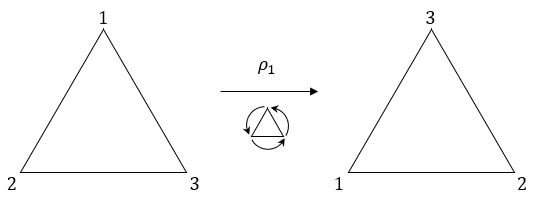
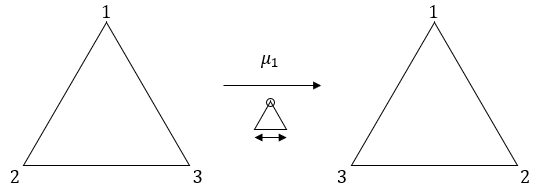
Representing this as a figure gives the following:
- $\rho_{k}$ rotates the triangle counterclockwise by $\displaystyle {{2 k \pi} \over {n}}$ for $|A| = n$. Here $\rho_{0}$ is the rotation that has no effect on the figure, and it becomes the identity element in the symmetric group. The reason for using $\rho$ is that $r$ was taken from rotation.
- $\mu_{k}$ fixes $k$ and swaps the remaining two points with each other. Alternatively, one may describe it as reflecting across an auxiliary line passing through $1$ and the center, as if in a mirror. The reason for using $\mu$ is that $m$ was taken from mirror Image.
It Is Not an Abelian Group
For $n \ge 3$, $S_{n}$ is not an Abelian group.
One of the interesting properties of the symmetric group is that it is not an Abelian group.
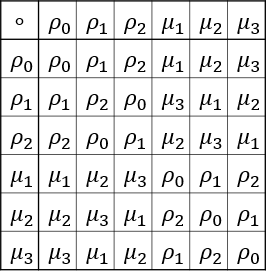
The table above shows all the operations of $S_{3}$. For example, $\rho_{1} \circ \mu_{1} = \mu_{3}$, while $\mu_{1} \circ \rho_{1} = \mu_{2}$. That is, $$ \rho_{1} \circ \mu_{1} \ne \mu_{1} \circ \rho_{1} $$ and therefore $S_{3}$ is not an Abelian group. For a real proof, it suffices to show through mathematical induction that every $S_{n}$ has such a counterexample.
Fraleigh. (2003). A first course in abstract algebra(7th Edition): p76~79. ↩︎