
Coriolis Force (Deflecting Force)
Definition1
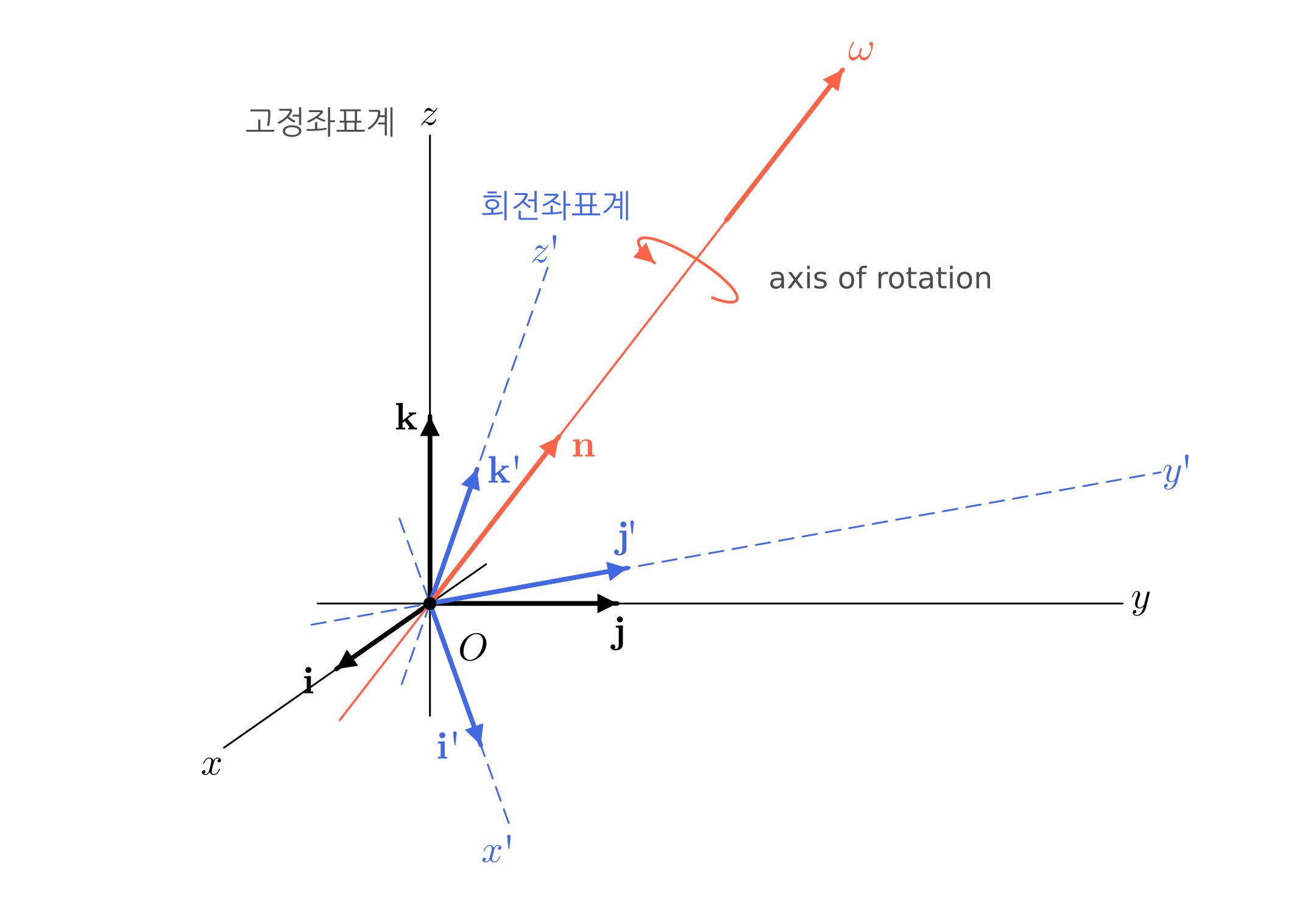
Consider an inertial frame $Oxyz$ and a coordinate system $Ox^{\prime}y^{\prime}z^{\prime}$ sharing the same origin and rotating relative to it with angular velocity $\boldsymbol{\omega}$. Let $\mathbf{n}$ be the unit vector along the axis of rotation and $\omega$ the angular speed; then the angular velocity of the rotating frame is $\boldsymbol{\omega} = \omega \mathbf{n}$, and its direction is determined by the right-hand rule, as in the definition of the cross product. $\mathbf{i}^{\prime}, \mathbf{j}^{\prime}, \mathbf{k}^{\prime}$ are the basis of the rotating frame, and unlike the basis $\mathbf{i}, \mathbf{j}, \mathbf{k}$ of the inertial frame, they change with time. Let the position, velocity, and acceleration of a particle of mass $m$ measured in the rotating frame be $\mathbf{r}^{\prime}, \mathbf{v}^{\prime}, \mathbf{a}^{\prime}$ respectively, and let $\mathbf{F}$ be the sum of the forces actually acting on the particle in the inertial frame. The equation of motion of the particle observed in the rotating frame is as follows.
$$ m \mathbf{a}^{\prime} = \mathbf{F} - m \dot{\boldsymbol{\omega}} \times \mathbf{r}^{\prime} - m \boldsymbol{\omega} \times \left( \boldsymbol{\omega} \times \mathbf{r}^{\prime} \right) - 2 m \boldsymbol{\omega} \times \mathbf{v}^{\prime} \tag{1} $$
The terms on the right-hand side other than the real force $\mathbf{F}$ are called inertial forces or fictitious forces, and among them, the term proportional to the velocity of the particle is called the Coriolis force.
$$ \mathbf{F}_{\text{Cor}} := - 2 m \boldsymbol{\omega} \times \mathbf{v}^{\prime} $$
Explanation
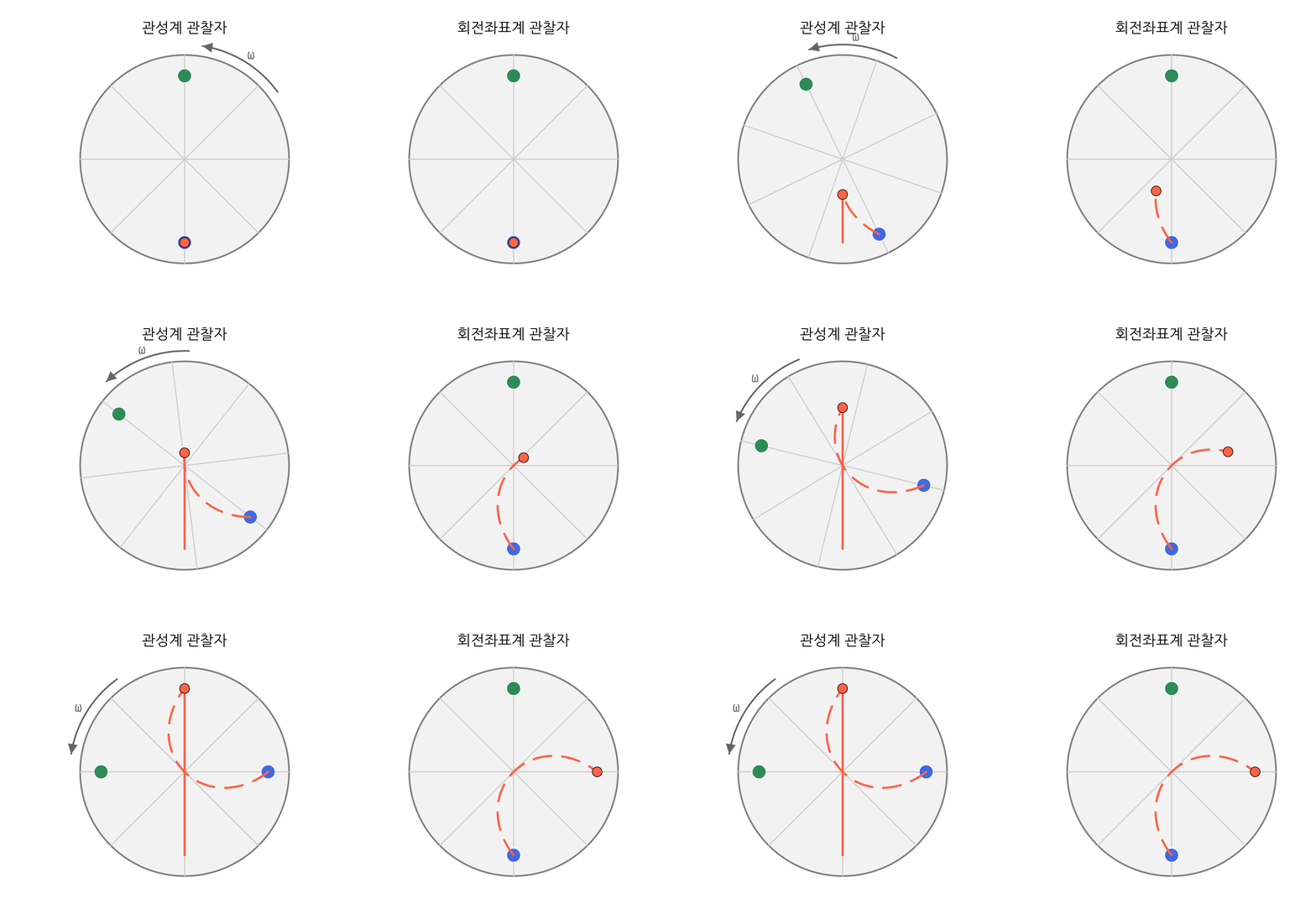
Put simply, the Coriolis force is this. If you throw an object straight on a rotating frame, it flies in a straight line in the inertial frame, but to an observer rotating with the frame, the path appears to curve sideways. The force this observer perceives as the cause of the curving is the Coriolis force. The figure and video below show well how observers outside and inside a rotating frame, respectively, perceive the trajectory of an object thrown on the rotating frame. The observer on the rotating frame clearly threw the object straight, but since the frame itself is rotating, the trajectory of the object appears curved. On the other hand, to a person watching from outside the rotating frame, the object appears to simply move in a straight line.
The Coriolis force is perpendicular to both the angular velocity $\boldsymbol{\omega}$ and the velocity $\mathbf{v}^{\prime}$. If $\alpha$ is the angle between the two vectors, its magnitude is $2m\omega v^{\prime} \sin\alpha$, and it vanishes when the particle is at rest relative to the rotating frame ($\mathbf{v}^{\prime} = \mathbf{0}$) or moves parallel to the axis of rotation ($\mathbf{v}^{\prime} \parallel \boldsymbol{\omega}$). It is the only inertial force that depends on the velocity, and since it is always perpendicular to the velocity, it does no work on the particle. That is, the Coriolis force does not change the speed but only bends the direction of motion. When viewed from above the axis of rotation, if the frame rotates counterclockwise, the Coriolis force acts to the right of the direction of motion.
The factor 2 arises from the superposition of two effects. One is the effect that, because the basis $\mathbf{i}^{\prime}, \mathbf{j}^{\prime}, \mathbf{k}^{\prime}$ of the rotating frame turns with time, the same velocity vector $\mathbf{v}^{\prime}$ changes by $\boldsymbol{\omega} \times \mathbf{v}^{\prime}$ when seen in the inertial frame; the other is the effect that, as the particle moves with $\mathbf{v}^{\prime}$, the position $\mathbf{r}^{\prime}$ changes, so the velocity $\boldsymbol{\omega} \times \mathbf{r}^{\prime}$ due to the rotation of the frame changes at the rate $\boldsymbol{\omega} \times \mathbf{v}^{\prime}$. The two terms add with equal magnitude to give $2\boldsymbol{\omega} \times \mathbf{v}^{\prime}$.
Since the Earth rotates with angular speed $\omega \approx 7.29 \times 10^{-5},\mathrm{rad/s}$, a coordinate system fixed to the Earth’s surface is a rotating frame. At a point of latitude $\lambda$, if we decompose $\boldsymbol{\omega}$ into a vertical component $\omega \sin\lambda$ and a horizontal component $\omega \cos\lambda$ pointing north, the horizontal component of the Coriolis force on a horizontally moving object comes only from the vertical component, and its magnitude is $2m\omega v^{\prime} \sin\lambda$. It acts to the right of the direction of motion in the Northern Hemisphere and to the left in the Southern Hemisphere, and it is $0$ at the equator.
Since the Earth’s rotation is slow, this force is very small. The Coriolis acceleration on an object moving at $10,\mathrm{m/s}$ at latitude $45^{\circ}$ is about $10^{-3},\mathrm{m/s^{2}}$, roughly one ten-thousandth of the gravitational acceleration. Therefore it can be neglected in motion of everyday scale, but in motion that takes place over long times and wide spaces, the effect accumulates and becomes pronounced. Examples include low-pressure systems in the Northern Hemisphere rotating counterclockwise, the plane of oscillation of a Foucault pendulum turning by $360^{\circ} \sin\lambda$ per day, long-range artillery shells deflecting to the right, and freely falling objects deflecting to the east. The story that the direction of the vortex when a bathtub drains differs by hemisphere is a common misconception; at that scale the Coriolis force is far smaller than the effects of the shape of the container or the initial flow of the water.
In meteorology and geography, it is called the deflecting force, in the sense that it changes the direction of motion. The name comes from the French engineer Gaspard-Gustave de Coriolis, who first described this force in 1835 while treating the mechanics of rotating machines.
Grant R. Fowles and George L. Cassiday. Analytical Mechanics (7th Edition, 2005), p196-201. ↩︎