
Precision Matrix
Definition1
For a univariate distribution, the reciprocal $\frac{1}{\sigma^{2}}$ of the variance $\sigma^{2}$ is called the precision.
For a multivariate distribution, the inverse matrix $\Lambda := \Sigma^{-1}$ of the covariance matrix $\Sigma$ is called the precision matrix.
Explanation
Like the covariance matrix, the precision matrix is a symmetric matrix. For the precision matrix to exist, the covariance matrix must be an invertible matrix, and since a covariance matrix is always positive semi-definite, this is equivalent to the covariance matrix being positive definite.
Why Is It Called Precision?
Let us see why the inverse of the covariance is called precision through an example in $1$ dimension. For the normal distribution $N(0, \sigma^{2})$, $\sigma^{2}$ is called the variance of the distribution. Since variance is a measure of how spread out the data are from the mean, a smaller variance means the data are clustered more closely around the mean. Therefore, the reciprocal of the variance $\frac{1}{\sigma^{2}}$ can be understood as a measure of how closely the data are gathered around the mean. In a distribution with a very small variance, sampling data would yield nearly the same values every time, which is why it can be called precision.
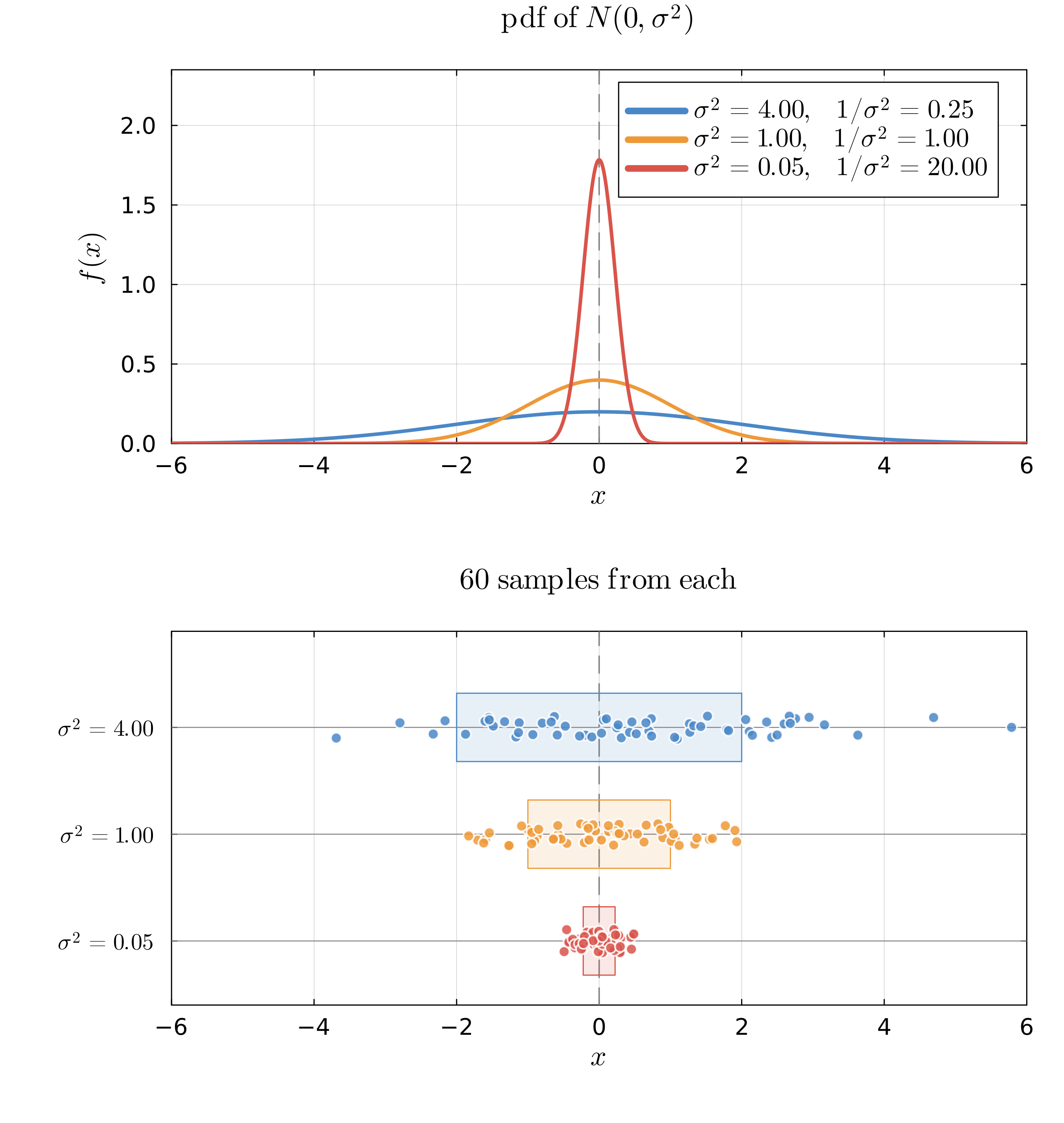
The figure above shows, side by side, the probability density functions of normal distributions with variances $4$, $1$, and $0.05$, together with $60$ samples drawn from each distribution. One can see that the larger the precision $\frac{1}{\sigma^{2}}$, the more the samples are concentrated in a narrow interval around the mean $0$.
Extending this to $n$ dimensions, the variance generalizes to the covariance matrix $\Sigma$, and the reciprocal of the variance generalizes to the inverse matrix $\Sigma^{-1}$ of the covariance matrix.
Properties
(a) The precision matrix $\Lambda$ is a symmetric matrix and a positive definite matrix.