
Leaky ReLU
Definition1
In machine learning, the following function is called the leaky rectified linear unit (Leaky ReLU).
$$ \operatorname{LeakyReLU}(x) := \begin{cases} x & x \gt 0 \\ \alpha x & x \le 0 \end{cases} $$
Here $\alpha$ is a small positive constant, usually taken to be $0.01$.
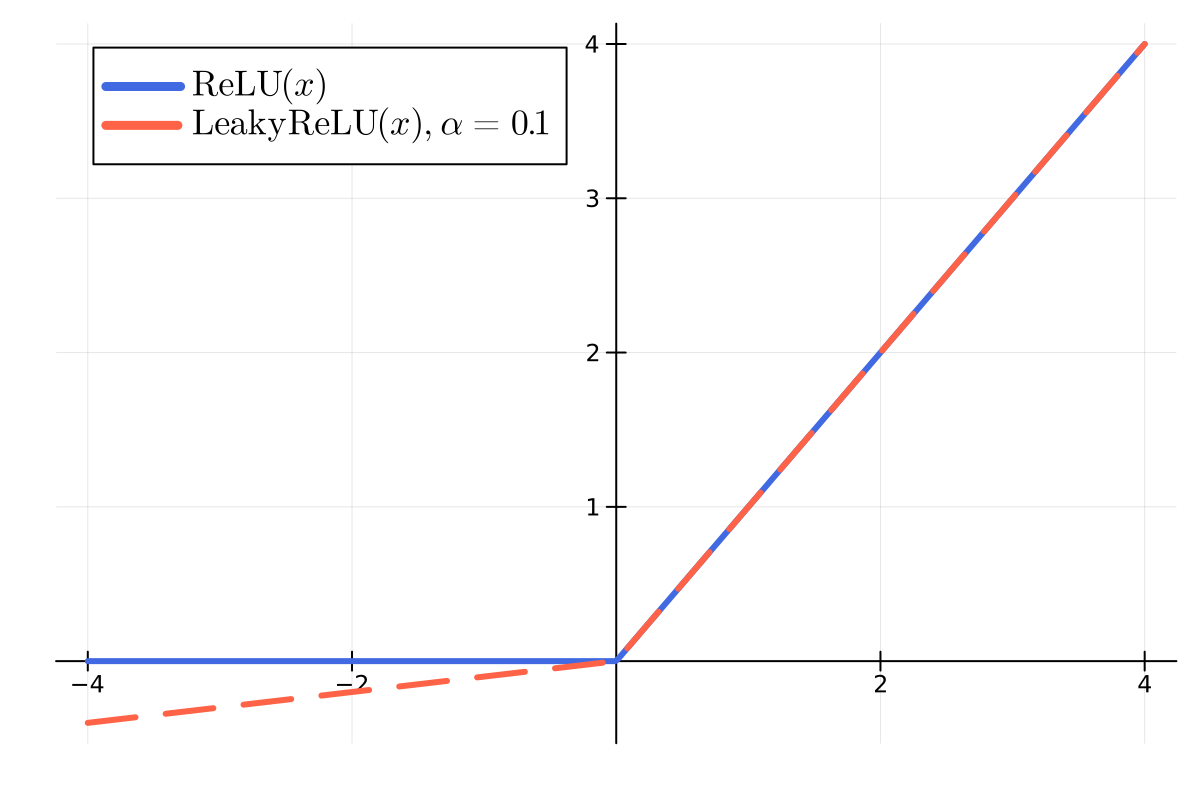
In the figure, $\alpha = 0.1$ is used so that the shape is clearly visible.
Explanation
The Leaky ReLU is a variant of the $\operatorname{ReLU}$, proposed by Maas, Hannun, and Ng in 2013 in their work on acoustic models for speech recognition1. The name ’leaky’ comes from the fact that, unlike the $\operatorname{ReLU}$, which completely blocks negative inputs and maps them to $0$, it lets negative inputs ’leak through’ little by little via a small slope $\alpha$.
Since the $\operatorname{ReLU}$ has both output and gradient equal to $0$ in the negative region, if the input to some neuron always ends up being negative during training, no gradient flows through that neuron at all and it is never updated again. This is called the dying $\operatorname{ReLU}$ problem, and the Leaky ReLU avoids it by leaving a gradient $\alpha \gt 0$ in the negative region as well. The original paper used $\alpha = 0.01$.
Meanwhile, a variant in which the slope $\alpha$ is treated not as a fixed constant but as a learnable parameter, the $\operatorname{PReLU}$ (parametric ReLU), was subsequently proposed as well2.
Properties
Various Representations3
When $0 \lt \alpha \lt 1$, it can be expressed in various ways as follows.
$$ \begin{align*} \operatorname{LeakyReLU}(x) &:= \begin{cases} x & x \gt 0 \\ \alpha x & x \le 0 \end{cases} \\[1em] &= \max \left\{ \alpha x, x \right\} \\[1em] &= \operatorname{ReLU}(x) - \alpha \operatorname{ReLU}(-x) \\[1em] &= \alpha x + (1 - \alpha) \operatorname{ReLU}(x) \end{align*} $$
In particular, according to the last expression, the Leaky ReLU is a convex combination of the identity function $x$ and the $\operatorname{ReLU}$, that is, the ramp function.
Derivative
The derivative is as follows.
$$ \operatorname{LeakyReLU}^{\prime}(x) = \begin{cases} 1 & x \gt 0 \\ \alpha & x \lt 0 \end{cases} $$
If $\alpha \ne 1$, it is not differentiable at $x = 0$, but as with the $\operatorname{ReLU}$, this is not a problem in practice. In implementations, the slope at that point may simply be set to $\alpha$ or $1$.
Other Properties
For $c \ge 0$, $\operatorname{LeakyReLU}(cx) = c \operatorname{LeakyReLU}(x)$ holds.
Invertibility: If $\alpha \gt 0$, it is an increasing function and hence a bijection, and its inverse is a Leaky ReLU whose slope in the negative region is $1/\alpha$. Writing $\operatorname{LeakyReLU}_{\alpha}$ with the slope of the negative region made explicit, we have the following.
$$ \left( \operatorname{LeakyReLU}_{\alpha} \right)^{-1} = \operatorname{LeakyReLU}_{1/\alpha} $$
See Also
Maas, Andrew L., Awni Y. Hannun, and Andrew Y. Ng. Rectifier nonlinearities improve neural network acoustic models. Proc. icml. Vol. 30. No. 1. 2013. ↩︎ ↩︎
He, Kaiming, et al. Delving deep into rectifiers: Surpassing human-level performance on ImageNet classification. Proceedings of the IEEE international conference on computer vision. 2015. ↩︎