Hyperbolic Tangent
Definition
Among the hyperbolic functions, the function defined below as the ratio of the hyperbolic sine to the hyperbolic cosine is called the hyperbolic tangent, commonly abbreviated as $\tanh$.
$$ \tanh x := \frac{\sinh x}{\cosh x} = \frac{e^{x} - e^{-x}}{e^{x} + e^{-x}} = \frac{e^{2x} - 1}{e^{2x} + 1} $$
Properties
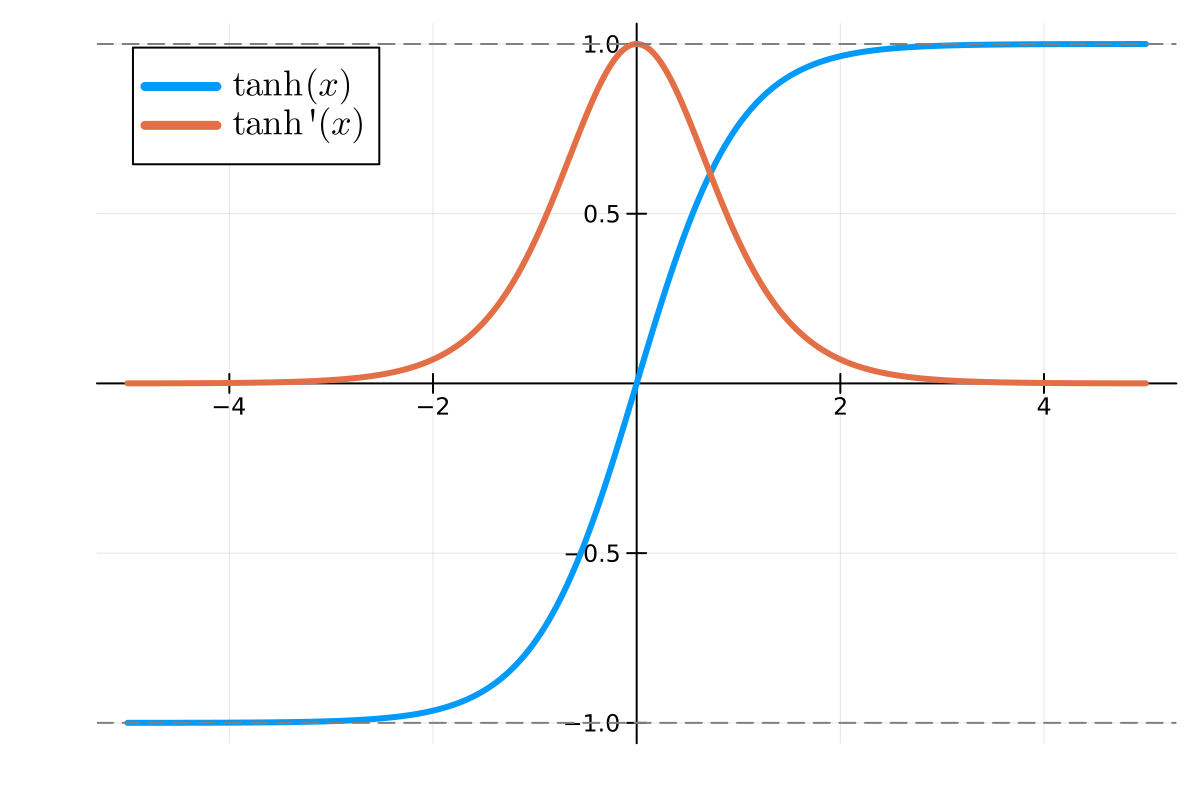
Range: The range is $(-1, 1)$, and as $x \to \pm\infty$, $\tanh x \to \pm 1$ asymptotically.
Odd function: $\tanh(-x) = -\tanh x$. In particular, since $\tanh 0 = 0$, the graph passes through the origin.
Derivative: The following holds. $$ (\tanh x)^{\prime} = 1 - \tanh^{2} x = \operatorname{sech}^{2} x $$ The derivative attains its maximum value $1$ at $x = 0$, and converges to $0$ as $|x|$ grows.
Relationship with the Sigmoid
It has the following relationship with the logistic sigmoid function $\sigma(x) = \dfrac{1}{1 + e^{-x}}$.
$$ \tanh x = 2\sigma(2x) - 1 $$
In other words, the hyperbolic tangent is the sigmoid stretched vertically so that its range moves from $(0, 1)$ to $(-1, 1)$, and translated so that it becomes symmetric about the origin.
$\tanh$ as an Activation Function
The hyperbolic tangent is one of the nonlinear activation functions widely used in artificial neural networks. Compared to the sigmoid, it has the following properties.
- Zero-centered: Since the sigmoid’s range $(0, 1)$ is always positive, the mean of its output deviates from $0$; but $\tanh$ has the range $(-1, 1)$, symmetric about the origin, so its output is distributed around $0$. This stabilizes the learning of the next layer.
- Larger gradient: As seen above, the derivative of $\tanh$ is at most $1$, whereas the derivative of the sigmoid cannot exceed $1/4$. Therefore $\tanh$ is relatively less vulnerable to gradient vanishing than the sigmoid.
However, since $\tanh$ also has the saturation property that its derivative approaches $0$ as $|x|$ grows, gradient vanishing still appears when layers are stacked very deeply. For this reason, the saturation-free $\operatorname{ReLU}$ family is mainly used in neural networks today, but $\tanh$ is still used when the network is not that deep or when one wants to restrict the range.