
Unit Cell
Definition1 2
A small unit that fills the whole space without gaps by repeating an identical arrangement and can represent a crystal structure is called a unit cell. The description of the relative positions of the points within a unit cell is called a basis.
Mathematical Definition
In the three-dimensional space $\mathbb{R}^{3}$, for a given lattice $L = \left\{ n_{1}\mathbf{a}_{1} + n_{2}\mathbf{a}_{2} + n_{3}\mathbf{a}_{3} \mid n_{i} \in \mathbb{Z} \right\}$, let the translation vector be $\mathbf{t} = m_{1}\mathbf{a}_{1} + m_{2}\mathbf{a}_{2} + m_{3}\mathbf{a}_{3}$ (where $n_{i}$ are arbitrary integers).
For a closed subset $U \subset \mathbb{R}^{3}$ of the whole space, if there exists $\left\{ \mathbf{ t}_{k} \right\}$ satisfying the following, then $U$ is called a unit cell
- $\bigcup_{k} (U + \mathbf{t}_{k}) = \mathbb{R}^{3}$
- For $k \neq \ell$, $(U + \mathbf{t}_{k})^{\circ} \cap (U + \mathbf{t}_{\ell})^{\circ} = \varnothing$
Here $+$ is the sum of sets, and $A^{\circ}$ is the interior of the set $A$.
The set of relative coordinates expressing the points within the unit cell $U$ of the lattice $L$ as linear combinations of the primitive lattice vectors $\mathbf{a}_{i}$ is called a basis.
$$ \mathbf{r}_{j} = x_{j} \mathbf{a}_{1} + y_{j} \mathbf{a}_{2} + z_{j} \mathbf{a}_{3}, \quad j = 1, 2, \ldots, N $$
Here $0 \le x_{j}, y_{j}, z_{j} \le 1$.
Explanation
Simply put, a unit cell is a subset that can represent the whole space without gaps and without overlaps by being translated and appended. Expressing the conditions of a unit cell in general terms gives the following.
- It covers the whole space without gaps.
- They do not overlap one another.
Each coordinate of the basis represents the coordinate at which each atom is located in the actual crystal structure. Therefore, the size of the basis $| \left\{ \mathbf{r}_{j} \right\} | = N$ signifies the number of atoms within the unit cell.
There is an important point when indicating how many lattice points there are within a unit cell. It is that for a lattice point located on the boundary, one must consider what fraction of that point is actually contained within the cell. In figure $(a)$ below, suppose the gray box on the left is the unit cell. Consider the lattice point $p_{1}$ at the center of the cell. For $p_{1}$, one can choose an arbitrary neighborhood $N_{\epsilon}(p_{1})$ that is contained in the unit cell $U$. In such a case, $p_{1}$ is ‘1’ lattice point.
On the other hand, for points on the boundary of the unit cell, such as $p_{2}$, one cannot choose a neighborhood contained in the unit cell for any $\epsilon$. In such a case, the count of $p_{2}$ becomes less than $1$. Specifically, for a neighborhood with a suitably small radius, since the ratio of the volume of the intersection with the unit cell to the volume of the neighborhood is $\frac{1}{4}$, this lattice point is $\frac{1}{4}$ of a lattice point within the unit cell. Therefore, the unit cell in $(a)$ contains a total of $1 + 4\cdot\frac{1}{4} = 2$ lattice points. Alternatively, one may understand it as: when the entire lattice is filled by translations of the unit cell, if a lattice point spans $n$ unit cells, then that lattice point should be counted as $\frac{1}{n}$.
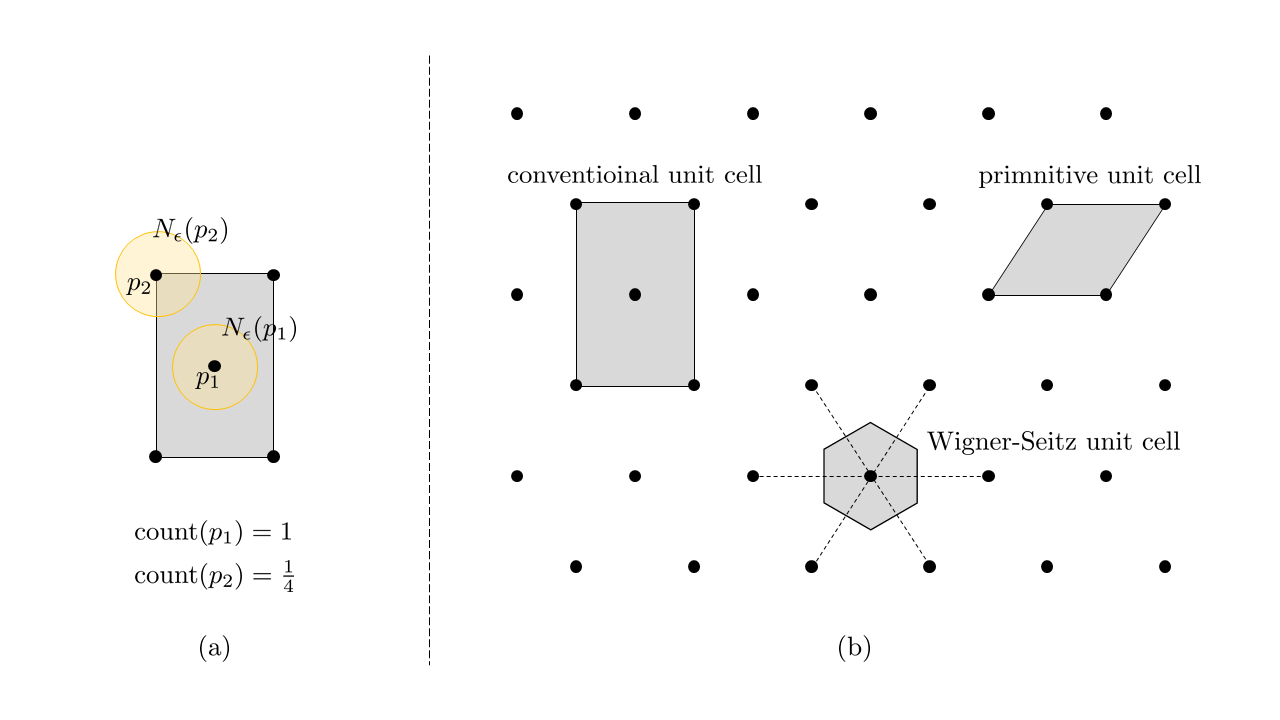
Whereas the unit cell in figure $(a)$ contains two lattice points, in figure $(b)$ the primitive unit cell and the Wigner-Seitz unit cell contain only $1$ lattice point.
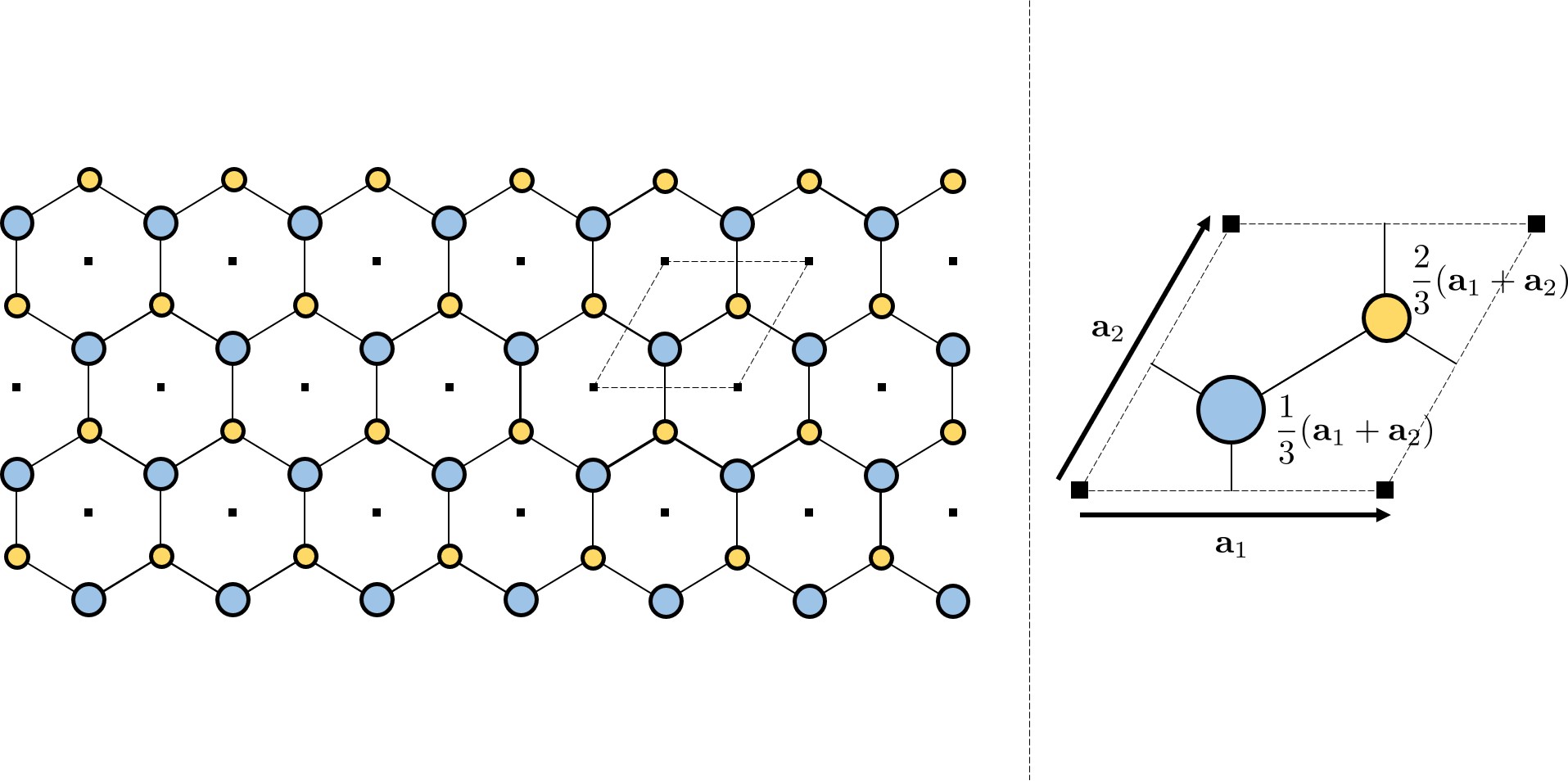
Any complex crystal structure can be described using a lattice, a unit cell, and a basis. The lattice represents the macroscopic repeating pattern of the crystal structure, while the basis represents how the atoms are locally arranged. A good example for understanding this is the honeycomb structure. Contrary to intuition, a honeycomb structure such as the one in the figure below is by definition not a lattice. However, the honeycomb structure can be expressed with a lattice and a basis. Here, the set of black dots within the hexagons of the honeycomb is the lattice, and the region formed by the dashed lines becomes the unit cell. And the blue dot and the yellow dot are expressed within the unit cell as the coordinates $(\frac{1}{3}, \frac{1}{3})$ and $(\frac{2}{3}, \frac{2}{3})$ respectively, and these two coordinates are the basis.
Primitive Unit Cell
A cell containing only one lattice point is called a primitive unit cell. When the lattice is given as $L = \left\{ n_{1}\mathbf{a}_{1} + n_{2}\mathbf{a}_{2} + n_{3}\mathbf{a}_{3} \mid n_{i} \in \mathbb{Z} \right\}$, the set of primitive lattice vectors $\mathbf{a}_{i}$ naturally becomes a primitive unit cell.
Wigner-Seitz Unit Cell
Taking one reference lattice point, the region surrounded by the perpendicular bisector planes between that lattice point and its neighboring lattice points is called a Wigner-Seitz unit cell. By definition it naturally becomes a primitive unit cell, and there are no lattice points on its boundary.
Conventional Unit Cell
As the name suggests, a unit cell designated by convention for ease of handling is called a conventional unit cell. It is commonly taken to be a rectangular parallelepiped (rectangle).