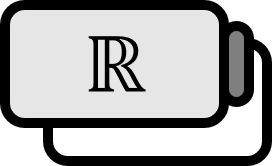
The Set of Real Numbers and the Empty Set Are Both Open and Closed
Theorem
$\mathbb{R}$ and $\emptyset$ are both open and closed.
Explanation
On the real numbers $\mathbb{R}$, the union of several open intervals is called an open set. For example, $(-1,0) \cup (2,3)$ is of course an open set, and $(0,1)$ or $\mathbb{R}$ are open sets as well. Meanwhile, being closed is defined through being open. For a subset $C$ of the real numbers, if $R \setminus C$ is open, then $C$ is called a closed set. As already stated in the given theorem, being open and being closed are not mutually exclusive. Therefore, ‘open’ does not mean ’not closed’, and likewise ‘closed’ does not mean ’not open’. The fact that these two states overlap in the set of real numbers and the empty set is quite an interesting story indeed.
Proof
Part 1. $\mathbb{R}$ and $\emptyset$ are open sets
Since $\mathbb{R} = (- \infty , \infty)$ can be expressed as $\displaystyle \bigcup_{n \in \mathbb{Z}} (n-1,n+1) = ( - \infty , \infty)$, it is an open set.
$$ \displaystyle \bigcup_{\alpha \in \emptyset} A_{\alpha} = \emptyset $$
The empty set is the union of $0$ open intervals, so by definition it is an open set. [ NOTE: If the vacuous truth is not satisfying or does not sit right with you, consider that $(x,x) = \emptyset$ for some real number $x \in \mathbb{R}$. ]
Part 2. $\mathbb{R}$ and $\emptyset$ are closed sets
Since $\emptyset = \mathbb{R} \setminus \mathbb{R}$ is open, $\mathbb{R}$ is closed.
Since $\mathbb{R} = \mathbb{R} \setminus \emptyset$ is open, $\emptyset$ is likewise closed.
■
Corollary
$\mathbb{R^n}$ and $\emptyset$ are both open and closed.
Meanwhile, this theorem also holds when the whole space is given as $\mathbb{R}^{n}$.