Crystal Structure
Definition1 2
An arrangement of atoms, molecules, ions, etc., that repeats periodically in three-dimensional space is called a crystal.
Mathematical definition
linearly independent $3$dimensional vectors $\mathbf{a}_{1} \in \mathbb{R}^{3}$ ($i = 1, 2, 3$). For these, the set of all points that are integer-coefficient linear combinations of them is called a lattice.
$$ \text{Lattice} := \left\{ n_{1} \mathbf{a}_{1} + n_{2} \mathbf{a}_{2} + n_{3} \mathbf{a}_{3} \mid n_{1}, n_{2}, n_{3} \in \mathbb{Z} \right\} \tag{1} $$
Here $\mathbf{a}_{i}$ is called a primitive lattice vector.
Explanation
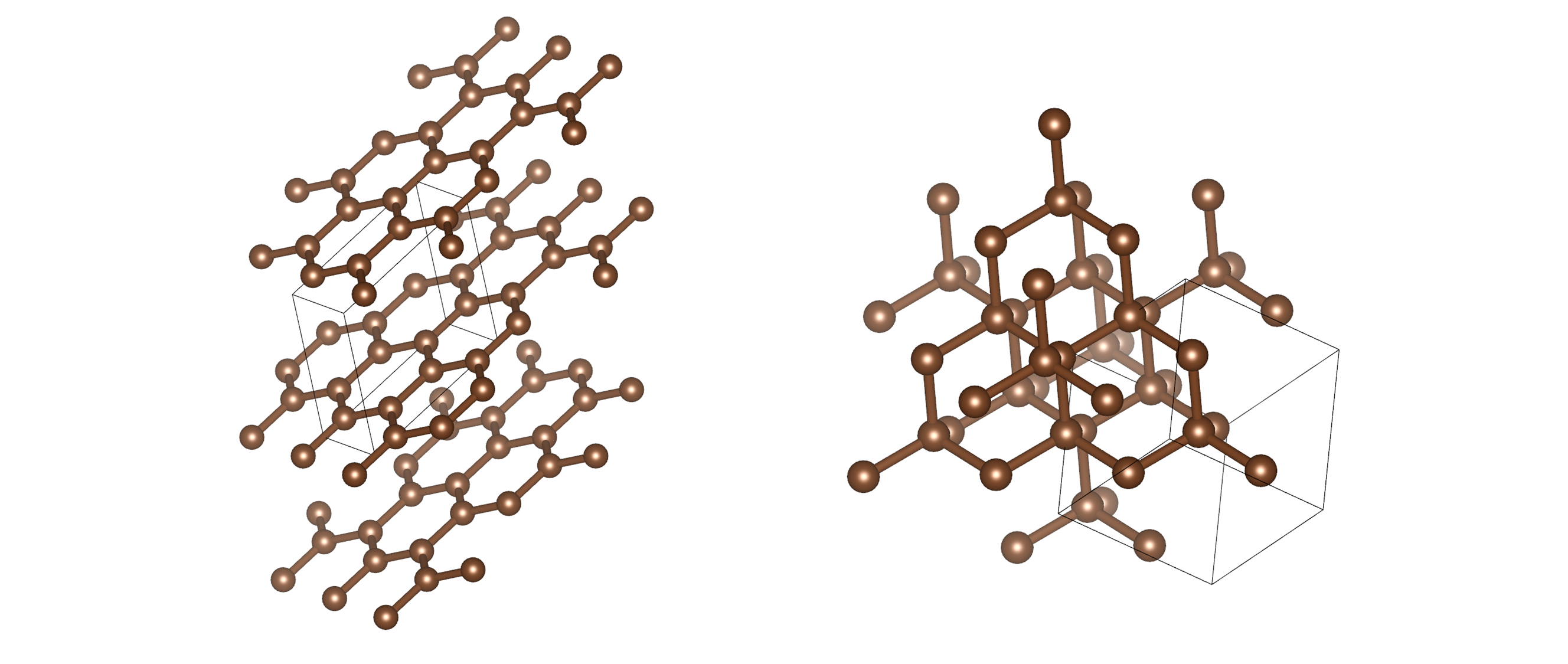
A crystal structure is the basic structural unit of a solid material; it refers to a configuration in which atoms or molecules are arranged regularly, and its geometry has a large influence on the material’s physical and chemical properties. For example, in the figure below, the left shows carbon atoms $\ce{C}$ repeating in a hexagonal planar arrangement, which is the crystal structure of graphite. In contrast, on the right carbon atoms $\ce{C}$ still repeat but are arranged three-dimensionally in the crystal structure of diamond. Although carbon is arranged regularly in both, graphite is soft and electrically conductive, whereas diamond is hard and an insulator, depending on the structure.
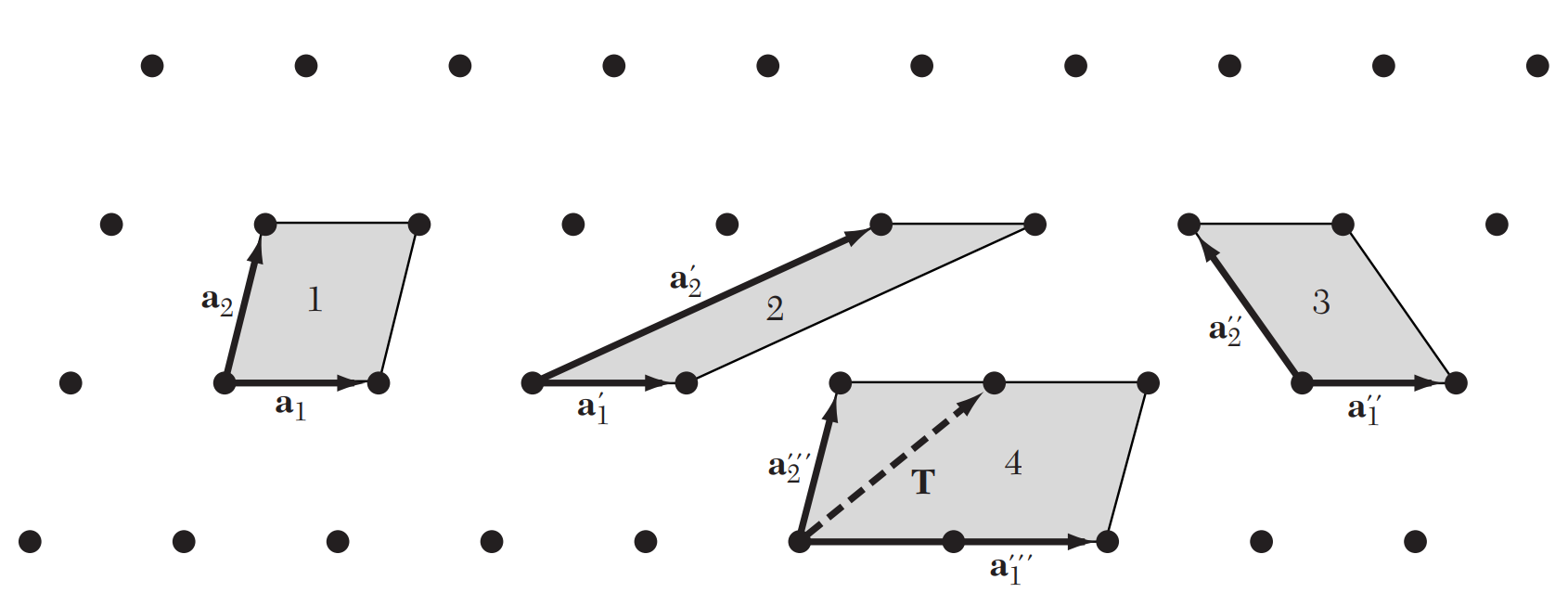
Because a crystal structure consists of a repeating arrangement of atoms, it can be expressed easily in mathematical terms. Definition $(1)$ is described with three-dimensional space in mind, but lattices in two or one dimension are defined in the same way. Primitive lattice vectors are also called primitive basis vectors or primitive translation vectors. As shown in the figure below3, the primitive lattice vectors $\mathbf{a}_{i}$ for the same lattice are not unique.
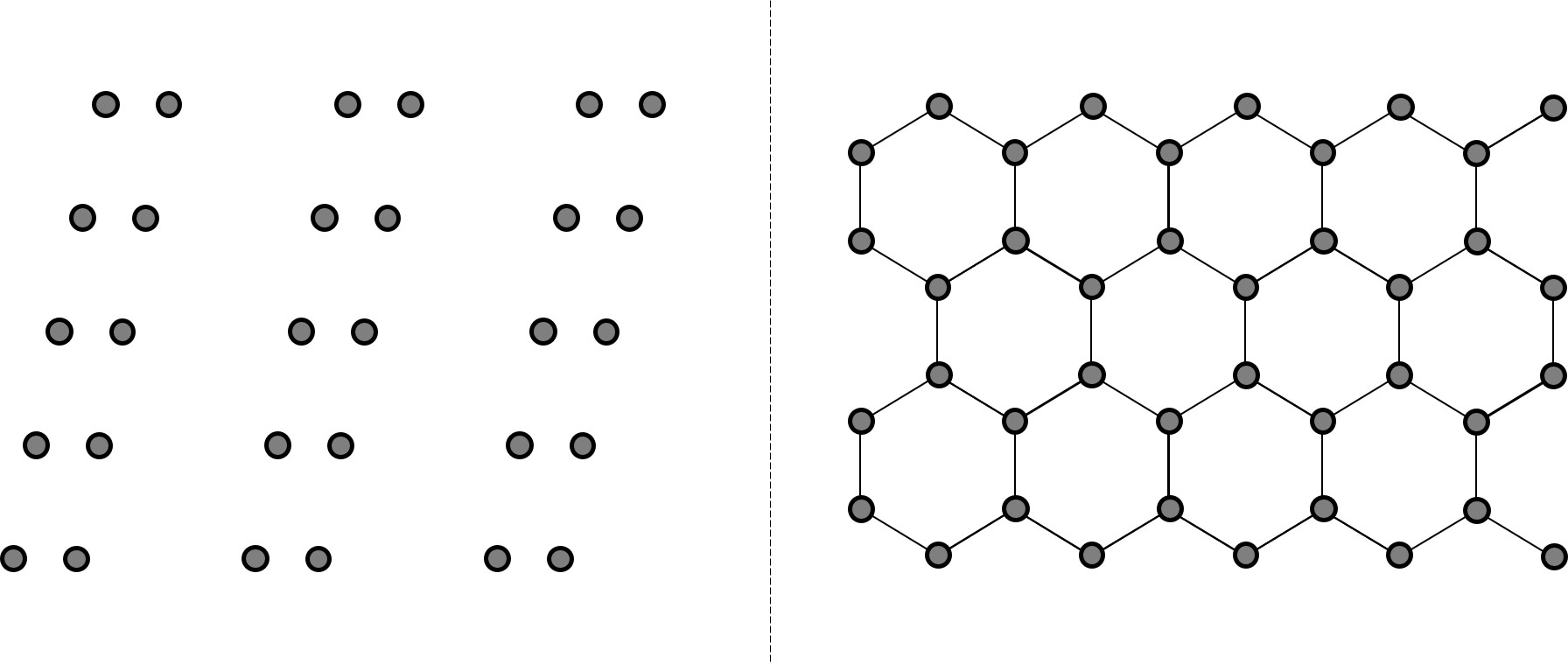
However, a lattice alone is not sufficient to represent a crystal structure. For instance, in the left figure below or in the honeycomb structure on the right, the same pattern clearly repeats, but the points do not satisfy the definition of a lattice. Therefore, to represent an arbitrary complex crystal structure, the concepts of unit cell and basis are required.