
seq2seq Model
Definition
The composition of an encoder, which maps a sequence of input vectors $\left\{ \mathbf{x}_{1}, \mathbf{x}_{2}, \dots, \mathbf{x}_{T_{x}} \right\}$ $(\mathbf{x}_{t} \in \mathbb{R}^{n})$ to a context vector $\mathbf{c} \in \mathbb{R}^{d_{c}}$, and a decoder, which maps the context vector to a sequence of output vectors $\left\{ \mathbf{y}_{1}, \mathbf{y}_{2}, \dots, \mathbf{y}_{T_{y}} \right\}$ $(\mathbf{y}_{t} \in \mathbb{R}^{p})$, is called a sequence-to-sequence model, or seq2seq for short. Expressing the encoder and decoder each as functions gives the following.
$$ \begin{align*} \operatorname{Encoder} : \left( \mathbb{R}^{n} \right)^{T_{x}} &\to \mathbb{R}^{d_{c}} \\ \left\{ \mathbf{x}_{t} \right\}_{t=1}^{T_{x}} &\mapsto \mathbf{c} \end{align*} $$
$$ \begin{align*} \operatorname{Decoder} : \mathbb{R}^{d_{c}} &\to \left( \mathbb{R}^{p} \right)^{T_{y}} \\ \mathbf{c} &\mapsto \left\{ \mathbf{y}_{t} \right\}_{t=1}^{T_{y}} \end{align*} $$
The seq2seq model is the composition of these two.
$$ \operatorname{seq2seq} := \operatorname{Decoder} \circ \operatorname{Encoder} : \left\{ \mathbf{x}_{1}, \mathbf{x}_{2}, \dots, \mathbf{x}_{T_{x}} \right\} \mapsto \left\{ \mathbf{y}_{1}, \mathbf{y}_{2}, \dots, \mathbf{y}_{T_{y}} \right\} $$
- Here $T_{x}, T_{y} \in \mathbb{N}$ are the lengths of the input sequence and the output sequence, respectively, and they need not be equal.
Explanation
The seq2seq model is a neural network model with an encoder-decoder structure, proposed for machine translation in the paper “Sequence to Sequence Learning with Neural Networks” presented at NIPS 20141.
Recurrent neural networks (RNNs) are typically used as the encoder and decoder; the original paper specifically used LSTMs. The encoder reads the input sequence in temporal order, updating its hidden state $\mathbf{h}_{t}$. In general, the context vector can be defined as a function of the hidden states, $\mathbf{c} = q(\mathbf{h}_{1}, \dots, \mathbf{h}_{T_{x}})$; the original paper makes the simplest choice among these and uses the hidden state at the last time step directly as the context vector ($\mathbf{c} = \mathbf{h}_{T_{x}}$). The decoder takes $\mathbf{c}$ as its initial hidden state and generates output vectors one time step at a time, where the output of the previous time step is fed in as the input of the next time step. In practice, the output length $T_{y}$ is not fixed in advance; rather, the decoder keeps generating until it outputs a special token that signifies the end of the sequence.
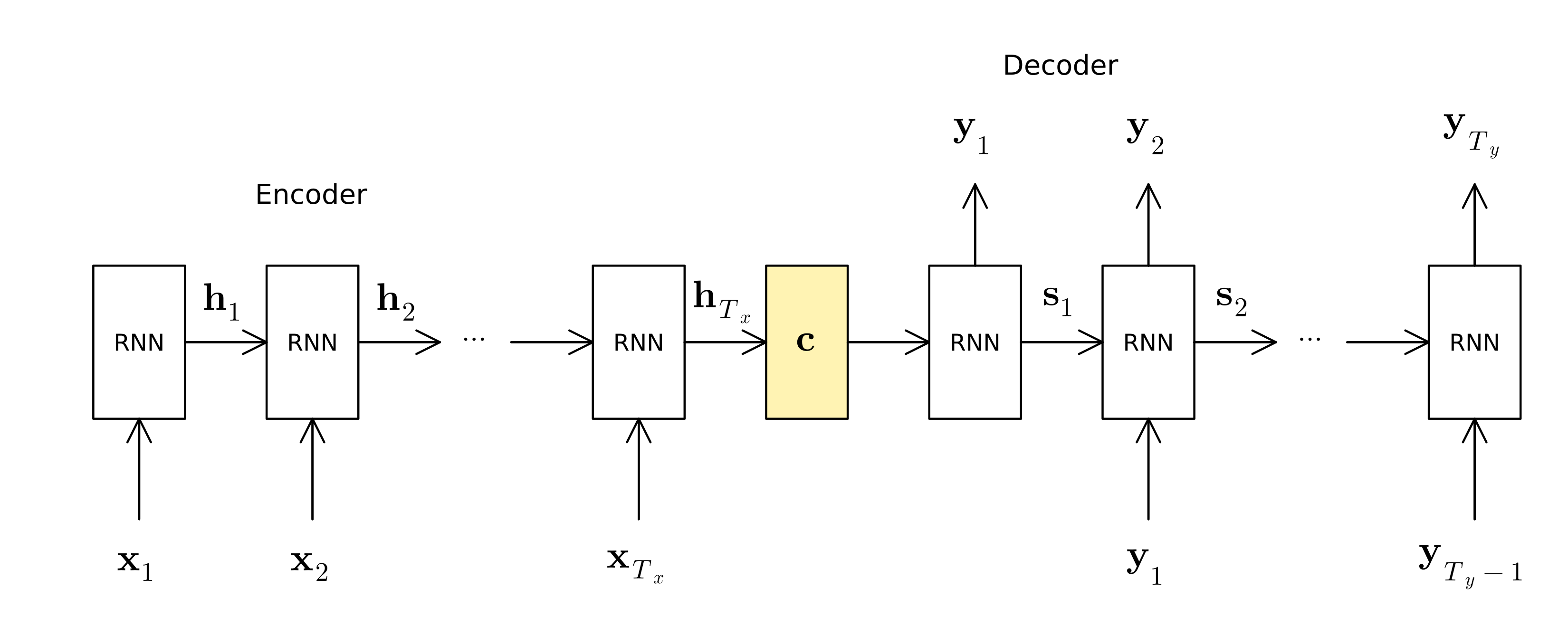
A characteristic of the seq2seq model, as mentioned in the definition, is that the input sequence and the output sequence need not have the same length ($T_{x} \ne T_{y}$). Considering machine translation, its representative application, this is an obviously required property: if we split the source text and its translation into tokens and embed them, as when translating “나는 학생이다” into “I am a student”, the lengths of the two sequences are generally different.
Meanwhile, the only information passed between the encoder and the decoder is the single context vector $\mathbf{c}$ of fixed dimension $d_{c}$. No matter how long the input becomes, its content must be squeezed into a single vector, so the longer the input, the greater the information loss—a bottleneck that can be seen as a structural limitation of the seq2seq model. To solve this problem, attention lets the decoder refer back to all of the encoder’s hidden states at every time step2, and going further, the transformer3 discards the recurrent structure entirely and processes sequences with attention alone.
See Also
Ilya Sutskever, Oriol Vinyals, and Quoc V. Le. “Sequence to sequence learning with neural networks.” Advances in neural information processing systems 27 (2014). ↩︎
Dzmitry Bahdanau, Kyunghyun Cho, and Yoshua Bengio. “Neural machine translation by jointly learning to align and translate.” arXiv preprint arXiv:1409.0473 (2014). ↩︎
Ashish Vaswani et al. Attention is all you need. Advances in neural information processing systems 30 (2017). ↩︎