
Circular Motion
Definition
Circular motion refers to the motion of a point particle that traces a circle while maintaining a constant distance from a fixed point.
Explanation
A typical example of circular motion is twirling an object attached to a string. It is convenient to introduce angular velocity when describing circular motion. Consider a particle moving on a circular orbit of radius $r$; let the angle measured from the $x$ axis be $\theta$. The time rate of change of $\theta$ is called angular velocity, and is usually denoted by $\omega$.
$$ \omega = \dfrac{d \theta}{d t} $$
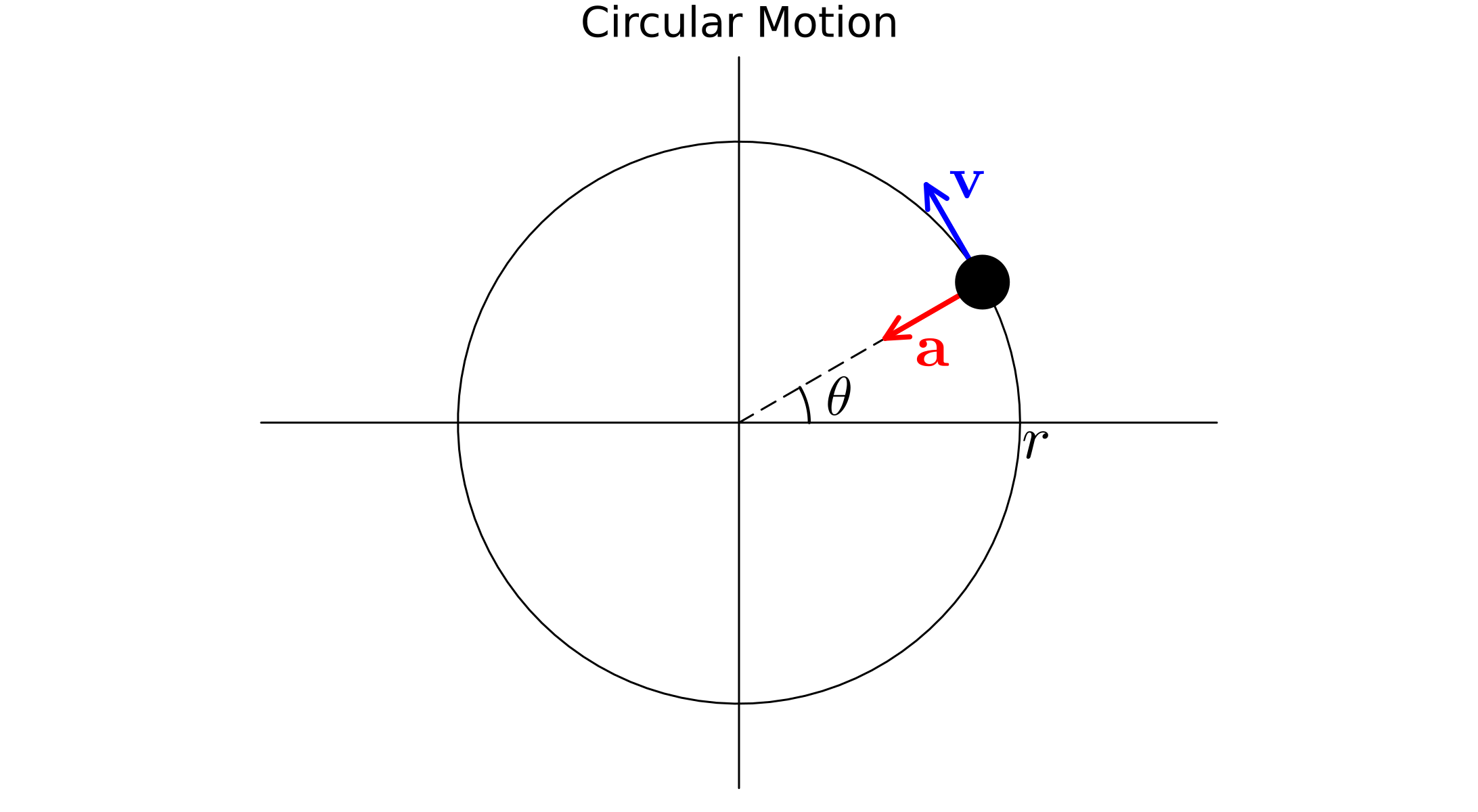
Uniform circular motion
Circular motion with constant speed is called uniform circular motion. Note that the velocity is not constant.
Uniform circular motion has the interesting property that the speed is constant while acceleration exists and the direction of the velocity is continuously changing. If the time it takes the particle to complete one revolution around the circle is $T$, called the period, then the angular velocity is
$$ \omega = \dfrac{2\pi}{T} = \dfrac{d\theta}{dt} = \dot{\theta} $$
The linear velocity in polar coordinates is
$$ \mathbf{v} = \dot{r}\hat{\mathbf{r}} + r\dot{\theta}\hat{\boldsymbol{\theta}} $$
Since the radius is constant, $\dot{r} = 0$. Therefore the relation between linear velocity and angular velocity is
$$ \mathbf{v} = r\dot{\theta}\hat{\boldsymbol{\theta}} = r \omega \hat{\boldsymbol{\theta}}, \quad v = | \mathbf{v} | = r\omega $$
The linear acceleration in polar coordinates is
$$ \mathbf{a} = (\ddot r -r\dot{\theta}^{2})\hat{\mathbf{r}} + (2\dot{r} \dot{\theta} + r\ddot{\theta})\hat{\boldsymbol{\theta}} $$
Here $\dot{r} = 0$, and because the motion is uniform circular motion $\ddot{\theta} = \dot{\omega} = 0$. Therefore, the acceleration of the particle in uniform circular motion is
$$ \mathbf{a} = -r\dot{\theta}^{2}\hat{\mathbf{r}} = -r\omega^{2}\hat{\mathbf{r}}, \quad a = |\mathbf{a}| = r\omega^{2} $$