Linear Function
Definition
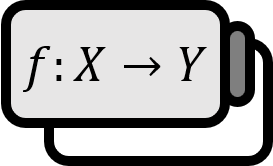
A function $f : X \to Y$ is said to be linear if it satisfies the following two conditions. For $x,x_{1},x_{2}\in X$ and $a \in \mathbb{R}$,
- $f(ax) = af(x)$
- $f(x_{1} + x_{2}) = f(x_{1}) + f(x_{2})$
Explanation
If it is not linear, it is said to be nonlinear. The two conditions are sometimes combined into a single expression as follows
$$ f(ax_{1} + x_{2}) = af(x_{1}) + f(x_{2}) $$
If in 2. the equality is replaced by less than or equal to $\le$, it is said to be quasilinear.
Bilinear
If a two-variable function $f = f(x,y)$ is linear with respect to each of its variables, it is said to be bilinear.
Multilinear
If a multivariable function $f= f(x_{1}, \dots, x_{n})$ is linear with respect to each of its variables, it is said to be multilinear.
$\mathbb{R}$-Linear
When one wants to make explicit that the scalars are taken from the real numbers, as in $a \in \mathbb{R}$ in the definition above, it is said to be $\mathbb{R}$-linear. Linear transformations between real vector spaces are of this kind. In general, if the scalar field is $\mathbb{F}$, it is called $\mathbb{F}$-linear.
$\mathbb{C}$-Linear
If the scalars are taken from the complex numbers and $f(az) = af(z)$ holds for every $a \in \mathbb{C}$, it is said to be $\mathbb{C}$-linear. Since the real numbers are complex numbers, being $\mathbb{C}$-linear automatically implies being $\mathbb{R}$-linear, but the converse does not hold. The function $f(z) = \overline{z}$ that returns the complex conjugate is a counterexample: for a real number $a$ we have $\overline{az} = a\overline{z}$, so it is $\mathbb{R}$-linear, but for the imaginary unit $i$ the equality breaks down as shown below.
$$ f(iz) = \overline{iz} = \overline{i}\overline{z} = -i\overline{z} = -if(z) $$