
What Is an Operator in Physics (Quantum Mechanics)?
Introduction
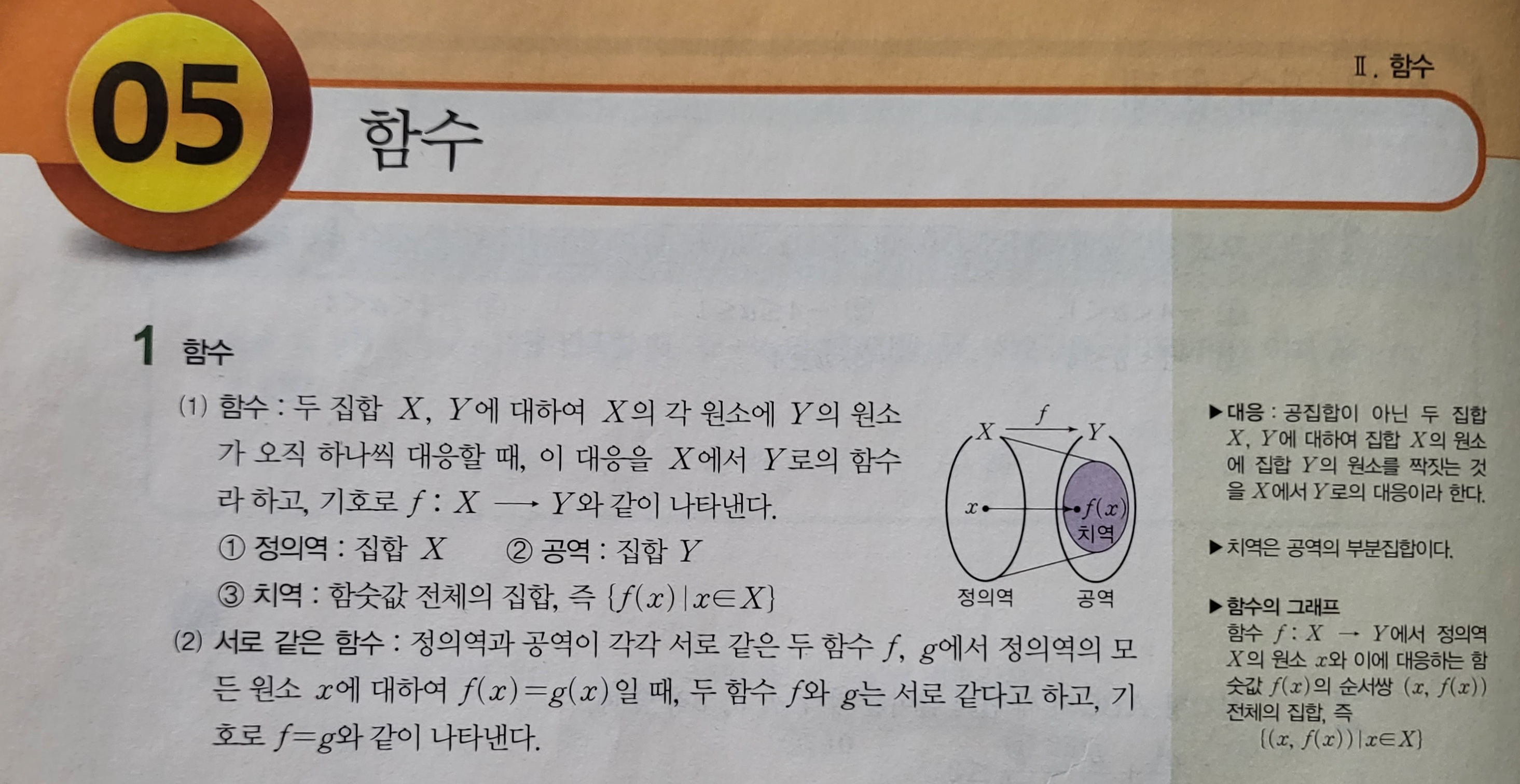
In mathematics, a function is a relation that assigns to each element of some set $X$ exactly one element of some set $Y$, and it is commonly denoted by $f$, taking the first letter of “function.” If $f$ is the function that assigns the element $x$ of the set $X$ to the element $y$ of the set $Y$, we write it as follows.
$$ y = f(x) $$
If that relation is given concretely in terms of $x$, it is expressed as in the following examples.
$$ y = 3x^{3} -2 x^{2} + x + 1 \quad \text{and} \quad y = e^{3x} \quad \text{and} \quad y = 5 \cos x $$
Many students in science and engineering probably think of a function as a relation between some number $x$ and some number $y$, as above. That is because almost all of the functions they actually encounter are like this. But as you can see from the definition above, a function does not necessarily have to connect a number with a number. In other words, it does not matter if the sets $X$ and $Y$ are not sets made up of numbers. For instance, one can think of a function that connects some function with a number, and this can be encountered as the concept of action when learning Hamilton’s principle in classical mechanics.
When you substitute a function into some function and consequently get some number, that function is called a functional. For example, the function $F$ defined as below is a functional.
$$ {\color{blue}F\big( {\color{orange}f(x)} \big)} := {\color{red} \int_{1}^{2} f(x) dx} $$
That is, the function $F$ takes as its function value the definite integral of some function from $1$ to $2$. If we actually carry out the computation,
$$ {\color{blue}F( {\color{orange} e^{x} })} = \int_{1}^2 e^x dx = {\color{red}e^2-e},\quad {\color{blue}F({\color{orange}x^2})}=\int_{1}^2 x^{2} dx = {\color{red}\frac{7}{3} } $$
Now let us go a little further and let the sets $X$ and $Y$ be sets of functions. Even in this case, we can think of a function that assigns $X$ to $Y$. A concrete example of such a function is differentiation. Let the function $f$ be differentiation. Then $f$ becomes the function that assigns the quadratic polynomial $x^{2} + 3x + 1$ to the linear polynomial $2x + 3$.
$$ f\left( x^{2} + 3x + 1 \right) = 2x + 3 $$
Such an $f$ is commonly called the differential operator, and it is denoted as $D = \dfrac{d}{dx}$. This time, let the function $g$ be the indefinite integral. Then $g$ becomes the function that assigns $\cos x$ to $\sin x$ (let us omit the constant of integration).
$$ g(\cos x) = \sin x $$
However, the phrase “a function that assigns functions to functions” has the word function appearing repeatedly, which is easy to confuse and is not a good expression. Therefore, in quantum mechanics such a function is called by the following special name.
Definition
In quantum mechanics, a function that assigns a (wave) function to a (wave) function is specifically called an operator.
Explanation
The operator appears in the field of mathematics called functional analysis, where it is translated under the name operator. The definition above is not the rigorous definition of an operator, but for physics students who have not studied a mathematics major, this much is sufficient.
The reason the del operator is called an operator is also related to the definition above. For example, the gradient $\nabla$ is an operator that assigns a scalar function $f$ to the vector function $\left( \dfrac{\partial f}{\partial x}, \dfrac{\partial f}{\partial y}, \dfrac{\partial f}{\partial z} \right)$. This is the reason why Live Shrimp Sushi Restaurant emphasizes not to think of the del operator as a vector.
In quantum mechanics, to distinguish operators from classical physical quantities, they are marked with a hat ($\ \hat{}\ $) or written in uppercase. For example, the momentum operator is written as follows.
$$ p = p_{\text{op}} = \hat{p} = P $$
When there is no room for misunderstanding, it is sometimes written simply as $p$. The types of operators include the following.
- position operator $X$
- momentum operator $P$
- angular momentum operator $L_{z}$
- ladder operator $L_{\pm}$
- energy operator, the Hamiltonian $H$
Example
In quantum mechanics, a wave function is a function that describes the state of motion of some particle according to time and position. Suppose the wave function of some particle is $\psi = \psi (x,t) = A e ^{i(kx+\omega t) }$. To avoid confusion with the momentum $p$, the momentum operator is written as $P$ or $P$. Given a wave function $\psi$, this operator is the one that assigns the function obtained by multiplying the wave function by this particle’s momentum $p$. Expressing this in a formula gives the following.
$$ P (\psi) = P \psi = p \psi $$
In this case, it is common to omit the parentheses as above. This is because substituting the wave function $\psi$ into the operator $P$ can be treated like the product of two matrices. If we view the above expression as a matrix product, it becomes an eigenvalue equation, and the wave function $\psi$ and the momentum $p$ become the eigenfunction and eigenvalue of the momentum operator $P$. The momentum operator is specifically as follows.
$$ P = \dfrac{\hbar}{\i}\dfrac{\partial}{\partial x} $$
Substituting the wave function $\psi$ into the operator above, we can confirm that we obtain the momentum $p=\hbar k$ as follows.
$$ P(\psi) = P\psi = \frac{\hbar}{\i}\frac{\partial }{\partial x} \left( \psi \right) = \frac{\hbar}{\i}\frac{\partial \psi}{\partial x} = (\i k)\frac{\hbar}{\i}\psi = p \psi $$
Physical Interpretation
As explained above, mathematically an operator is merely a function (or a matrix), but in quantum mechanics this is interpreted as the observation of a physical quantity. Then the eigenvalue equation below is interpreted as follows: for the wave function (eigenfunction) $\psi$, when some physical quantity is measured as $\hat{Q}$, its value is $q$.
$$ \hat{Q}\psi = q\psi $$
That is, to put it simply, $\hat{Q}$ can be seen as the act of me stepping onto a scale, $\psi$ as me (the person), and $q$ as the measured body weight.