Rikitake Attractor
Model1
The following is the governing equation of the Rikitake attractor.
$$ \begin{align*} \dot{x} =& -\mu x + y z \\ \dot{y} =& -\mu y + (z - a) x \\ \dot{z} =& 1 - x y \end{align*} $$
Parameters
- $a = 1.7$
- $\mu = 0.7$
Explanation
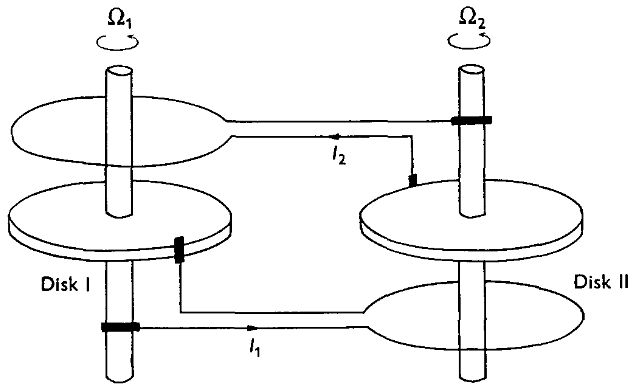
The name Rikitake may seem unfamiliar at first glance, but it actually comes from Tsuneji Rikitake, a Japanese geophysicist. It is said to be related to a dynamo using two disks, and indeed, looking at Rikitake’s paper, there is a process in which it is derived as an ordinary differential equation for current and resistance2.
Attractor
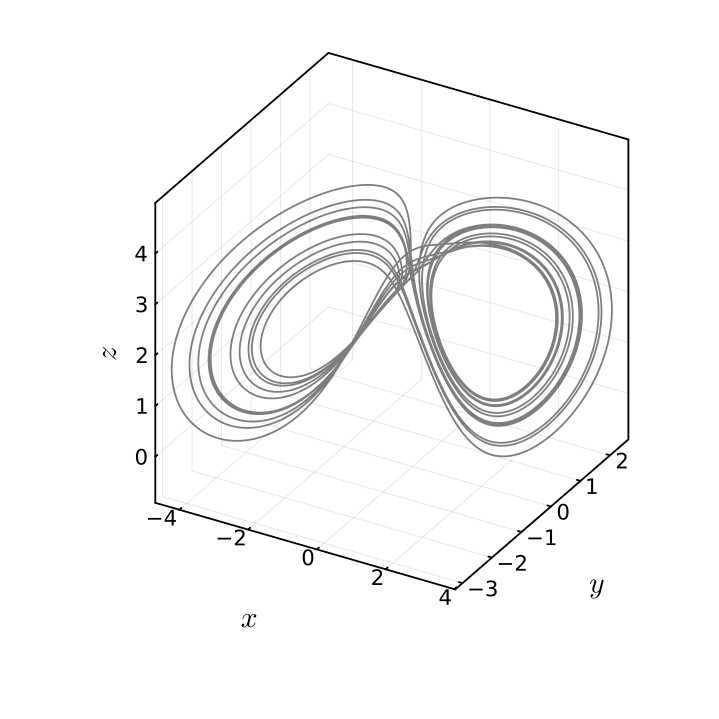
As an attractor, it has a shape that looks like the Lorenz attractor flipped upside down. If the Lorenz attractor resembles slanted eyes, the Rikitake attractor resembles drooping eyes, and since its complexity is not high, there is nothing that could be called a distinctive feature of the Rikitake attractor itself.
Code
The following is Julia code that simulates the Rikitake attractor.
using DataFrames, DifferentialEquations, OrdinaryDiffEqLowOrderRK

function factory_rikitake(μ::Number; ic = [0.1, 0.1, 0.1], saveat = 0:1e-2:100)
    a = 1.7
    function sys(du, u, p, t)
        x, y, z = u
        μ = p[1]

        du[1] = -μ*x + y*z
        du[2] = -μ*y + (z - a)*x
        du[3] = 1 - x*y
        return du
    end
    sol = solve(ODEProblem(sys, ic, (0, last(saveat)), [μ]), RK4(), dt = saveat.step.hi, adaptive=false, maxiters = Inf)
    dsol = [sol.k[2][1] stack([solk[2] for solk in sol.k[2:end]])]
    matrix = [sol.t sol[:, :]' dsol']
    return matrix[sol.t .≥ first(saveat), :][1:end-1, :]
end
factory_rikitake(T::Type, args...; kargs...) =
DataFrame(factory_rikitake(args...; kargs...), ["t", "x", "y", "z", "dx", "dy", "dz"])


sol = factory_rikitake(DataFrame, 0.7, saveat = 900:1e-2:1000)
plot(sol.x, sol.y, sol.z, alpha = .5, color = :black, xlabel = L"x", ylabel = L"y", zlabel = L"z", size = [400, 400])
Llibre, J., & Messias, M. (2009). Global dynamics of the Rikitake system. Physica D: Nonlinear Phenomena, 238(3), 241-252. http://dx.doi.org/10.1016/j.physd.2008.10.011 ↩︎
Rikitake T. Oscillations of a system of disk dynamos. Mathematical Proceedings of the Cambridge Philosophical Society. 1958;54(1):89-105. https://doi.org/10.1017/S0305004100033223 ↩︎