Dadras Attractor
Model1
The following is the governing equation of the Dadras attractor.
$$ \begin{align*} \dot{x} =& y - a x + b y z \\ \dot{y} =& c y - x z + z \\ \dot{z} =& d x y - e z \end{align*} $$
Parameters
- $a = 2.6$
- $b = 2.7$
- $c = 1.8$
- $d = 3$
- $e = 7.4$
Explanation
Attractor
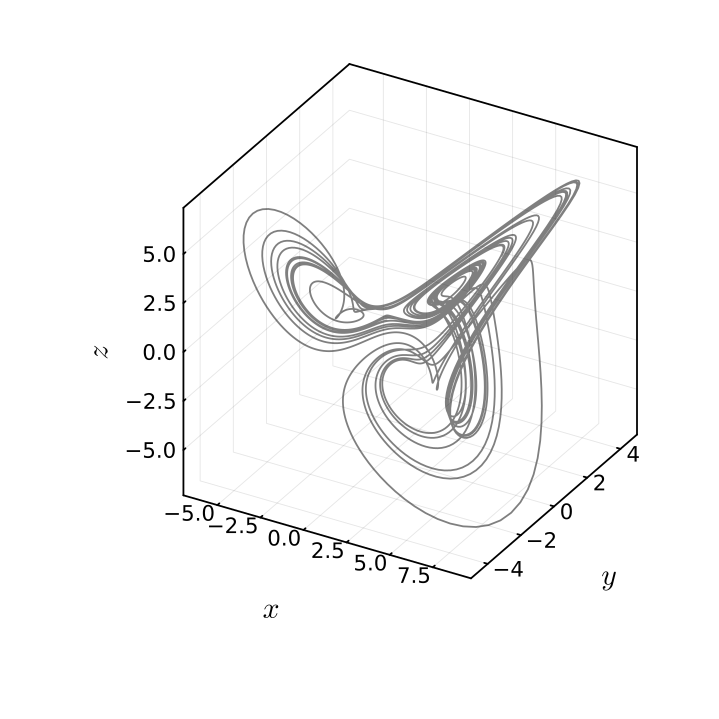
Looking at the strange attractor, it has a bizarre shape, as if yet another wing had sprouted from the butterfly shape of the Lorenz attractor.
Bifurcation
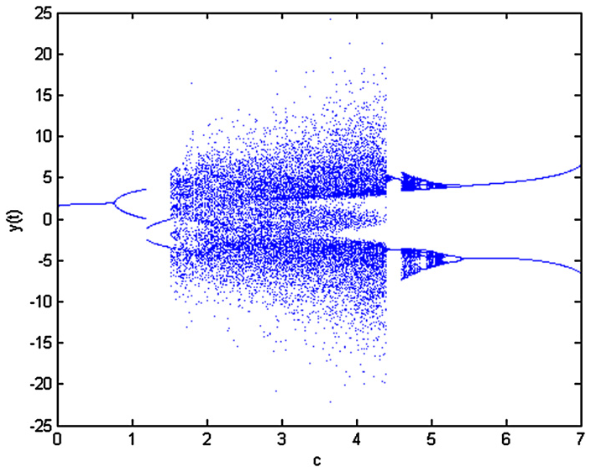
The Dadras attractor has at most only quadratic terms on its right-hand side, yet compared to other systems of similar complexity, it exhibits a distinctive bifurcation diagram.
Code
The following is Julia code that simulates the Dadras attractor.
using DataFrames, DifferentialEquations, OrdinaryDiffEqLowOrderRK

function factory_dadras(c::Number; ic = [0, 0, 2], saveat = 0:1e-2:100)
      a,   b, d,   e = (
    2.6, 2.7, 3, 7.4)
    function sys(du, u, p, t)
        x, y, z = u
        a = p[1]

        du[1] = y - a*x + b*y*z
        du[2] = c*y - x*z + z
        du[3] = d*x*y - e*z
        return du
    end
    sol = solve(ODEProblem(sys, ic, (0, last(saveat)), [c]), RK4(), dt = saveat.step.hi, adaptive=false, maxiters = Inf)
    dsol = [sol.k[2][1] stack([solk[2] for solk in sol.k[2:end]])]
    matrix = [sol.t sol[:, :]' dsol']
    return matrix[sol.t .≥ first(saveat), :][1:end-1, :]
end
factory_dadras(T::Type, args...; kargs...) =
DataFrame(factory_dadras(args...; kargs...), ["t", "x", "y", "z", "dx", "dy", "dz"])

sol = factory_dadras(DataFrame, 1.8, saveat = 900:1e-2:1000)
plot(sol.x, sol.y, sol.z, alpha = .5, color = :black, xlabel = L"x", ylabel = L"y", zlabel = L"z", size = [400, 400])
Dadras, S., & Momeni, H. R. (2009). A novel three-dimensional autonomous chaotic system generating two, three and four-scroll attractors. Physics Letters A, 373(40), 3637-3642. https://doi.org/10.1016/j.physleta.2009.07.088 ↩︎