📂Dynamical Systems
Bogdanov-Takens Bifurcation
Definition1
A bifurcation that occurs, with respect to two parameters, when the bifurcation curves of a homoclinic bifurcation and a Hopf bifurcation meet is called a Bogdanov-Takens bifurcation. Its normal form is as follows. $$ \begin{align*} \dot{\eta_{1}} =& \eta_{2} \\ \dot{\eta_{2}} =& \beta_{1} + \beta_{2} \eta_{1} + \eta_{1}^{2} - \eta_{1} \eta_{2} \end{align*} $$
Explanation
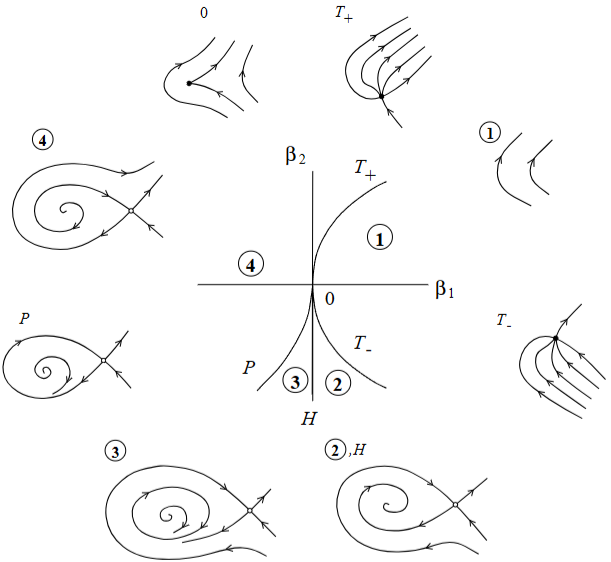
- ①: There is no fixed point at all.
- ① → ②: Crossing $T_{-}$, one saddle and one stable fixed point are created.
- ② → ③: Crossing $H$, the stability of the stable fixed point is reversed and one limit cycle is created. In other words, a supercritical Hopf bifurcation has occurred.
- $P$: The limit cycle meets the saddle and becomes a homoclinic orbit, and as a result a homoclinic bifurcation occurs.
- ④: The saddle and the limit cycle separate, leaving only an unstable fixed point and one saddle. Compared with ①, the stability of the non-saddle fixed point has been reversed.
Kuznetsov. (1998). Elements of Applied Bifurcation Theory: p314~325. ↩︎