Bautin Bifurcation
Definition1
A bifurcation in two parameters, in which the limit cycle of a Hopf bifurcation exhibits a pitchfork bifurcation as a bifurcation of limit cycles, is called a Bautin bifurcation. Its normal form is as follows. $$ \begin{align*} \dot{\rho} =& \rho \left( \beta_{1} + \beta_{2} \rho^{2} - \rho^{4} \right) \\ \dot{\phi} =& 1 \end{align*} $$ Here, $z = \rho e^{i \phi}$ is a complex number expressed in polar notation.
Explanation
In the following bifurcation diagram, the point where $\beta_{1} = \beta_{2} = 0$ is called the Bautin point.
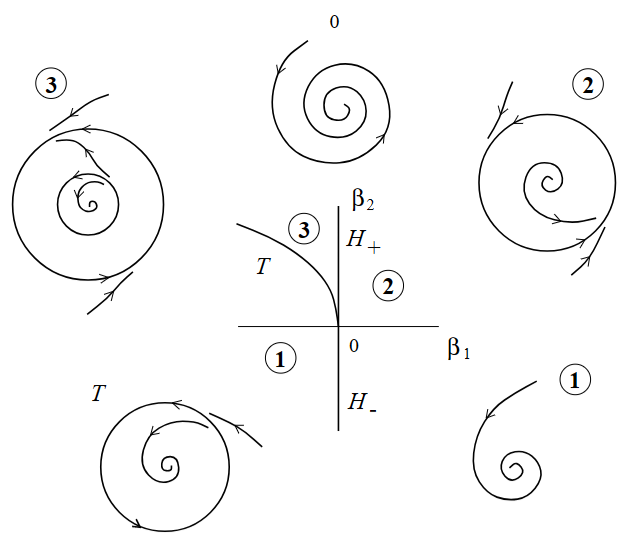
- ①: There is only one stable fixed point.
- ① → ②: Passing through $H_{-}$, the stability of the fixed point in ① is reversed and a single stable cycle appears. In other words, a supercritical Hopf bifurcation occurs.
- ②: There is only one stable cycle.
- ② → ③: Passing through $H_{+}$, an unstable cycle appears in ② and the existing unstable fixed point becomes stable. In other words, a pitchfork bifurcation has occurred in terms of cycles.
- ③: Two cycles exist.
Since the Bautin bifurcation highlights multiple cycles, it is also called the generalized Hopf bifurcation.
Kuznetsov. (1998). Elements of Applied Bifurcation Theory: p307~314. ↩︎