
Derivation of the Shallow Water Equations
Model1
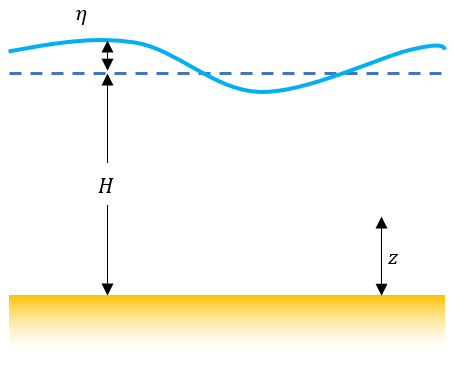
Consider a layer of incompressible fluid whose mean height above the ground surface is $H$. Let $\eta$ denote the displacement from that height, and let $u$ and $v$ denote the zonal and meridional currents, respectively. Then the governing equations for the flow velocity are written as follows. $$ \begin{align*} {\frac{ \partial \eta }{ \partial t }} + H \left( {\frac{ \partial u }{ \partial x }} + {\frac{ \partial v }{ \partial y }} \right) =& 0 \\ {\frac{ \partial u }{ \partial t }} + u {\frac{ \partial u }{ \partial x }} + v {\frac{ \partial u }{ \partial y }} - f v =& -g {\frac{ \partial \eta }{ \partial x }} \\ {\frac{ \partial v }{ \partial t }} + u {\frac{ \partial v }{ \partial x }} + v {\frac{ \partial v }{ \partial y }} + f u =& -g {\frac{ \partial \eta }{ \partial y }} \end{align*} $$ Here $f$ is the Coriolis frequency and $g$ is the gravitational acceleration.
Explanation
As the name suggests, the shallow water equations use the shallow $\eta$ in place of the very deep $H$, reflect water through the premise that the fluid is incompressible, and incorporate the Coriolis force, from which one can guess that they are particularly well suited to ocean models.
Derivation
This is not mathematically rigorous; think of it as merely grasping roughly how the equations arise.
Part 1. Pressure
We first consider the right-hand side that appears in equations of the Navier–Stokes type. The pressure at a point of height $z$ is as follows. $$ p = \rho g \left( H + \eta - z \right) $$ If we assume that $\rho$, $g$, and $H$ are all constants, its partial derivatives can be computed simply. $$ \begin{align*} {\frac{ \partial p }{ \partial x }} =& \rho g {\frac{ \partial \eta }{ \partial x }} \\ {\frac{ \partial p }{ \partial y }} =& \rho g {\frac{ \partial \eta }{ \partial y }} \end{align*} $$
Part 2. Incompressibility
Let $u, v, w$ be the velocities in the $x, y, z$ directions. From the premise of incompressibility $\nabla \cdot ( u, v, w) = 0$, we start with the following continuity equation. $$ \nabla \cdot ( u, v, w ) = {\frac{ \partial u }{ \partial x }} + {\frac{ \partial v }{ \partial y }} + {\frac{ \partial w }{ \partial z }} = 0 $$ Integrating this from $z = 0$ to $z = H + \eta$, we obtain the following by the fundamental theorem of calculus. $$ \left( H + \eta \right) {\frac{ \partial u }{ \partial x }} + \left( H + \eta \right) {\frac{ \partial v }{ \partial y }} + w (\eta) - w (0) = 0 $$ Since the flow velocity in the $z$ direction at the bottom is $0$, we have $w (0) = 0$, and since $w (\eta)$ equals the material derivative $D_{t} \eta$ of $\eta$, let us substitute it directly. $$ \begin{align*} & \left( H + \eta \right) {\frac{ \partial u }{ \partial x }} + \left( H + \eta \right) {\frac{ \partial v }{ \partial y }} + D_{t} \eta - 0 = 0 \\ \implies & \left( H + \eta \right) \left( {\frac{ \partial u }{ \partial x }} + {\frac{ \partial v }{ \partial y }} \right) + {\frac{ \partial \eta }{ \partial t }} + u {\frac{ \partial \eta }{ \partial x }} + v {\frac{ \partial \eta }{ \partial y }} = 0 \end{align*} $$ Applying the product rule $\left( p q \right) ' = p ' q + p q '$ in reverse here, this can be tidied up neatly. $$ {\frac{ \partial \eta }{ \partial t }} + {\frac{ \partial }{ \partial x }} \left[ u \left( H + \eta \right) \right] + {\frac{ \partial }{ \partial y }} \left[ v \left( H + \eta \right) \right] = 0 $$ Here $u \eta$ and $v \eta$ will be extremely small values compared to $Hu$ or $Hv$, which are multiplied by the water depth $H$, so they can be neglected.
Part 3. Coupling
The Navier–Stokes equations in which the partial derivatives of pressure have been replaced by partial derivatives of $\eta$ are as follows. $$ \begin{align*} {\frac{ \partial u }{ \partial t }} + u {\frac{ \partial u }{ \partial x }} + v {\frac{ \partial u }{ \partial y }} - f v =& -g {\frac{ \partial \eta }{ \partial x }} \\ {\frac{ \partial v }{ \partial t }} + u {\frac{ \partial v }{ \partial x }} + v {\frac{ \partial v }{ \partial y }} + f u =& -g {\frac{ \partial \eta }{ \partial y }} \end{align*} $$ Meanwhile, the partial differential equation expressing $\eta$ in terms of the flow velocity is as follows. $$ {\frac{ \partial \eta }{ \partial t }} + H \left( {\frac{ \partial u }{ \partial x }} + {\frac{ \partial v }{ \partial y }} \right) = 0 $$ Coupling these yields, as a result, the shallow water equations.
■
Kundu. (2008). Fluid mechanics(4th Edition): p627. ↩︎