Cusp Bifurcation
Definition12
A bifurcation in which, with respect to two parameters, a saddle-node bifurcation and a pitchfork bifurcation occur at a sharp point, a cusp, is called a cusp bifurcation. Its normal form is as follows. $$ \dot{u} = r u - u^{3} + h $$
Explanation
Among two-parameter bifurcations, the cusp bifurcation is relatively easy to understand. The following figure explains the cusp bifurcation most intuitively.
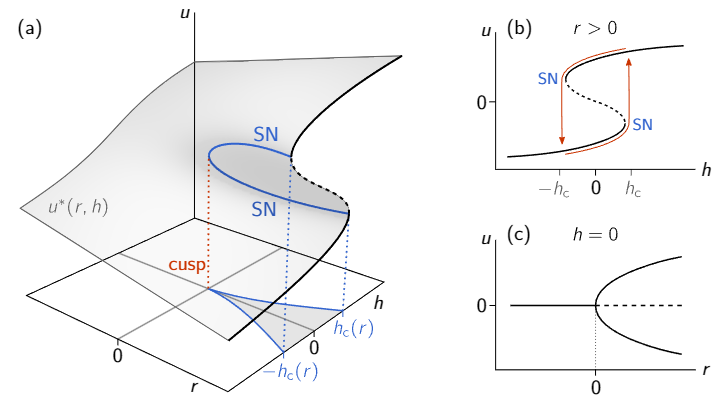
For $r > 0$, the system does not simply undergo a saddle-node bifurcation depending on $h$; it is characterized by exhibiting hysteresis. In a certain interval $\left( - h_{c} (r) , h_{c} (r) \right)$, the system has three fixed points, and these are in turn related to the pitchfork bifurcation.
Kuznetsov. (1998). Elements of Applied Bifurcation Theory: p301~306. ↩︎
Frey, E., & Brauns, F. (2022). Self-organization of protein patterns. In Active Matter and Nonequilibrium Statistical Physics: Lecture Notes of the Les Houches Summer School (pp. 347-445). Oxford University Press. https://doi.org/10.48550/arXiv.2012.01797 ↩︎