FitzHugh–Nagumo Model
Model1
The model obtained by taking only the essential elements of the Hodgkin–Huxley model, viewed as a fast-slow system, and simplifying it to a two-dimensional differential equation in the fast variable $v$ and the slow variable $w$ is called the FitzHugh–Nagumo model. $$ \begin{align*} \epsilon \dot{v} =& v ( 1 - v ) (v - \alpha) - w + I_{\text{app}} \\ \dot{w} =& v - \gamma w \end{align*} $$ A typical parameter setting is said to be $\alpha = 0.1$, $\gamma = 0.5$, $\epsilon = 0.01$.
Explanation2
Hodgkin–Huxley model: $$ \begin{align*} C_{m} \dot{V} =& - \bar{g}_{\text{Na}} m^{3} h \left( V - V_{\text{Na}} \right) - \bar{g}_{\text{K}} n^{4} \left( V - V_{\text{K}} \right) - \bar{g}_{\text{L}} \left( V - V_{\text{L}} \right) + I_{\text{app}} \\ \dot{m} =& \alpha_{m} (1 - m) - \beta_{m} m \\ \dot{n} =& \alpha_{n} (1 - n) - \beta_{n} n \\ \dot{h} =& \alpha_{h} (1 - h) - \beta_{h} h \end{align*} $$
In the Hodgkin–Huxley model, if we set $m$ to some constant $m_{0}$ and, from the relation $h + n \approx 0.8$, put $h = 0.8 - n$, the model simplifies as follows. $$ \begin{align*} - C_{m} \dot{V} =& \bar{g}_{\text{Na}} m_{0}^{3} (0.8 - n) \left( V - V_{\text{Na}} \right) + \bar{g}_{\text{K}} n^{4} \left( V - V_{\text{K}} \right) + \bar{g}_{\text{L}} \left( V - V_{\text{L}} \right) - I_{\text{app}} \\ \dot{n} =& \alpha_{n} (1 - n) - \beta_{n} n \end{align*} $$
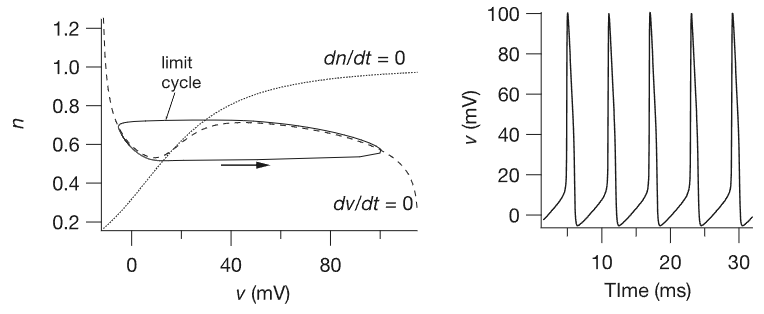
Applying a current of $I_{\text{app}} = 50$ and looking at the phase plane and the time evolution of $V$, one can confirm that $V$ changes abruptly, showing the typical dynamics of a fast-slow system. Meanwhile, although it does not have exactly the same terms, the phase plane of the FitzHugh–Nagumo model and the time evolution of $v$ look as follows.
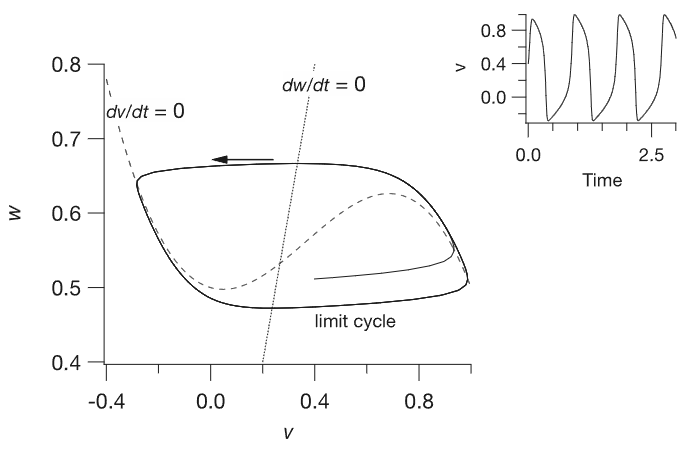
This shows that the FitzHugh–Nagumo model, though derived from and simplified from the Hodgkin–Huxley model, preserves its essential dynamics well.