Hodgkin–Huxley Model
Model1
The governing equation that describes the action potential in a neuron is called the Hodgkin–Huxley model. $$ C_{m} \dot{V} = - g_{\text{Na}} \left( V - V_{\text{Na}} \right) - g_{\text{K}} \left( V - V_{\text{K}} \right) - g_{\text{L}} \left( V - V_{\text{L}} \right) + I_{\text{app}} $$
Variables
- $V(t)$: represents the potential of the cell membrane at time $t$.
Parameters
- $C_{m} = 1$: the capacitance of the cell membrane.
- $g_{\text{Na}}$, $g_{\text{K}}$, $g_{\text{L}}$: the conductances of the sodium ion channel, the potassium ion channel, and the leak channel, respectively.
- $V_{\text{Na}}$, $V_{\text{K}}$, $V_{\text{L}}$: the equilibrium potentials of the sodium ion channel, the potassium ion channel, and the leak channel, respectively.
- $I_{\text{app}}$: the current applied to the cell membrane.
Explanation2
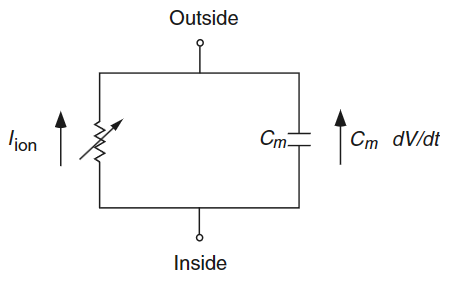
A cell moves ions into and out of itself through ion channels in its membrane, generating electric currents and carrying out its physiological functions. If we regard the cell as a kind of capacitor, the cell membrane becomes an insulator separating the inside of the cell from the outside. The capacitance of the insulator is defined as $C_{m} = Q / V$, the ratio of the amount of charge across the capacitor to the voltage, and since the current is the rate of change of charge $dQ / dt$, this can be expressed as the following ordinary differential equation. $$ C_{m} {\frac{ d V }{ d t }} + I_{\text{ion}} = 0 $$ Here $V$ is usually set as $V = V_{i} - V_{e}$, the difference between the potential inside the cell $V_{i}$ and the potential outside the cell $V_{e}$. The conductance and equilibrium potential should differ for each kind of ion; the current $I_{S}$ due to a particular ion $S$ is assumed to be linearly proportional to $V$ multiplied by the conductance $g_{S}$ corresponding to $S$, as below, raising the potential when it is lower than the equilibrium potential $V_{S}$ and lowering it when it is higher than $V_{S}$. $$ I_{S} = g_{S} \left( V - V_{S} \right) $$
While studying the giant axon of the squid, Hodgkin and Huxley independently decomposed $I_{\text{ion}}$ into currents of two kinds of ions, potassium $\text{K}$ and sodium $\text{Na}$, and treated the rest as the leak current. Hence $I_{\text{ion}} = I_{\text{Na}} + I_{\text{K}} + I_{\text{L}}$, and the term $I_{\text{app}}$ for the current applied to the cell membrane was included on the right-hand side. In their actual research, the conductances were not taken to be constant; instead, three variables reflecting the opening and closing of ion channels were added.
Potassium Conductance
$$ g_{\text{K}} = \bar{g}_{\text{K}} n^{4} $$ The potassium conductance is a variable meant to reflect potassium activation, and it was set as $n^{4}$ not so much for physiological reasons but because $4$ was the smallest power of some variable that fit the experimental data. $\bar{g}_{\text{K}}$ is another constant.
Sodium Conductance
$$ g_{\text{Na}} = \bar{g}_{\text{Na}} m^{3} h $$ For the sodium conductance, the experimental data were fitted with two kinds of variables that act differently even for the same sodium: the sodium activation variable $m$ and the sodium inactivation variable $h$.
Final Model
As a result, the Hodgkin–Huxley model becomes a system of ordinary differential equations in four variables and an extremely complicated model, as follows. $$ \begin{align*} C_{m} \dot{V} =& - \bar{g}_{\text{Na}} m^{3} h \left( V - V_{\text{Na}} \right) - \bar{g}_{\text{K}} n^{4} \left( V - V_{\text{K}} \right) - \bar{g}_{\text{L}} \left( V - V_{\text{L}} \right) + I_{\text{app}} \\ \dot{m} =& \alpha_{m} (1 - m) - \beta_{m} m \\ \dot{n} =& \alpha_{n} (1 - n) - \beta_{n} n \\ \dot{h} =& \alpha_{h} (1 - h) - \beta_{h} h \end{align*} $$ For the parameters used here, potentials are in units of $\mathrm{mV}$ and currents in units of $\mathrm{\mu A / cm^{2}}$, with the specific values $\bar{g}_{\text{Na}} = 120$, $\bar{g}_{\text{K}} = 36$, $\bar{g}_{\text{L}} = 0.3$, $V_{\text{Na}} = 50$, $V_{\text{K}} = -77$, $V_{\text{L}} = -54.4$. $\alpha$ and $\beta$ are not constants but were set as the following complicated functions. $$ \begin{align*} \alpha_{m} =& {\frac{ 0.1 \left( 25 - V \right) }{ \exp \left( {\frac{ 25 - V }{ 10 }} \right) - 1 }} \\ \beta_{m} =& 4 \exp \left( - {\frac{ V }{ 18 }} \right) \\ \alpha_{n} =& {\frac{ 0.01 \left( 10 - V \right) }{ \exp \left( {\frac{ 10 - V }{ 10 }} \right) - 1 }} \\ \beta_{n} =& 0.125 \exp \left( - {\frac{ V }{ 80 }} \right) \\ \alpha_{h} =& 0.07 \exp \left( - {\frac{ V }{ 20 }} \right) \\ \beta_{h} =& {\frac{ 1 }{ \exp \left( {\frac{ 30 - V }{ 10 }} \right) + 1 }} \end{align*} $$
In fact, since the membrane potential differs not only between species but also between individuals, results fitted to data in this way cannot be recklessly generalized; nevertheless, this model is also the most standard starting point for the mathematical modeling of membrane ion channels.
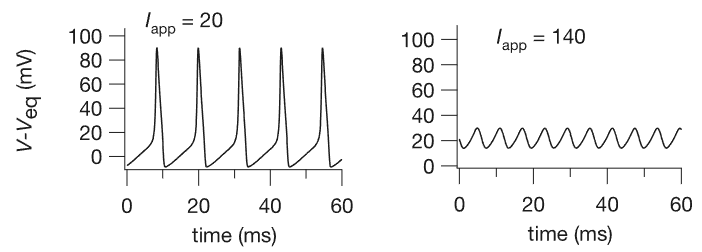
Looking at the time evolution of $V$ for different values of $I_{\text{app}}$, we can confirm that the model reproduces well the spike, in which the potential suddenly rises and then falls again, as shown above.