F-Cycles and S-Cycles of Dynamical Systems with Symmetry
Definition1
Let $I$ be the identity matrix. Suppose the dynamical system $\dot{v} = f(v)$ has a symmetry, in other words, that it satisfies the following conditions for some $R \ne I$. $$ \begin{align*} R f(v) =& f (R v) \\ R^{2} =& I \end{align*} $$
With respect to this, the notions of fixed and symmetric for periodic solutions and limit cycles are defined as follows:
- A periodic solution $v (t)$ of $\dot{v} = f(v)$ is said to be fixed if $R x (t) = x (t)$ for all $t$. The limit cycle corresponding to a fixed periodic solution is called an F-cycle.
- A periodic solution $v (t)$ of $\dot{v} = f(v)$ is said to be symmetric if, for all $t$ and for the smallest period $T$, it satisfies the following. $$ R x (t) = x \left( t + {\frac{ T }{ 2 }} \right) $$ The limit cycle corresponding to a symmetric periodic solution is called an S-cycle.
Explanation2
In the definition of an S-cycle, one can of course easily check that $R^{2} x = I x = x = x (t + T)$. If, formally speaking, an F-cycle is a fixed point with respect to the symmetry transformation $R$, then an S-cycle is a limit cycle that possesses symmetry with respect to time $t$ as well, one that truly lives up to the name symmetric.
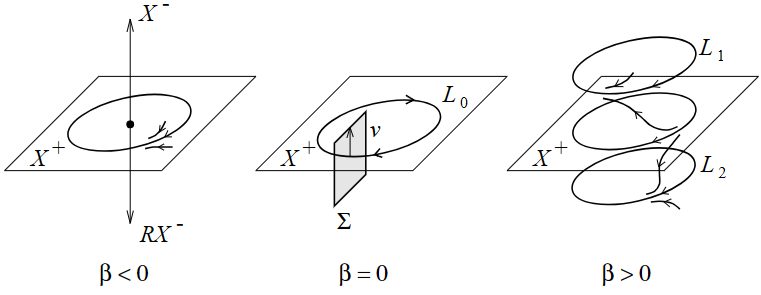
Tangent Bifurcation
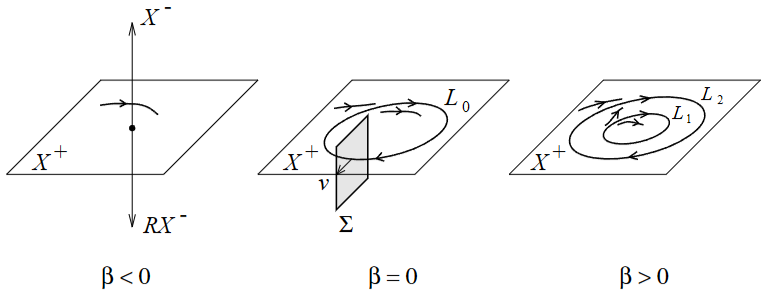
Pitchfork Bifurcation