Hartman-Grobman Theorem
Definition1
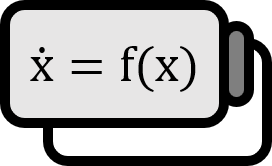
For $f$ belonging to class $C^{r} \left( \mathbb{R}^{n} \right)$, suppose that the vector field $\dot{x} = f(x)$ has a fixed point $x_{0}$, and that it is hyperbolic in the sense that every eigenvalue of the Jacobian $Df \left( x_{0} \right)$ of $f$ has nonzero real part. Then $\dot{\xi} = Df \left( x_{0} \right) \xi$ is the linearized vector field of the original vector field. The flow generated by $\dot{x} = f(x)$ is $C^{0}$-conjugate to the flow generated by $\dot{\xi} = Df \left( x_{0} \right) \xi$ in a neighborhood of $x = x_{0}$.
Explanation
$$ h \left( \phi (t , x) \right) = \psi \left( \alpha (t, x), h(x) \right) $$ The definition of conjugacy of a class for two flows $\phi$ and $\psi$ is roughly that there exists a homeomorphism $h \in C^{0}$ satisfying the above, so what the Hartman-Grobman theorem says amounts to ’near a hyperbolic fixed point, the original vector field and the linearized vector field are very similar’. Being very similar means being simply the same topologically, so this is an extremely important result.
Wiggins. (2003). Introduction to Applied Nonlinear Dynamical Systems and Chaos Second Edition(2nd Edition): p350. ↩︎