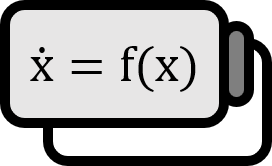
Definition of Quasi-static Attractor
Definition 1
Let there be an open system such as $\dot{x} = f \left( x , \lambda (t) \right)$. If $\lambda$ is a constant, we call the system itself a system parameterized by $\lambda$ (a parameterized system) and call a stable solution of this system a quasi-static attractor.
Explanation
For example, consider the very simple system $\dot{x} = - \left( x - \lambda \right)$. When $x > \lambda$, $x$ decreases, and when $x < \lambda$, $x$ increases; hence $x = \lambda$ is a stable fixed point. The reason we call this quasi-static rather than simply a fixed point is that, while it is static when $\lambda$ is fixed to a single value, if $\lambda$ evolves in time as in $\lambda = \lambda(t)$, the location of the fixed point changes for each $t$.
This property, provided stability holds, can extend not only to a periodic orbit but more generally to the concept of an attractor. Given sufficient time the system will approach a stable state; the only difference is that the stable state changes continuously as time progresses.
Ashwin, P., Wieczorek, S., Vitolo, R., & Cox, P. (2012). Tipping points in open systems: bifurcation, noise-induced and rate-dependent examples in the climate system. Philosophical Transactions of the Royal Society A: Mathematical, Physical and Engineering Sciences, 370(1962), 1166-1184. https://doi.org/10.1098/rsta.2011.0306 ↩︎