Lame Parameters
Theorem
$$ \mathbf{u} = \mathbf{u} \left( t ; \mathbf{x} \right) = \left( u_{1} \left( t ; \mathbf{x} \right) , u_{2} \left( t ; \mathbf{x} \right) , u_{3} \left( t ; \mathbf{x} \right) \right) $$ In particular, in three-dimensional space let the observation point $t$ and the spatial coordinate $\mathbf{x} = \left( x_{1} , x_{2} , x_{3} \right)$ and represent the velocity field as the above velocity vector. Let this fluid be a Newtonian fluid possessing viscosity and compressibility. The Cauchy stress tensor under the assumption of [isotropy] that is $\sigma$ can be expressed with respect to the symmetrized gradient $\varepsilon$ as follows. $$ \sigma = - p I + 2 \mu \varepsilon + \lambda \tr \left( \varepsilon \right) I $$ Here $I$ is the identity matrix.
The two scalars $\mu$ and $\lambda$ are called the Lamé parameters.
Explanation
The Lamé parameters are parameters that can be regarded as weights appearing in a linear combination of the Cauchy stress tensor: $\mu$ is related to viscosity and $\lambda$ is related to compressibility. This representation of the Cauchy stress tensor plays an important role in the derivation and generalization of the Navier–Stokes equations.
Proof 1
This argument is not intended to be mathematically rigorous; it starts from intuitive geometry and intermittently assumes quantities are “sufficiently small,” using many approximations.
Let the Jacobian of $\mathbf{u}$ be denoted concisely by $\nabla \mathbf{u}$. Define the matrix operation $\epsilon (\mathbf{u})$ as follows; this is called the symmetrized gradient. $$ \varepsilon (\mathbf{u}) = {\frac{ 1 }{ 2 }} \left( \nabla \mathbf{u} + \left( \nabla \mathbf{u} \right)^{T} \right) $$

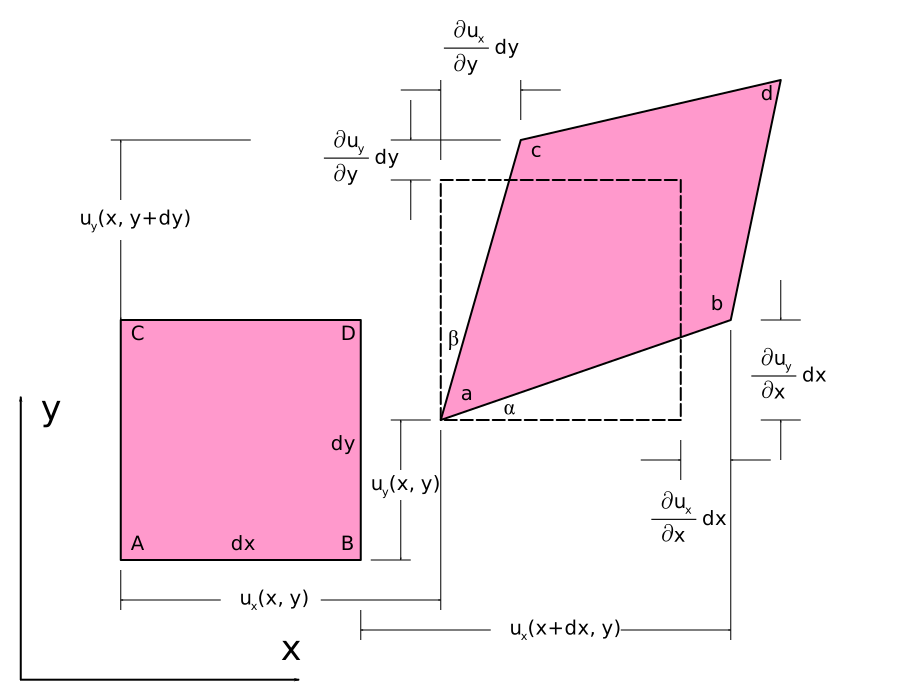
Consider an infinitesimal rectangular parallelepiped whose width $x = x_{1}$, length $y = x_{2}$, and height $z = x_{3}$ are respectively $dx$, $dy$, and $dz$. Without loss of generality (see this note), suppose the deformation shown above occurs about the $x$ axis. Assuming isotropy of the fluid, $\sigma$ can be decomposed into the sum of hydrostatic pressure $-p I$ and deviatoric stress $\tau$ as follows. $$ \sigma = - p I + \tau $$
Viscosity
- The ratio of an object’s original length $L_{0}$ to the change in length $\Delta L$, i.e. $\Delta L / L_{0}$, is called the tensile strain.
- If the horizontal displacement of a shear plane is $\Delta x$ and the height of the shear plane is $h$, then $\Delta x / h$ is called the shear strain.
- The ratio of an object’s original volume $V_{0}$ to the change in volume $\Delta V$, i.e. $\Delta V / V_{0}$, is called the volume strain.
First, define the strain tensor due to viscosity, the strain tensor $S$, as follows. $$ S = \begin{bmatrix} s_{xx} & s_{xy} & s_{xz} \\ s_{yx} & s_{yy} & s_{yz} \\ s_{zx} & s_{zy} & s_{zz} \end{bmatrix} $$
Under the main assumption that this fluid is Newtonian, the dynamic viscosity coefficient $\mu$ can be taken to be linearly proportional as in $\tau = \mu S$. $$ \sigma = - p I + \mu S $$
Here, the normal strain in the vertical direction $s_{xx}$ is expressed as the ratio $\Delta L / L_{0}$ between the change $\Delta L = \overline{ab} - \overline{AB}$ of the length (from the original segment $AB$ of length $L_{0} = \overline{AB}$ to the deformed segment $ab$ of length $\overline{ab}$). The original length is $\overline{AB} = dx$, and the deformed length $\overline{ab}$ changes under the influence of the velocity $\mathbf{u} = \left( u_{x} , u_{y} , u_{z} \right)$. Omitting the $z$-axis for this calculation, it becomes the following. $$ \begin{align*} \overline{ab} =& \sqrt{ \left( dx + {\frac{ \partial u_{x} }{ \partial x }} dx \right)^{2} + \left( {\frac{ \partial u_{y} }{ \partial x }} dx \right)^{2} } \\ =& dx \sqrt{ \left( 1 + {\frac{ \partial u_{x} }{ \partial x }} \right)^{2} + \left( {\frac{ \partial u_{y} }{ \partial x }} \right)^{2} } \end{align*} $$
If the change in velocity in the $y$ direction due to variation along the $x$ axis, i.e. $\partial u_{y} / \partial x$, is sufficiently small, then $\overline{ab}$ reduces to the following. $$ \overline{ab} = dx + {\frac{ \partial u_{x} }{ \partial x }} dx $$ Accordingly, the normal deformation in the $x$-axis direction $s_{xx}$ is $$ \begin{align*} s_{xx} =& {\frac{ \Delta L }{ L_{0} }} \\ =& {\frac{ \overline{ab} - \overline{AB} }{ \overline{AB} }} \\ =& {\frac{ \left( dx + {\frac{ \partial u_{x} }{ \partial x }} dx \right) - dx }{ dx }} \\ =& {\frac{ \partial u_{x} }{ \partial x }} \end{align*} $$
For the same reasons, $s_{yy}$ and $s_{zz}$ can be obtained as follows. $$ \begin{align*} s_{yy} =& {\frac{ \partial u_{y} }{ \partial y }} \\ s_{zz} =& {\frac{ \partial u_{z} }{ \partial z }} \end{align*} $$
The shear deformation $s_{xy}$ can be represented as the sum of the angle $\alpha$ produced when $\overline{AB}$ deforms into $\overline{ab}$ and the angle $\beta$ produced when $\overline{AC}$ deforms into $\overline{ac}$. $$ s_{xy} = \alpha + \beta $$ For sufficiently small angles, $\alpha$ and $\beta$ can be approximated by their pre-trigonometric values as $\tan \alpha \approx \alpha$ and $\tan \beta \approx \beta$, respectively. $$ \begin{align*} \alpha \approx& \tan \alpha = {\frac{ {\frac{ \partial u_{y} }{ \partial x }} dx }{ dx + {\frac{ \partial u_{x} }{ \partial x }} dx }} = {\frac{ \partial u_{y} }{ \partial x }} {\frac{ 1 }{ 1 + {\frac{ \partial u_{x} }{ \partial x }} }} \\ \beta \approx& \tan \beta = {\frac{ {\frac{ \partial u_{x} }{ \partial y }} dy }{ dy + {\frac{ \partial u_{y} }{ \partial y }} dy }} = {\frac{ \partial u_{x} }{ \partial y }} {\frac{ 1 }{ 1 + {\frac{ \partial u_{y} }{ \partial y }} }} \end{align*} $$
Since $\partial u_{x} / \partial x$ and $\partial u_{y} / \partial y$ are much smaller than $1$, $s_{xy} = s_{yx}$ can be approximated as follows. $$ s_{xy} = s_{yx} = \alpha + \beta \approx {\frac{ \partial u_{x} }{ \partial y }} + {\frac{ \partial u_{y} }{ \partial x }} $$
Writing out $S$ explicitly yields the following. $$ S = \begin{bmatrix} {\frac{ \partial u_{x} }{ \partial x }} & {\frac{ \partial u_{x} }{ \partial y }} + {\frac{ \partial u_{y} }{ \partial x }} & {\frac{ \partial u_{x} }{ \partial z }} + {\frac{ \partial u_{z} }{ \partial x }} \\ {\frac{ \partial u_{y} }{ \partial x }} + {\frac{ \partial u_{x} }{ \partial y }} & {\frac{ \partial u_{y} }{ \partial y }} & {\frac{ \partial u_{y} }{ \partial z }} + {\frac{ \partial u_{z} }{ \partial y }} \\ {\frac{ \partial u_{z} }{ \partial x }} + {\frac{ \partial u_{x} }{ \partial z }} & {\frac{ \partial u_{z} }{ \partial y }} + {\frac{ \partial u_{y} }{ \partial z }} & {\frac{ \partial u_{z} }{ \partial z }} \end{bmatrix} $$
Symmetrized gradient: $$ \varepsilon (\mathbf{u}) = {\frac{ 1 }{ 2 }} \left( \nabla \mathbf{u} + \left( \nabla \mathbf{u} \right)^{T} \right) $$
Decomposing terms so that the result is the symmetrized gradient yields the concise expression below. $$ \begin{align*} \sigma =& - p I + \tau \\ =& - p I + \mu S \\ =& - p I + \mu 2 {\frac{ 1 }{ 2 }} \left( \nabla \mathbf{u} + \left( \nabla \mathbf{u} \right)^{T} \right) \\ =& - p I + 2 \mu \varepsilon \end{align*} $$
Compressibility
Now suppose the fluid is compressible so that volume strain is reflected. Formally, the following term $W = \lambda \delta$ is added. $$ \sigma = - p I + 2 \mu \varepsilon + W $$
The original volume is $V_{0} = dx dy dz$, and the deformed volume $V$ is given by $$ \begin{align*} V =& \left( dx + {\frac{ \partial u_{x} }{ \partial x }} dx \right) \left( dy + {\frac{ \partial u_{y} }{ \partial y }} dy \right) \left( dz + {\frac{ \partial u_{z} }{ \partial z }} dz \right) \\ =& dx dy dz \left( 1 + {\frac{ \partial u_{x} }{ \partial x }} \right) \left( 1 + {\frac{ \partial u_{y} }{ \partial y }} \right) \left( 1 + {\frac{ \partial u_{z} }{ \partial z }} \right) \\ =& dx dy dz \left( 1 + s_{xx} \right) \left( 1 + s_{yy} \right) \left( 1 + s_{zz} \right) \\ =& V_{0} \left( 1 + s_{xx} + s_{yy} + s_{zz} + s_{xx} s_{yy} + s_{yy} s_{zz} + s_{zz} s_{xx} + s_{xx} s_{yy} s_{zz} \right) \end{align*} $$ Since $1 \gg s_{xx} \gg s_{xx} s_{yy}$, terms that are multiplied two or more times can be neglected, and the volume strain $\delta$ can be approximated as follows. $$ \delta = {\frac{ \Delta V }{ V_{0} }} = {\frac{ V - V_{0} }{ V_{0} }} = s_{xx} + s_{yy} + s_{zz} $$ Noting that $\delta = \tr \left( S \right) = \tr \left( \varepsilon \right)$ and that these strains are equally reflected in each dimension, the identity matrix $I$ multiplies to give the sum across dimensions, yielding the following. $$ \sigma = - p I + 2 \mu \varepsilon + \lambda \tr \left( \varepsilon \right) I $$
■