
Various Definitions of Modulus of Elasticity
Definition 1
- The force that causes the deformation of an object is called stress.
- As a result of stress, the quantity that measures the degree of deformation is called strain.
- The ratio of stress to strain is called the elastic modulus. $$ \text{elastic modulus} = \frac{\text{stress}}{\text{strain}} $$
There are commonly three types of elastic moduli.
Elasticity of Length
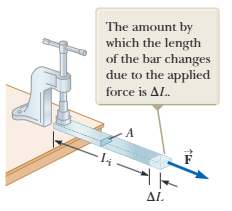
- The ratio $F / A$ of the externally applied force $F$ to the perpendicular cross-sectional area $A$ is called the tensile stress.
- The ratio $\Delta L / L_{0}$ of the change in length $\Delta L$ to the original length $L_{0}$ of the object is called the tensile strain.
- The ratio $Y$ of the tensile stress to the tensile strain is called Young’s modulus. $$ Y := \frac{\text{tensile stress}}{\text{tensile strain}} = \frac{F / A}{\Delta L / L_{0}} $$
Elasticity of Shape
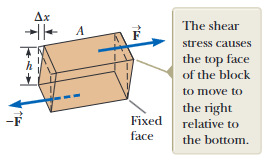
- When $F$ denotes the force that pushes tangentially along a shear surface of area $A$, the ratio $F / A$ of force to area is called the shear stress.
- When $\Delta x$ denotes the distance that the shear surface moves in the horizontal direction and $h$ denotes the height of the shear surface, $\Delta x / h$ is called the shear strain.
- The ratio $S$ of the shear stress to the shear strain is called the shear modulus. $$ S := \frac{\text{shear stress}}{\text{shear strain}} = \frac{F / A}{\Delta x / h} $$
Elasticity of Volume
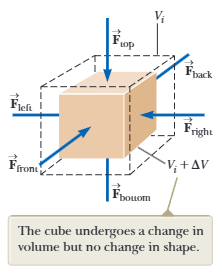
- When $F$ denotes the force applied to an object with surface area $A$, $P = F / A$ is called the pressure. The change in pressure $\Delta P$ is called the volume stress.
- The ratio $\Delta V / V_{0}$ of the change in volume $\Delta V$ to the original volume $V_{0}$ of the object is called the volume strain.
- The ratio $B$ of the volume stress to the volume strain is called the bulk modulus. $$ B := \frac{\text{volume stress}}{\text{volume strain}} = - \frac{\Delta F / A}{\Delta V / V_{0}} = - \frac{\Delta P}{\Delta V / V_{0}} $$
- The reciprocal $B^{-1}$ of the bulk modulus is called the compressibility.
Here, the minus sign in the definition of $B$ is needed so that $B$ becomes positive, reflecting the fact that the volume decreases as the pressure increases.
Explanation
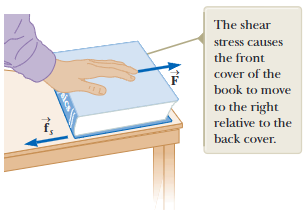
While the others may be fine, shear stress can be difficult to understand intuitively; a common example is the deformation that occurs when, as in the figure above, one presses down on a thick book from the top and pushes it sideways.
- A term that collectively refers to liquids and gases
- A collection of molecules that are randomly arranged and gathered together2
- A substance in which normal stress acts in the state of rest, and continuous deformation occurs and it flows when a shear force acts in the state of flow1
However, when one actually encounters shear stress in practice, the interest is not in the phenomenon of a thick book being pushed; rather, one will encounter it more often when dealing with substances such as fluids.
The description in the definition of a fluid that “normal stress acts and deformation occurs due to shear force” is hard to understand at first, but once one understands the concept of shear stress as being “pushed sideways,” as in the example of the thick book, one can imagine the motion of a fluid much more clearly.
The fact that normal stress acts in the state of rest is, literally, the property of pouring down vertically and collapsing. When it receives a top-to-bottom stress due to gravity, atmospheric pressure, and so on, no sudden fracture occurs; instead, continuous deformation takes place. On the other hand, the fact that shear stress acts in the state of flow leads to the deformation that occurs while flowing in the horizontal direction.