
Proof of the Optical Properties of a Hyperbola
Theorem
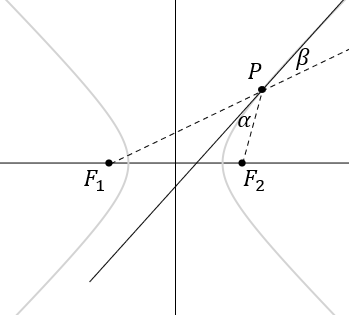
For a point $P$ on a hyperbola and its two foci $F_{1}, F_{2}$, let the angles that the tangent at $P$ makes with $\overline{PF_{1}}$ and $\overline{PF_{2}}$ be $\alpha$ and $\beta$, respectively. Then $\alpha$ and $\beta$ are equal.
Explanation
Simply put, light emitted from one focus of a hyperbola, when reflected, propagates in the same direction as if it had come from the other focus.
Applications reportedly include building telescopes using an auxiliary mirror shaped like a hyperboloid, and navigation systems that determine a ship’s position using the difference in arrival times of radio waves transmitted from two base stations.
Proof
I searched extensively, and proving it by the method introduced in Proof of the Optical Properties of a Parabola is the cleanest; apart from that there was no clever trick. Among the alternatives I have seen so far, I found the proof that requires the fewest lemmas and used it to fill in the missing content1.
Part 1.
$$ {\frac{ x^{2} }{ a^{2} }} - {\frac{ y^{2} }{ b^{2} }} = 1 $$ Without loss of generality, let this hyperbola be represented by the equation shown above. If the coordinates of the foci are $F_{1} = (-c, 0)$ and $F_{2} = (c, 0)$ with respect to $c^{2} = a^{2} + b^{2}$, and $P = \left( x_{0} , y_{0} \right)$, then the equation of the tangent at $P$ is $x_{0} x / a^{2} - y_{0} y / b^{2} = 1$, and substituting $y = 0$ yields $Q = \left( a^{2} / x_{0} , 0 \right)$. Accordingly, the lengths from $Q$ to the foci are as follows. $$ \begin{align*} \overline{Q F_{1}} =& c + {\frac{ a^{2} }{ x_{0} }} \\ \overline{Q F_{2}} =& c - {\frac{ a^{2} }{ x_{0} }} \end{align*} $$
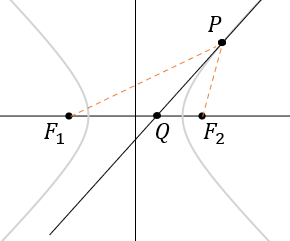
$$ \begin{align*} \overline{P F_{1}} =& \sqrt{ \left( x_{0} + c \right)^{2} + y_{0}^{2} } \\ \overline{P F_{2}} =& \sqrt{ \left( x_{0} - c \right)^{2} + y_{0}^{2} } \end{align*} $$ Since $P$ is a point on the hyperbola, $y_{0}^{2} = \left( b/a \right)^{2} \left( x_{0}^{2} - a^{2} \right)$, and using this we can compute the squared lengths of the segments as follows. $$ \begin{align*} & \left( x_{0} \pm c \right)^{2} + y_{0}^{2} \\ =& \left( x_{0} \pm c \right)^{2} + \left( b/a \right)^{2} \left( x_{0}^{2} - a^{2} \right) \\ =& \left( 1 + {\frac{ b^{2} }{ a^{2} }} \right) x_{0}^{2} \pm 2 c x_{0} + c^{2} - b^{2} \\ =& \left( {\frac{ c^{2} }{ a^{2} }} \right) x_{0}^{2} \pm 2 c x_{0} + a^{2} \\ =& \left( {\frac{ c }{ a }} x_{0} \pm a \right)^{2} \\ =& {\frac{ x_{0}^{2} }{ a^{2} }} \left( c \pm {\frac{ a }{ x_{0} }} \right)^{2} \end{align*} $$
The second factor grouped under the square is the distance from $Q$ to the focus, so it is expressed as a constant multiple of that distance. $$ \begin{align*} \overline{P F_{1}} =& {\frac{ x_{0} }{ a }} \left( c + {\frac{ a^{2} }{ x_{0} }} \right) = {\frac{ x_{0} }{ a }} \overline{Q F_{1}} \\ \overline{P F_{2}} =& {\frac{ x_{0} }{ a }} \left( c - {\frac{ a^{2} }{ x_{0} }} \right) = {\frac{ x_{0} }{ a }} \overline{Q F_{2}} \end{align*} $$
Normally one would finish the proof here by asserting that $\overline{PQ}$ is the angle bisector, but the key point of this proof is that it does not use such a lemma.
Part 2.
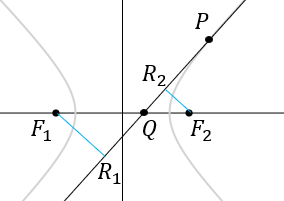
First, let the point where the tangent at $P$ meets the $x$-axis be $Q$, and let the feet of the perpendiculars dropped from $F_{1}$ and $F_{2}$ onto the tangent be $R_{1}$ and $R_{2}$, respectively. Then the two triangles $\triangle{F_{1}QR_{1}}$ and $\triangle{F_{2}QR_{2}}$ formed in this way are similar, and we obtain the following. $$ {\frac{ \overline{R_{1} F_{1}} }{ \overline{R_{2} F_{2}} }} = {\frac{ \overline{Q F_{1}} }{ \overline{Q F_{2}} }} $$ By the result obtained in Part 1, the following equality holds. $$ {\frac{ \overline{R_{1} F_{1}} }{ \overline{R_{2} F_{2}} }} = {\frac{ \overline{Q F_{1}} }{ \overline{Q F_{2}} }} = {\frac{ \overline{P F_{1}} }{ \overline{P F_{2}} }} $$
Part 3.
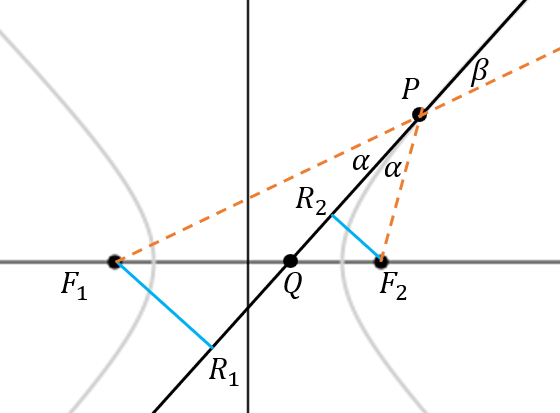
The two triangles $\triangle{P F_{1} R_{1}}$ and $\triangle{P F_{2} R_{2}}$ are similar, and we can see that $\alpha$ and $\beta$ are equal.