Convex Functions, Concave Functions
Definition
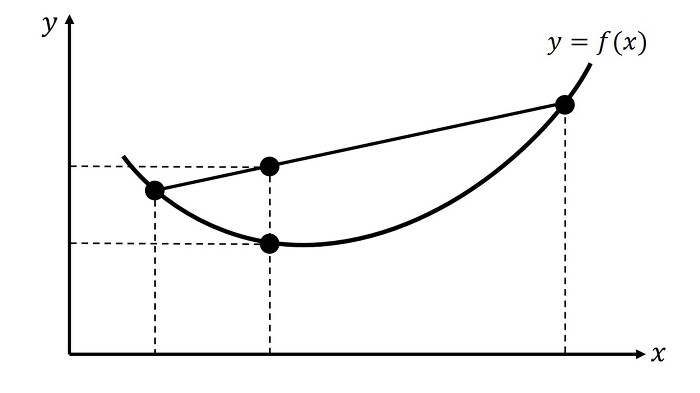
For two elements $x_{1} , x_{2}$ of an interval $I \subset \mathbb{R}$, a function $f : I \to \mathbb{R}$, and $0 \le t \le 1$,
- When $f( t x_{1} + (1-t) x_{2}) \le t f(x_{1}) + (1-t) f(x_{2})$, $f$ is defined as a convex function on $I$.
- When $f( t x_{1} + (1-t) x_{2}) \ge t f(x_{1}) + (1-t) f(x_{2})$, $f$ is defined as a concave function on $I$.
Explanation
Since there are too many confusing expressions like convex upward or concave downward, I will use the English terms convex and concave as they are. I strongly recommend memorizing convex and concave by matching them with the shape of the graph. Judging from the formulas alone, the definitions may seem unfamiliar at first glance, but if you think about the concept of internal division, you will be able to accept them as quite commonsense definitions. Since this is an intuitively easy concept, if you do not need formal development or explanation, there is no need to memorize the definition. Usually, starting from the quadratic function in middle school through the sign of the second derivative and so on, you have seen them so tediously often that their properties are also familiar.
To Be Honest
To be blunt, concave is not really used; you can consider that only convex is used.
Second Derivative
Second derivative of a convex function: Suppose $f$ is twice differentiable on $I$. That $f$ is convex on $I$ is a necessary and sufficient condition for $f '' (x) \ge 0$.
Let us note here that the condition of being twice differentiable is added. Since curves like $y = x^2$ or $y = \ln {x}$ are usually used as examples, it is easy to overlook, but you can see that ‘continuity’ was not even mentioned in the convex function we redefined.