Cross Product in Three-Dimensional Euclidean Space
Definition
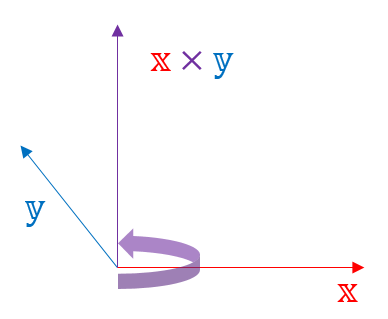
For $\mathbf{x}, \mathbf{y} \in \mathbb{R}^3$, define the following as the cross product of $\mathbf{x}$ and $\mathbf{y}$.
$$ \begin{align*} \mathbf{x} \times \mathbf{y} =& (x_{2}y_{3} - x_{3}y_{2}, x_{3}y_{1} - x_{1}y_{3}, x_{1}y_{2} - x_{2}y_{1}) \\ =& \det \begin{bmatrix} \mathbf{i} & \mathbf{j} & \mathbf{k} \\ x_{1} & x_{2} & x_{3} \\ y_{1} & y_{2} & y_{3} \end{bmatrix} \\ =& \begin{bmatrix} 0 & -x_{3} & x_{2} \\ x_{3} & 0 & -x_{1} \\ -x_{2} & x_{1} & 0 \end{bmatrix} \begin{bmatrix} y_{1} \\ y_{2} \\ y_{3} \end{bmatrix} \end{align*} $$
Explanation
For reference, $\mathbf{i} = (1,0,0)$, $ \mathbf{j} = (0,1,0)$, and $\mathbf{k} = (0,0,1)$. As with the inner product, a more general definition of the cross product is possible, but in practical terms it is usually considered only in three dimensions. Because the result of the operation is a vector, it is also called the vector product; a literal translation of “cross product” is the scissor product (가위곱). The term “cross product” is most commonly used, though it can be confused with the outer product.
| Operation | scalar product (inner product) | vector product (scissor product) | tensor product (outer product) |
|---|---|---|---|
| Dimension | $n$-dimensional vector | $3$-dimensional vector | $n$-dimensional vector |
| Notation | $\mathbf{u} \cdot \mathbf{v} = \mathbf{u}^{\mathsf{T}} \mathbf{v}$ | $\mathbf{u} \times \mathbf{v}$ | $\mathbf{u} \otimes \mathbf{v} = \mathbf{u}\mathbf{v}^{\mathsf{T}}$ |
| Result | scalar $=1 \times 1$ matrix | $3$-dimensional vector | $n \times n$ matrix |
| Value | $\sum_{i} u_{i}v_{i} = u_{1}v_{1} + \cdots + u_{n}v_{n}$ | $\begin{bmatrix} u_{2}v_{3} - u_{3}v_{2} \\ u_{3}v_{1} - u_{1}v_{3} \\ u_{1}v_{2} - u_{2}v_{1} \end{bmatrix}$ | $\begin{bmatrix} u_{1}v_{1} & u_{1}v_{2} & \cdots & u_{1}v_{n} \\ u_{2}v_{1} & u_{2}v_{2} & \cdots & u_{2}v_{n} \\ \vdots & \vdots & \ddots & \vdots \\ u_{n}v_{1} & u_{n}v_{2} & \cdots & u_{n}v_{n}\end{bmatrix}$ |
The most frequent applications are in physics, appearing often when expressing torque, the Lorentz force, and so on. Its geometric form can be easily visualized using the right-hand rule. Below are several properties of the cross product presented without proof.
Properties
For $\mathbf{x}, \mathbf{y}, \mathbf{z} \in \mathbb{R}^3$ and $k \in \mathbb{R}$ the following hold.
(1) $\mathbf{x} \times \mathbf{x} = \mathbf{0}$
(2) $\mathbf{x} \times \mathbf{y} = -\mathbf{y} \times \mathbf{x} $
(3) $(k \mathbf{x}) \times \mathbf{y} = k (\mathbf{x} \times \mathbf{y}) = \mathbf{x} \times (k \mathbf{y})$
(4) $\mathbf{x} \times ( \mathbf{y}+ \mathbf{z} )= (\mathbf{x} \times \mathbf{y}) + (\mathbf{x} \times \mathbf{z})$
(5) scalar triple product: $(\mathbf{x} \times \mathbf{y}) \cdot \mathbf{z} = \mathbf{x} \cdot ( \mathbf{y} \times \mathbf{z})$
(6) vector triple product (bac-cab identity): $\mathbf{x} \times ( \mathbf{y} \times \mathbf{z} ) = (\mathbf{x} \cdot \mathbf{z}) \mathbf{y} - (\mathbf{x} \cdot \mathbf{y}) \mathbf{z} $
(7) $\left\| \mathbf{x} \cdot \mathbf{y} \right\|^{2} = (\mathbf{x} \cdot \mathbf{x} ) ( \mathbf{y} \cdot \mathbf{y} ) - ( \mathbf{x} \cdot \mathbf{y} )^2$
(8) $\left\| \mathbf{x} \times \mathbf{y} \right\| = \left\| \mathbf{x} \right\| \left\| \mathbf{y} \right\| \sin{\theta} $
(9) If $\mathbf{x} \times \mathbf{y} \ne \mathbb{0}$ then $\mathbf{x} \times \mathbf{y} $ is orthogonal to $\mathbf{x}$ and $\mathbf{y}$.
(10) Jacobi identity: $\mathbf{x} \times (\mathbf{y} \times \mathbf{z}) + \mathbf{z} \times (\mathbf{x} \times \mathbf{y}) + \mathbf{y} \times (\mathbf{z} \times \mathbf{x}) = \mathbf{0}$
Property (2) is called skew symmetry or anti-commutativity.
Because the commutative law does not hold, there are many properties that may seem counterintuitive. Get accustomed to them by solving problems and working them out on paper.
Proofs
(10)
bac-cab
By property (6),
$$ \begin{align*} & \mathbf{x} \times (\mathbf{y} \times \mathbf{z}) + \mathbf{y} \times (\mathbf{z} \times \mathbf{x}) + \mathbf{z} \times (\mathbf{x} \times \mathbf{y}) \\ &= (\mathbf{x} \cdot \mathbf{z}) \mathbf{y} - (\mathbf{x} \cdot \mathbf{y}) \mathbf{z} + (\mathbf{y} \cdot \mathbf{x}) \mathbf{z} - (\mathbf{y} \cdot \mathbf{z}) \mathbf{x} + (\mathbf{z} \cdot \mathbf{y}) \mathbf{x} - (\mathbf{z} \cdot \mathbf{x}) \mathbf{y} \\ &= \big[(\mathbf{x} \cdot \mathbf{z}) \mathbf{y} - (\mathbf{z} \cdot \mathbf{x}) \mathbf{y}\big] + \big[- (\mathbf{x} \cdot \mathbf{y}) \mathbf{z} + (\mathbf{y} \cdot \mathbf{x}) \mathbf{z}\big] + \big[- (\mathbf{y} \cdot \mathbf{z}) \mathbf{x} + (\mathbf{z} \cdot \mathbf{y}) \mathbf{x}\big] \\ &= \mathbf{0} \end{align*} $$
■
Direct calculation
Let us compute $\mathbf{x} \times (\mathbf{y} \times \mathbf{z})$.
$$ \begin{align*} \mathbf{x} \times (\mathbf{y} \times \mathbf{z}) &= \begin{bmatrix} 0 & -x_{3} & x_{2} \\ x_{3} & 0 & -x_{1} \\ -x_{2} & x_{1} & 0 \end{bmatrix} \begin{bmatrix} 0 & -y_{3} & y_{2} \\ y_{3} & 0 & -y_{1} \\ -y_{2} & y_{1} & 0 \end{bmatrix} \begin{bmatrix} z_{1} \\ z_{2} \\ z_{3} \end{bmatrix} \\ &= \begin{bmatrix} 0 & -x_{3} & x_{2} \\ x_{3} & 0 & -x_{1} \\ -x_{2} & x_{1} & 0 \end{bmatrix} \begin{bmatrix} y_{2}z_{3} - y_{3}z_{2} \\ y_{3}z_{1} - y_{1}z_{3} \\ y_{1}z_{2} - y_{2}z_{1} \\ \end{bmatrix} \\ &= \begin{bmatrix} x_{2}(y_{1}z_{2} - y_{2}z_{1}) - x_{3}(y_{3}z_{1} - y_{1}z_{3}) \\ x_{3}(y_{2}z_{3} - y_{3}z_{2}) - x_{1}(y_{1}z_{2} - y_{2}z_{1}) \\ x_{1}(y_{3}z_{1} - y_{1}z_{3}) - x_{2}(y_{2}z_{3} - y_{3}z_{2}) \end{bmatrix} \\ \end{align*} $$
Therefore we obtain
$$ \begin{align*} & \mathbf{x} \times (\mathbf{y} \times \mathbf{z}) + \mathbf{y} \times (\mathbf{z} \times \mathbf{x}) + \mathbf{z} \times (\mathbf{x} \times \mathbf{y}) \\ &= \begin{bmatrix} {\color{red}x_{2}y_{1}z_{2}} {\color{blue} \ - \ x_{2}y_{2}z_{1}} {\color{green} \ - \ x_{3}y_{3}z_{1}} + {\color{orange}x_{3}y_{1}z_{3}} \\ x_{3}y_{2}z_{3} - x_{3}y_{3}z_{2} - x_{1}y_{1}z_{2} + x_{1}y_{2}z_{1} \\ x_{1}y_{3}z_{1} - x_{1}y_{1}z_{3} - x_{2}y_{2}z_{3} + x_{2}y_{3}z_{2} \end{bmatrix} + \begin{bmatrix} {\color{blue}y_{2}z_{1}x_{2}} {\color{magenta} \ - \ y_{2}z_{2}x_{1}} - y_{3}z_{3}x_{1} + {\color{green}y_{3}z_{1}x_{3}} \\ y_{3}z_{2}x_{3} - y_{3}z_{3}x_{2} - y_{1}z_{1}x_{2} + y_{1}z_{2}x_{1} \\ y_{1}z_{3}x_{1} - y_{1}z_{1}x_{3} - y_{2}z_{2}x_{3} + y_{2}z_{3}x_{2} \end{bmatrix} \\ & \qquad + \begin{bmatrix} {\color{magenta}z_{2}x_{1}y_{2}} {\color{red} \ - \ z_{2}x_{2}y_{1}} {\color{orange} \ - \ z_{3}x_{3}y_{1}} + z_{3}x_{1}y_{3} \\ z_{3}x_{2}y_{3} - z_{3}x_{3}y_{2} - z_{1}x_{1}y_{2} + z_{1}x_{2}y_{1} \\ z_{1}x_{3}y_{1} - z_{1}x_{1}y_{3} - z_{2}x_{2}y_{3} + z_{2}x_{3}y_{2} \end{bmatrix} \\ &= \begin{bmatrix} 0 \\ 0 \\ 0 \end{bmatrix} \end{align*} $$
■