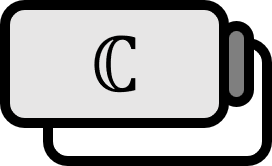
Proof of the Maximum Modulus Theorem
Theorem 1
Let a function $f$ be continuous on a simple closed contour $\mathscr{C}$, analytic in the interior, and not a constant function at any point. Then the $z = z_{0}$ that maximizes $|f(z)|$ on $\mathscr{C}$ exists on $\mathscr{C}$.
Explanation
Put simply, in complex analysis the maximum value of $|f|$ within a closed contour lies on its boundary. At this level it can no longer be caught up with intuitively, and for whatever reason all one can say is that it is truly remarkable. To internalize it, it is best to actually think of various functions oneself and confirm that it is true.
Usually, while a theorem may be easy to accept as fact, understanding its proof is difficult; but the maximum-minimum modulus theorem is rather the opposite. Because the modulus is involved, the geometric shape from real functions keeps coming to mind and can get in the way of understanding. Even granting at most that some function exists and its maximum modulus lies on the boundary of the contour integral interval, it is hard to imagine that the minimum modulus also lies on the same boundary. So do not fret too much about the shape and, as explained above, accept it by applying it directly to various functions.
The following is obvious once one considers $\displaystyle {{1} \over {f}}$: by the maximum modulus theorem, the point that maximizes $\displaystyle \left| {{1} \over {f}} \right|$ exists on $\mathscr{C}$. That point, put another way, is the point that minimizes $|f|$, so the minimum modulus theorem can be deduced.
Minimum Modulus Theorem
Let a function $f$ be continuous on a simple closed contour $\mathscr{C}$, analytic in the interior, and not a constant function at any point.
If $|f(z)| \ne 0$ in the interior of $\mathscr{C}$, then the $z = z_{0}$ that minimizes $|f(z)|$ exists on $\mathscr{C}$.
Proof
Assume that the point $z = z_{0}$ at which $|f(z)|$ is maximal exists in the interior of $\mathscr{C}$. Then, by the density of the real numbers, there always exists an $r>0$ such that $|z - z_{0}| = r$ lies in the interior of $\mathscr{C}$.
Meanwhile, since $\left| f(z_{0}) \right|$ takes its maximum value at $z = z_{0}$, we have $|f(z_{0} + r e ^{ i \theta } )| \le \left| f(z_{0}) \right|$; but since $f$ is not a constant function at any point, it must be that $|f(z_{0} + r e ^{ i \theta } )| < \left| f(z_{0}) \right|$.
Gauss’s Mean Value Theorem: If a function $f$ is analytic on the closed circle $| z - z_{0} | \le r$, then $$f(z_{0}) = {{1} \over {2 \pi}} \int_{0}^{2 \pi} f(z_{0} + r e ^{i \theta } ) d \theta$$
By Gauss’s mean value theorem, $$ f(z_{0}) = {{1} \over {2 \pi}} \int_{0}^{2 \pi} f(z_{0} + r e ^{i \theta } ) d \theta $$ Taking the modulus of both sides, $$ \begin{align*} \left| f(z_{0}) \right| =& \left| {{1} \over {2 \pi}} \int_{0}^{2 \pi} f(z_{0} + r e ^{i \theta } ) d \theta \right| \\ \le & {{1} \over {2 \pi}} \int_{0}^{2 \pi} | f(z_{0} + r e ^{i \theta } ) | d \theta \end{align*} $$ However, $$ \begin{align*} \left| f(z_{0}) \right| \le & {{1} \over {2 \pi}} \int_{0}^{2 \pi} | f(z_{0} + r e ^{i \theta } ) | d \theta \\ <& {{1} \over {2 \pi}} \int_{0}^{2 \pi} | f(z_{0}) | d \theta \\ =& \left| f(z_{0}) \right| \end{align*} $$ so $$ \left| f(z_{0}) \right| < \left| f(z_{0}) \right| $$ This is a contradiction, so $z=z_{0}$ cannot exist in the interior of $\mathscr{C}$.
■
Osborne (1999). Complex variables and their applications: p95. ↩︎